tools/rebuild_pages.sh rebuilds the site within 5 minutes of a change; by hand: python3 -B tools/site.py.1RB1LC_1RC---_1LD1LC_1RE0LC_1RF0RE_1RA0RD
Where it stands
Cryptid candidate, parked at the deeper analysis
Stopped by Dennis 2026-10-10: stays cryptid candidate, proof work parked with twin #27 (1RB0RA_1RC0RF_1RD1LE_1RE---_1LF1LE_1RA0LE). Halting reduces exactly to a validated 5-stage chain on the cluster 11.01.00, with arrival phases x,E,x,x,E (60/60 random instances halt).
Read the full status
Seeds of this chain keep forming in the disordered mixed zone: 11 by 2.45e10 steps, about 0.7 per doubling. Their later stages depend only on left-context mod-4 phases, and those match the generic coin rates (about 50/35/13/50%); nothing visible forces them. The step-12,975,111 near miss is seed #3, which got through x,E,x. Under the coin model each seed halts with probability about 1%: probabilistic, cryptid-like. Priority call for Dennis: stop, or continue by decoding the mixed zone (would need a rule forcing the stage phases).
About this picture
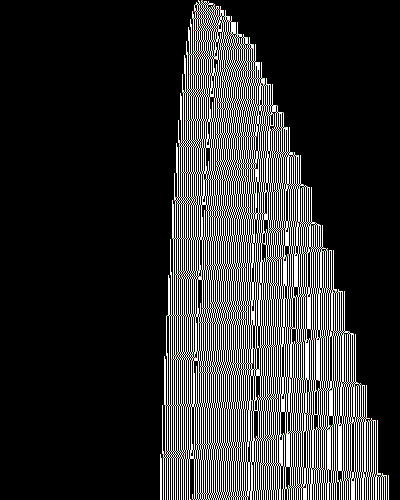
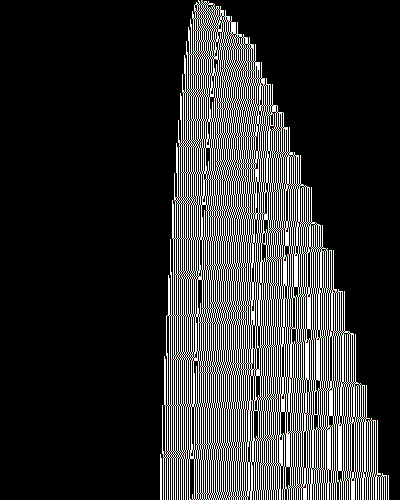
The standard picture (bbchallenge.org's Default view): each row is the whole tape at one step, time runs downward, and the head's path draws the pattern.
Overview
In one sentence
Defect groups drift left at 1, 3/4, 1/2, 3/8.. cells/bounce: exact 16-bounce counter on left, chaotic edge on right
- Status
- Cryptid candidatedeepen2 · updated 2026-10-10Parked · Stopped by Dennis 2026-10-10: stays cryptid candidate, proof work parked with twin #27 (1RB0RA_1RC0RF_1RD1LE_1RE---_1LF1LE_1RA0LE). The 2 open questions are optional.idle since Oct 10 12:49 · status.json 2026-10-10
- Class
- Structural counter + chaotic edgeours: Structural counter + chaotic edge (sheet) · ours adds: drifting defect groups (hierarchical counter) fed by a chaotic right edge · med confidence
- On the list
- line 324 of
BB6_holdouts_663.txt· historical 740 line 358
Your calls on file 2
- parked
- Stopped by Dennis 2026-10-10: stays cryptid candidate, proof work parked with twin #27 (1RB0RA_1RC0RF_1RD1LE_1RE---_1LF1LE_1RA0LE).
- decision.json · answered 2026-10-10: stop
- Stop work on #6 and its twin #27: keep #6 flagged CRYPTID_CANDIDATE and park proof work, rather than spend a stage decoding the mixed zone? Decisions →
Mechanism
How it works: 3 notes
- Tape: (01)^n runs split by single defects (11, 00, 1111); the head zig-zags between them; the wall grows 2 cells/bounce.
- Defect groups drift left from the right edge at exact speeds 1, 3/4, 1/2, 3/8...; left block repeats every 16 bounces.
- The right edge is chaotic (hi ~ 20·sqrt(L)). Halting needs E to sweep an odd (10) run ending in 00: unseen to 1e11.
Figures for Checkpoint A
2 rows per wall bounce, every 4th cell; each white/black edge is a defect. Follow the edges downward.

0101... run shows as solid white or solid black (its phase), and every white/black edge inside the tape is a defect (00, 11 or 1111)Right edge pinned, defects only (black). Compare the dense band at the right edge with the slanted lines leaving it.
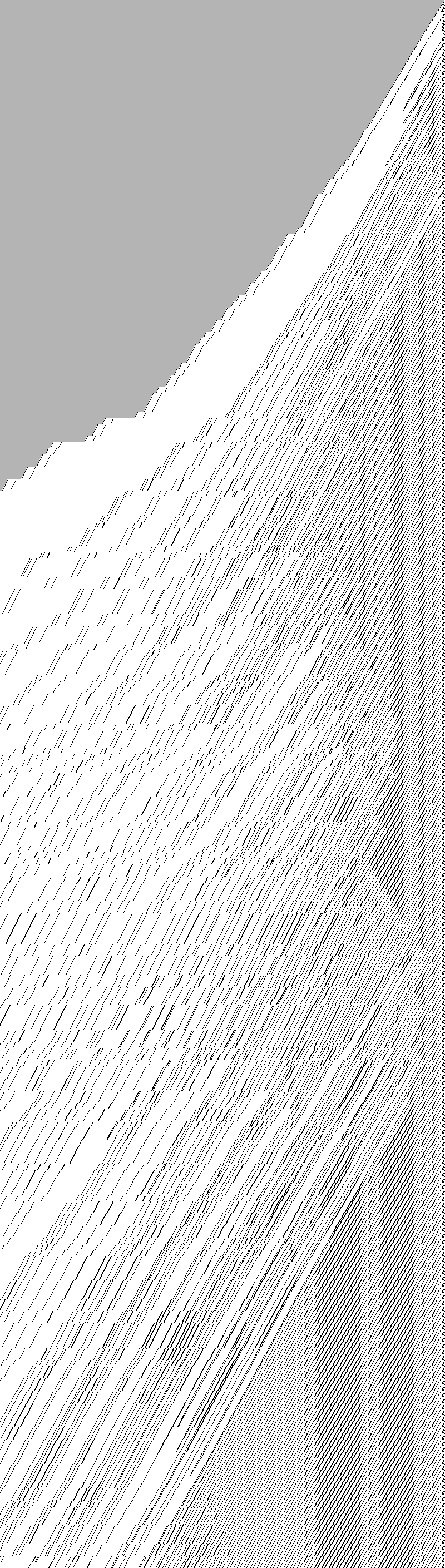
00 or 11) among the pixel's 2 cells clean 0101... run not yet visitedMore figures (3)Fig 3–5: Defects to 1e9, left wall pinned · Blaze, 100M steps · bbchallenge default view, first 10,000 steps
Defect groups drift away from the wall; lines curve only because rows are equal in steps, not bounces.

00 or 11) among the pixel's 8 cells clean 0101... run not yet visitedThe wall grows like sqrt(t); the right edge stays ragged and almost still.

The site's view of the first 10,000 steps: zig-zag bounces between defects.
Rules (8/8 validated)exact tape rewrites the proof will formalize, each re-checked by simulation
| rule | from ⟶ to | cases | steps | checked |
|---|---|---|---|---|
| G16 left block (16 bounces) | 0∞ <D 11 (01)14 (10)a 14 (01)3 12 (10)8 (01)b (10)12 1 (10)c 13 (10)6 (01)18 0 (01)2 r ⟶ 0∞ <D 11 (01)14 (10)a+8 14 (01)3 12 (10)8 (01)b+2 (10)12 1 (10)c+2 13 (10)6 (01)18 0 (01)2 r' | a odd >= 1, b even >= 4, c even >= 2, independent; r = real right part (4 tapes, 1e7..1e9). Other parity classes: 0/12 pass (wrong guess killed). [Notation fixed at assembly: was '<D 011 ...', which puts an extra 0 left of the 11; re-checked 30/30 in sim notation.] | — | ✓32/32 |
| orbit lock | c0 (blank tape) ⟶ G16 skeleton with (a,b,c,d) = (8n+61, 2n, 2n-2, n), L = 32n+26, at every 16th wall visit | observed on the orbit (25 snapshots, n = 25..1051), not a random-parameter test | — | ✓25/25 |
| H halt trigger | E> (10)2n+1 001 ⟶ halt (B reads 1) | sibling E> 10^(2n) 001 -> 01^(2n) 1 1 <C 1 in 4n+3 (safe turn), 40/40 | 4n+5 (busycoq halts_in 4n+4) | ✓40/40 |
| left sweep | (10)n <C ⟶ <C (01)n | — | 2n | ✓40/40 |
| right sweep, even | E> (01)2n ⟶ (10)2n E> | also E> 10^(2n) -> 01^(2n) E> in 4n | 4n | ✓80/80 |
| right sweep, odd | E> (01)2n+1 ⟶ (10)2n+1 D> | also E> 10^(2n+1) -> 01^(2n+1) F> in 4n+2 (F then reads the next cell: 0 0 1 there = halt) | 4n+2 | ✓80/80 |
| wall bounce | 0∞ <C ⟶ 0∞ 1 0 E> | — | 3 | ✓40/40 |
| edge extension | E> 0∞ ⟶ 1 <C 1101 0∞ | the only place B is entered in 1e9 steps (512 times); B always reads 0 there | 8 | ✓40/40 |
Compressed historythe tape as 0∞ <D 11 (01)14 (10)a 14 (01)3 12 (10)8 (01)b (10)12 1 (10)c 13 (10)6 (01)18 0 (01)d 13 (01)6 r at 25 moments: where the rules are read off
| step | a | b | c | d | L (=-lo) | hi | defects |
|---|---|---|---|---|---|---|---|
| 1,074,148 | 261 | 50 | 48 | 25 | 826 | 893 | 102 |
| 1,363,638 | 293 | 58 | 56 | 29 | 954 | 981 | 98 |
| 1,824,222 | 341 | 70 | 68 | 35 | 1,146 | 992 | 111 |
| 2,547,476 | 405 | 86 | 84 | 43 | 1,402 | 1,036 | 117 |
| 3,379,994 | 469 | 102 | 100 | 51 | 1,658 | 1,058 | 115 |
| 4,342,350 | 533 | 118 | 116 | 59 | 1,914 | 1,124 | 117 |
| 5,697,176 | 613 | 138 | 136 | 69 | 2,234 | 1,157 | 106 |
| 7,590,424 | 709 | 162 | 160 | 81 | 2,618 | 1,223 | 100 |
| 10,120,334 | 821 | 190 | 188 | 95 | 3,066 | 1,300 | 123 |
| 13,434,250 | 949 | 222 | 220 | 111 | 3,578 | 1,344 | 113 |
| 18,237,176 | 1,109 | 262 | 260 | 131 | 4,218 | 1,388 | 119 |
| 23,714,088 | 1,269 | 302 | 300 | 151 | 4,858 | 1,465 | 152 |
| 31,886,544 | 1,477 | 354 | 352 | 177 | 5,690 | 1,520 | 139 |
| 42,795,146 | 1,717 | 414 | 412 | 207 | 6,650 | 1,553 | 156 |
| 56,264,118 | 1,973 | 478 | 476 | 239 | 7,674 | 1,641 | 150 |
| 75,566,108 | 2,293 | 558 | 556 | 279 | 8,954 | 1,718 | 171 |
| 100,001,538 | 2,645 | 646 | 644 | 323 | 10,362 | 1,751 | 176 |
| 133,437,932 | 3,061 | 750 | 748 | 375 | 12,026 | 1,850 | 171 |
| 177,848,642 | 3,541 | 870 | 868 | 435 | 13,946 | 1,883 | 182 |
| 237,710,744 | 4,101 | 1,010 | 1,008 | 505 | 16,186 | 1,960 | 171 |
| 316,436,342 | 4,741 | 1,170 | 1,168 | 585 | 18,746 | 1,960 | 183 |
| 423,685,322 | 5,493 | 1,358 | 1,356 | 679 | 21,754 | 2,158 | 213 |
| 563,100,552 | 6,341 | 1,570 | 1,568 | 785 | 25,146 | 2,356 | 235 |
| 751,446,202 | 7,333 | 1,818 | 1,816 | 909 | 29,114 | 2,587 | 262 |
| 1,000,348,998 | 8,469 | 2,102 | 2,100 | 1,051 | 33,658 | 2,818 | 275 |
alast 8,469blast 2,102clast 2,100dlast 1,051L (=-lo)last 33,658hilast 2,818defectslast 275Template comparisonBLv3.v TM1: partly applies · the nearest solved proof, what carries over, and the transitions that differ
| 0 | 1 | |
|---|---|---|
| A | 1RB | 1LC |
| B | 1RC | --- |
| C | 1LD | 1LC |
| D | 1RE | 0LC |
| E | 1RF | 0RE |
| F | 1RA | 0RD |
differs from the template
- file
BLv3.v:7- module
TM1 (TM2 shares it)- machine
1RB0RA_1LC0RD_0LD0LB_1RA1LE_0LC1LF_0LA---(11 transitions apart)- diff
8 of 11 transitions differ under best relabeling (A0 A1 B0 C1 D0 E0 E1 F1); BLv3 TM2 8, BLv2 TM1-3 8-9, Bouncer_v4 9- note
- Method carries: columns (01)^n+defect, head passes as a signal stream, per-column transducer + quadRect closure. Lemmas don't: we add 1111 columns, our edge grows, and BLv3's own cut tape halts on our machine at sim step 20,175.
Proof strategy & riskshow the formal proof will go · 3 risks to watch
BLv3-style. 1) es/ind for sweep/wall/edge rules; 2) the 16-bounce left-block rule with a odd, b,c even (multistep_nonhalt + progress_nonhalt_cond on n); 3) the hard part: a closed (regular) set for the edge region that excludes 'E> 10^odd 001' (LongN/InfiniteRect quadRect, or a CTL-style language search first).
- ▲Edge is chaotic and growing (hi ~ 20*sqrt(L), 56 groups at 1e9): a finite closed set may not exist -> STUCK at step 3.
- ▲Halting is a parity event (odd (10) run before a 00 defect); a late halt like BLv2's 3 kills is possible. None to 1e11.
- ▲On mxdys's UBRRBA_TODO list (Dennis: fair game); twin #27 is this exact table started in state E, so one proof should cover both.
Stats & provenance1011 steps simulated · 352,865 cells · the status in full · files
- simulated
- 1011 steps
- tape
- 352,865 cells · 177,158 nonzeros
- growth
- wall L ~ 1.08*sqrt(t) (2 cells/bounce); right edge hi ~ 20*sqrt(L) ~ t^0.25; defects 99 -> 275 (1e6 -> 1e9)
- status now
- Stopped by Dennis 2026-10-10: stays cryptid candidate, proof work parked with twin #27 (1RB0RA_1RC0RF_1RD1LE_1RE---_1LF1LE_1RA0LE). Halting reduces exactly to a validated 5-stage chain on the cluster 11.01.00, with arrival phases x,E,x,x,E (60/60 random instances halt). Seeds of this chain keep forming in the disordered mixed zone: 11 by 2.45e10 steps, about 0.7 per doubling. Their later stages depend only on left-context mod-4 phases, and those match the generic coin rates (about 50/35/13/50%); nothing visible forces them. The step-12,975,111 near miss is seed #3, which got through x,E,x. Under the coin model each seed halts with probability about 1%: probabilistic, cryptid-like. Priority call for Dennis: stop, or continue by decoding the mixed zone (would need a rule forcing the stage phases). (status.json, 2026-10-10)
- observer's note
- Left counter found and validated; edge chaotic but no Collatz-like arithmetic (gaps grow linearly). Needs Dennis's call on the edge approach.
- files
- observe.json · notes.md · status.json
Proof & checks
○ Checkpoint B: no note from Dennis found
- notes.md L54: - Checkpoint questions are now yes/no questions about the figures. Moved off the card (strategy calls, not figure reading; settle them in proof.md / Checkpoint B):
Files
machines/<tm>/: 13 entries · raw notes, status, scripts, images
| name | size | changed |
|---|---|---|
| notes.md ↓ | 18 KB | 2026-10-10 12:49 |
| status.json ↓ | 1.1 KB | 2026-10-10 12:49 |
| observe.json ↓ | 13 KB | 2026-10-10 04:41 |
| deepen.json ↓ | 6.3 KB | 2026-10-10 07:09 |
| decision.json ↓ | 4.0 KB | 2026-10-10 12:49 |
| data/ | 3 items | 2026-10-10 07:09 |
| img/ | 8 items | 2026-10-10 01:55 |
| scripts/ | 30 items | 2026-10-10 07:09 |
| qsim.jsonl ↓ | 13 KB | 2026-10-10 00:08 |
| qsim_n1.jsonl ↓ | 654 B | 2026-10-10 00:11 |
| qsim_n2_summary.jsonl ↓ | 10 KB | 2026-10-10 00:34 |
| sim_records_1e11.jsonl.gz ↓ | 3.6 MB | 2026-10-10 00:24 |
| sim_records_1e9.jsonl.gz ↓ | 374 KB | 2026-10-10 00:07 |
status.json in full
{
 "tm": "1RB1LC_1RC---_1LD1LC_1RE0LC_1RF0RE_1RA0RD",
 "status": "CRYPTID_CANDIDATE",
 "stage": "deepen2",
 "updated": "2026-10-10",
 "reason": "Stopped by Dennis 2026-10-10: stays cryptid candidate, proof work parked with twin #27 (1RB0RA_1RC0RF_1RD1LE_1RE---_1LF1LE_1RA0LE). Halting reduces exactly to a validated 5-stage chain on the cluster 11.01.00, with arrival phases x,E,x,x,E (60/60 random instances halt). Seeds of this chain keep forming in the disordered mixed zone: 11 by 2.45e10 steps, about 0.7 per doubling. Their later stages depend only on left-context mod-4 phases, and those match the generic coin rates (about 50/35/13/50%); nothing visible forces them. The step-12,975,111 near miss is seed #3, which got through x,E,x. Under the coin model each seed halts with probability about 1%: probabilistic, cryptid-like. Priority call for Dennis: stop, or continue by decoding the mixed zone (would need a rule forcing the stage phases).",
 "parked": "Stopped by Dennis 2026-10-10: stays cryptid candidate, proof work parked with twin #27 (1RB0RA_1RC0RF_1RD1LE_1RE---_1LF1LE_1RA0LE)."
}