tools/rebuild_pages.sh rebuilds the site within 5 minutes of a change; by hand: python3 -B tools/site.py.1RB0RF_1RC1RF_1LD1RA_---0LE_1LA0LE_0RA0LC
Upstream result
Claimed elsewhere
The blank-start machine never halts: BECv10.v.TM34 ↗. Recorded commit time: 2026-10-13T13:42:06Z. First public push time is not established.
Absent from the current 663 holdout list. Earlier local observations remain below.
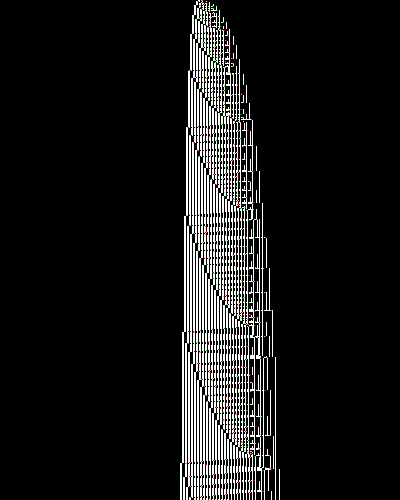
About this picture
The standard picture (bbchallenge.org's Default view): each row is the whole tape at one step, time runs downward, and the head's path draws the pattern.
Overview
In one sentence
Mirrored FractalBEC bounce+counter; C1 makes the eat partial: N grows +1/+3/+4+r per epoch, leftovers ride along
- Upstream
- The blank-start machine never halts: BECv10.v.TM34 ↗. Recorded commit time: 2026-10-13T13:42:06Z. First public push time is not established.
- Status
- Externally Solvedinformal proof · updated 2026-10-10Parked · Funded stage lemma_x (Dennis 2026-10-10) ended at its pre-agreed exit: the excursion entries do not close into a finite list of safe types, so #10 is flagged CRYPTID_CANDIDATE. The 2 open questions are optional.idle since Oct 10 13:18 · status.json 2026-10-10
- Informal proof
- proof.mdconditional; see Proof for what is still open
- Class
- Bell eats counterours: Bell eats counter (sheet) · ours adds: partial eat (leftover digits ride in next counter) · med confidence
- On the list
- not on
BB6_holdouts_663.txt(line 611 of the previous list) · historical 740 line 611
Your calls on file 3
- funded
- option: lemma_x · date: 2026-10-10
- next
- Cryptid protocol: AntiHydra-style Rocq rule reduction of the rule layer (proof.md 1-4, 2.5) at low priority, as for the other cryptid candidates. The twin 1RB0RE_1RC1RE_1LD1RA_1LA0LD_0RA0LF_1LD--- shares the verdict.
- 2026-10-10 · lemma_x
- Fund one more stage on Lemma X (classify the excursion entries exactly), on the condition that if the entry types do not close into a finite list within the stage, #10 gets flagged CRYPTID_CANDIDATE? (Dennis: go with all recommendations (2026-10-10))
Mechanism
How it works: 3 notes
- Mirror of FractalBEC tm10: blocks (110)^a 0 (011)^b on the left, a binary counter on the right; each bounce adds 1.
- C1 differs: when b runs out the bell eats the counter only partly, so N grows by 1, 3 or 4+r per epoch, never doubles.
- Uneaten digits stay as inert 1s inside the next counter (residue); carries pass straight through them.
Figures for Checkpoint A
Both panels: one row per entry into C moving right. Compare the down-right diagonals: how many, how long.
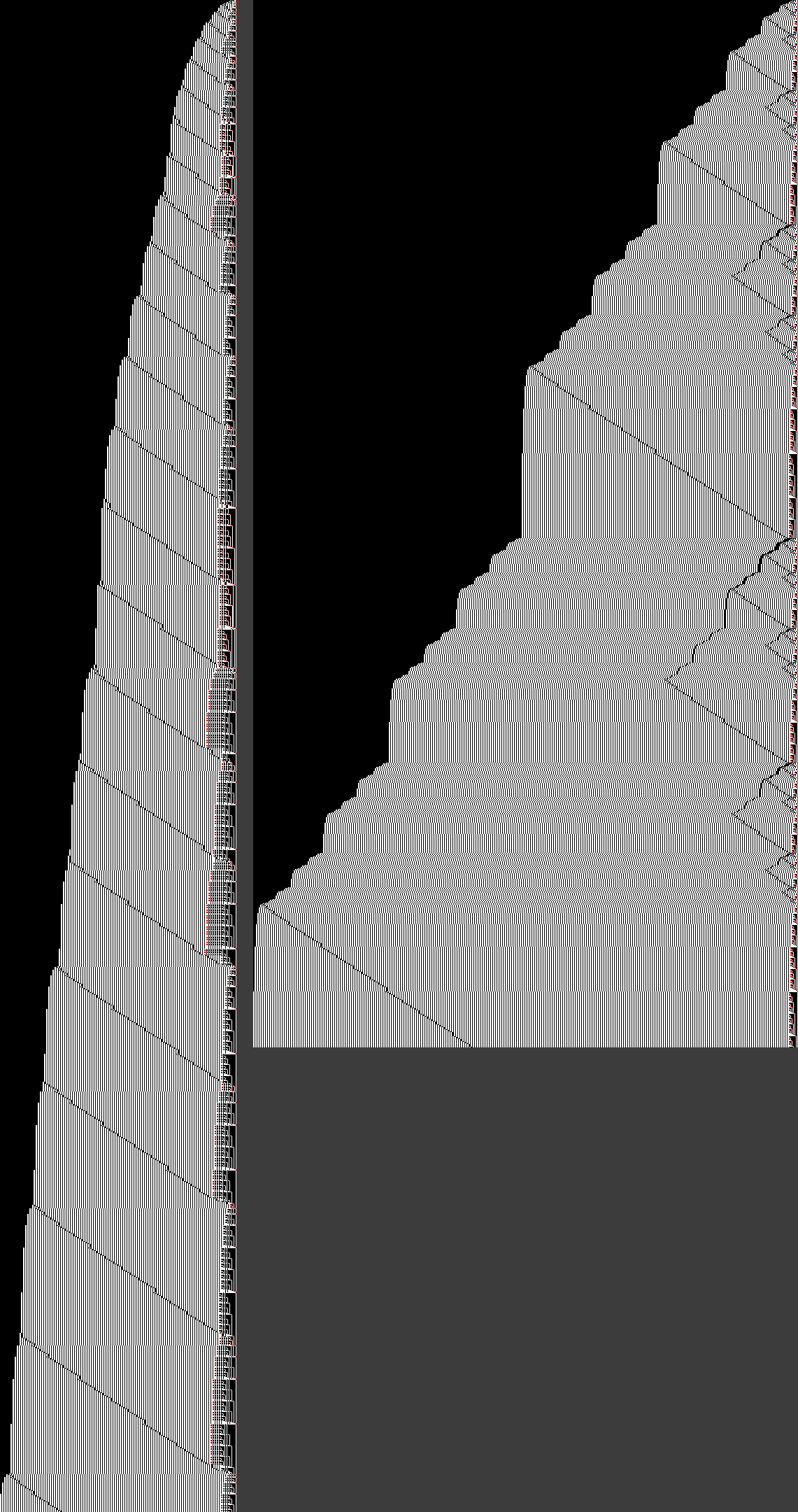
1RB0RF_1RC1RF_1LD1RB_---0LE_1LA0LE_0RA0LC, only C1 differs); Each down-right diagonal = one epoch (the 0-marker crossing the blocks): ours has 25 epochs by step 300,000, each a little longer than the last; the template has 8, each ~4x longerThe counter at the right edge. Watch the isolated 1s between its digits while carries pass.
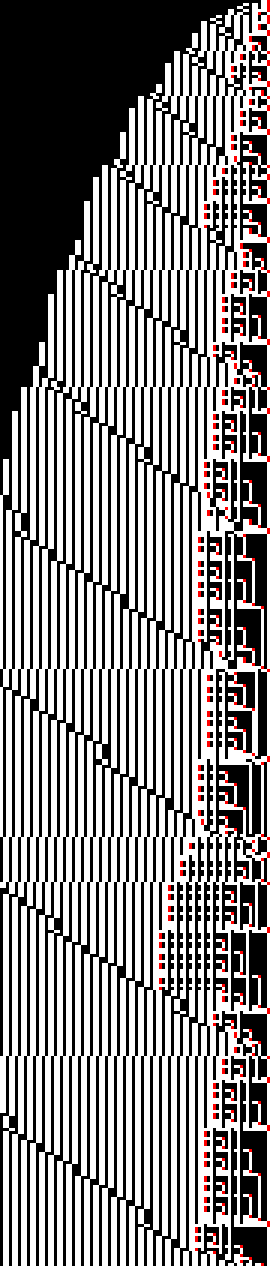
More figures (3)Fig 3–5: Left/right records to 100M steps · bbchallenge default view, first 10,000 steps · Blaze, 10 million steps
The right edge gains 2,083 cells, the left only 276.
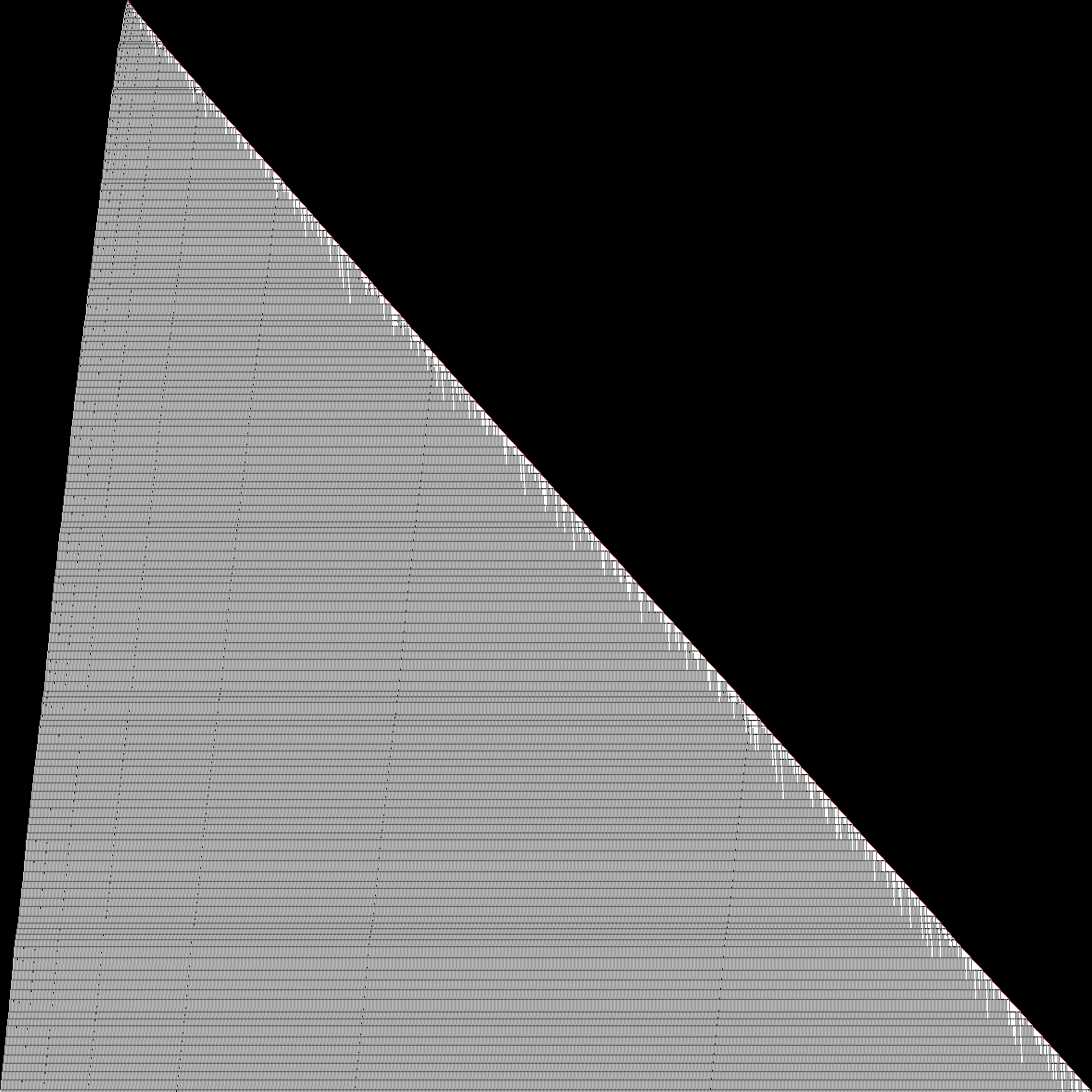
The site's view: a bouncer growing mostly to the right.
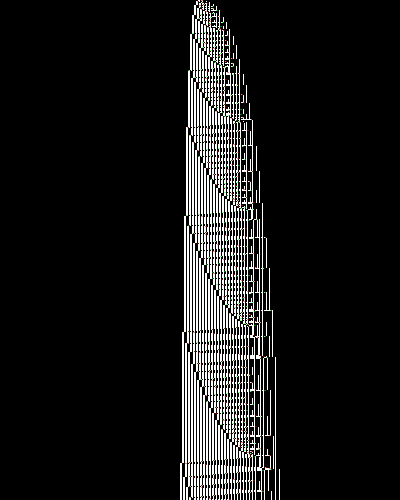
One smooth bell, no chaotic edge.

Rules (5/5 validated)exact tape rewrites the proof will formalize, each re-checked by simulation
| rule | from ⟶ to | cases | steps | checked |
|---|---|---|---|---|
| R1c bounce, clean counter | 0∞ (110)a 0 (011)b+1 C> enc(a) 0∞ ⟶ 0∞ (110)a+1 0 (011)b C> enc(a+1) 0∞ | a>=1, b>=1. enc(v) = v0 010 (00 v1)(00 v2)...(00 vk), LSB first, trailing 0s trimmed; covers top-digit overflow at a=2^k-1 | 8b+8, plus 6t+8 if t>0 (t = trailing 1-bits of a) | ✓127/127 |
| R1g bounce, any counter word | 0∞ (110)a 0 (011)b+1 C> X 0∞ ⟶ 0∞ (110)a+1 0 (011)b C> X' 0∞ | b>=1; X = counter words with residue sampled from epochs N=37 and N=331; X' depends on X only (a,b inert; tested a<=3000, b<=1500) | — | ✓160/160 |
| E0 epoch end, N even (clean start) | 0∞ 110 0 (011)N-1 C> 101 0∞ ⟶ 0∞ 110 0 (011)N C> 110 enc3(N/2) 0∞ | N even, N>=2. enc3(m) = (00 m0)(00 m1)... LSB first. N' = N+1. ~4N^2 steps | — | ✓60/60 |
| E1 epoch end, N = 3 mod 4 (clean start) | 0∞ 110 0 (011)N-1 C> 101 0∞ ⟶ 0∞ 110 0 (011)N+2 C> F((N+1)/4) 0∞ | N = 3 mod 4. F(v) = 1 0 v0 (00 v1)(00 v2)..., F(0) = 1. N' = N+3 | — | ✓40/40 |
| E2 epoch end, N = 1 mod 4 (clean start) | 0∞ 110 0 (011)N-1 C> 101 0∞ ⟶ 0∞ 110 0 (011)N+3+r C> F(N >> (3+r)) 0∞ | N = 1 mod 4; r = run of 1-bits of N starting at bit 2 (r=0..7 tested). N' = N+4+r. N up to 14077 | — | ✓50/50 |
Compressed historythe tape as 0∞ <E (010)n T 0∞ at 37 moments: where the rules are read off
| step | n (left record; next epoch has N = n+1 blocks) | dn (to next left record) | T (residue word) |
|---|---|---|---|
| 5 | 0 | 2 | 1 |
| 27 | 2 | 3 | 1 |
| 103 | 5 | 1 | 1 |
| 301 | 6 | 5 | 101,001 |
| 671 | 11 | 1 | 101 |
| 1,409 | 12 | 6 | 110,000,001,001 |
| 2,547 | 18 | 3 | 101,000,001 |
| 4,311 | 21 | 1 | 110,001,000,001 |
| 6,637 | 22 | 3 | 1.1·1020 |
| 9,263 | 25 | 1 | 1.1·1016 |
| 12,495 | 26 | 10 | 1.1·1022 |
| 16,755 | 36 | 8 | 110,001,000,001 |
| 22,985 | 44 | 6 | 101 |
| 31,741 | 50 | 3 | 101 |
| 68,663 | 57 | 1 | 1.1·1019 |
| 142,521 | 83 | 1 | 101 |
| 325,161 | 112 | 4 | 101,001 |
| 633,549 | 139 | 1 | 101,000,000,001 |
| 1,700,857 | 181 | 1 | 1.1·1053 |
| 3,550,431 | 242 | 7 | 1.1·1026 |
| 6,445,689 | 298 | 13 | 1.01·1023 |
| 10,785,351 | 355 | 1 | 1.1·1038 |
| 16,752,945 | 414 | 9 | 1.01·1035 |
| 35,427,995 | 533 | 1 | 1.1·1053 |
| 64,344,189 | 652 | 4 | 1.1·1059 |
| 106,333,873 | 778 | 13 | 1.1·1053 |
| 164,740,061 | 925 | 1 | 1.01·1017 |
| 242,559,051 | 1,048 | 4 | 1.1·1038 |
| 341,501,535 | 1,172 | 5 | 1.1·1044 |
| 463,868,397 | 1,294 | 9 | 1.1·1065 |
| 615,487,043 | 1,446 | 23 | 1.1·1068 |
| 704,637,887 | 1,524 | 6 | 1.1·1047 |
| 802,671,779 | 1,604 | 8 | 1.1·1038 |
| 910,235,979 | 1,680 | 6 | 1.1·1032 |
| 967,799,275 | 1,706 | 5 | 1.1·1059 |
| 979,514,913 | 1,711 | 1 | 1.1·1065 |
| 991,319,599 | 1,712 | ? | 1.1·1083 |
n (left record; next epoch has N = n+1 blocks)last 1,712dn (to next left record)last ?T (residue word)last 1.1·1083Template comparisonFractalBEC.v Section: partly applies · the nearest solved proof, what carries over, and the transitions that differ
| 0 | 1 | |
|---|---|---|
| A | 1RB | 0RF |
| B | 1RC | 1RF |
| C | 1LD | 1RA |
| D | --- | 0LE |
| E | 1LA | 0LE |
| F | 0RA | 0LC |
differs from the template
- file
FractalBEC.v- module
Section FractalBEC, instance nonhalt10 (line 269)- machine
1LB0LF_1LC1LF_1RD1LB_---0RE_1RA0RE_0LA0RC(11 transitions apart)- diff
mirror of tm10 = 1RB0RF_1RC1RF_1LD1RB_---0LE_1LA0LE_0RA0LC; only C1 differs: 1RB -> 1RA- note
- On ours RInc 4/4 and Ov 8/8 hold; LInc fails for every odd counter (8/16, C reads LSB 1 -> 1RA) and config i -> i+1 fails 5/6. Bounce shape carries over; counter encoding and doubling epoch map do not.
Proof strategy & riskshow the formal proof will go · 3 risks to watch
BECv7/FractalBEC shape: prove R1 (shift rule + counter increment over a residue-tolerant digit word, Inductive like BECv7) with ind; then an epoch lemma K(1,N-1,X) -->+ K(1,N'-1,X') with N'>N; nonhalt via multistep_nonhalt + progress_nonhalt_cond, invariant 'X in residue language'. E0-E2 alone do not close: real orbit almost never has a clean counter.
- ▲General epoch map with residue not found yet: dN depends on residue (N=21: clean +5, with residue +10).
- ▲Residue language may be big: 6-factors stable (23) but 8-factors still new at epoch 178; zero runs up to 20.
- ▲Probably 15-30 KB of Rocq (counter-with-separators encoding); twin holdout 1RB0RE_1RC1RE_1LD1RA_1LA0LD_0RA0LF_1LD--- shares the trajectory.
Stats & provenance109 steps simulated · 5,243 cells · the status in full · files
- simulated
- 109 steps
- tape
- 5,243 cells · 2,610 nonzeros
- growth
- span ~t^0.34 (1085 / 2360 / 5243 cells at 1e7 / 1e8 / 1e9); 278 epochs to 1e9, N +~6/epoch, epoch ~4N^2 steps
- status now
- Funded stage lemma_x (Dennis 2026-10-10) ended at its pre-agreed exit: the excursion entries do not close into a finite list of safe types, so #10 is flagged CRYPTID_CANDIDATE. Proved this stage (scripts/fs_lemmax.py, seeds 1-2, all PASS): no excursion starts at an even eat (Lemma A); an odd entry has P' <= 1.25*2^B1 (Lemma B); after a slack>=0 eat the slack fails only via a super-cascade (odd, P=2^B1), P>=2^(B1+1), or an even cascade with B(n)<B1 (R2); the even cascade is safe for any residue (EC). Fatal for a finite case analysis: the family sigma0(B)=(3*2^(B-2)-7,[3,0^(B-6),10,0,2]) satisfies everything Lemma X may assume (slack 2, no excursion; entry shape P0=15*2^(B-4)) yet reaches a super-cascade at epoch 2 and a non-normalized eat at epoch 4 for every B>=8 (exact to B=300; TM-confirmed at B=8: non-normalized eat at n=194). So safety depends on the orbit's exact residue counts solving equations like P=2^B: pseudo-random arithmetic along one orbit (ground rule 6). Heuristic for non-halting stays strong: 0 non-normalized eats in >2e9 natural eats and to 1e10 main-orbit epochs; natural entries are cascades (1,769) and w=1 near-cascades (11), never w>=2; the TM even recovers from the family's non-normalized eats (B=8,9,10). Not a kill. (status.json, 2026-10-10)
- observer's note
- Mechanism found and bounce + clean-epoch rules validated; not Collatz-like (branches on low bits of a linearly growing N). Open: residue dynamics.
- files
- observe.json · notes.md · proof.md · status.json
Proof & checks
- proof.md · the informal proof
- check_proof.py · the numeric checks of proof.md
○ Checkpoint B: no note from Dennis found
Files
machines/<tm>/: 15 entries · raw notes, status, scripts, images
| name | size | changed |
|---|---|---|
| notes.md ↓ | 26 KB | 2026-10-10 13:18 |
| proof.md ↓ | 41 KB | 2026-10-10 13:18 |
| status.json ↓ | 1.7 KB | 2026-10-10 13:17 |
| observe.json ↓ | 13 KB | 2026-10-10 04:41 |
| deepen.json ↓ | 6.3 KB | 2026-10-10 13:17 |
| data/ | 3 items | 2026-10-10 00:26 |
| decisions/ | 1 item | 2026-10-10 13:17 |
| img/ | 10 items | 2026-10-10 00:25 |
| scripts/ | 27 items | 2026-10-10 13:16 |
| check_proof.py ↓ | 34 KB | 2026-10-10 07:54 |
| qsim.jsonl ↓ | 6.7 KB | 2026-10-10 00:08 |
| rulefit.json ↓ | 59 KB | 2026-10-10 00:18 |
| rulefit.txt ↓ | 4.3 KB | 2026-10-10 00:18 |
| sim_1e9.jsonl ↓ | 149 B | 2026-10-10 00:07 |
| sim_1e9.time ↓ | 42 B | 2026-10-10 00:07 |
status.json in full
{
 "tm": "1RB0RF_1RC1RF_1LD1RA_---0LE_1LA0LE_0RA0LC",
 "status": "CRYPTID_CANDIDATE",
 "stage": "informal_proof",
 "updated": "2026-10-10",
 "cryptid_flag": true,
 "reason": "Funded stage lemma_x (Dennis 2026-10-10) ended at its pre-agreed exit: the excursion entries do not close into a finite list of safe types, so #10 is flagged CRYPTID_CANDIDATE. Proved this stage (scripts/fs_lemmax.py, seeds 1-2, all PASS): no excursion starts at an even eat (Lemma A); an odd entry has P' <= 1.25*2^B1 (Lemma B); after a slack>=0 eat the slack fails only via a super-cascade (odd, P=2^B1), P>=2^(B1+1), or an even cascade with B(n)<B1 (R2); the even cascade is safe for any residue (EC). Fatal for a finite case analysis: the family sigma0(B)=(3*2^(B-2)-7,[3,0^(B-6),10,0,2]) satisfies everything Lemma X may assume (slack 2, no excursion; entry shape P0=15*2^(B-4)) yet reaches a super-cascade at epoch 2 and a non-normalized eat at epoch 4 for every B>=8 (exact to B=300; TM-confirmed at B=8: non-normalized eat at n=194). So safety depends on the orbit's exact residue counts solving equations like P=2^B: pseudo-random arithmetic along one orbit (ground rule 6). Heuristic for non-halting stays strong: 0 non-normalized eats in >2e9 natural eats and to 1e10 main-orbit epochs; natural entries are cascades (1,769) and w=1 near-cascades (11), never w>=2; the TM even recovers from the family's non-normalized eats (B=8,9,10). Not a kill.",
 "funded": {
  "option": "lemma_x",
  "date": "2026-10-10"
 },
 "next": "Cryptid protocol: AntiHydra-style Rocq rule reduction of the rule layer (proof.md 1-4, 2.5) at low priority, as for the other cryptid candidates. The twin 1RB0RE_1RC1RE_1LD1RA_1LA0LD_0RA0LF_1LD--- shares the verdict."
}