tools/rebuild_pages.sh rebuilds the site within 5 minutes of a change; by hand: python3 -B tools/site.py.1RB0RA_1LC0LD_1LE1LD_0LB0RE_1RF1LB_---0RA
Upstream result
Claimed elsewhere
The blank-start machine never halts: BECv10.v.TM32 ↗. Recorded commit time: 2026-10-13T13:42:06Z. First public push time is not established.
Absent from the current 663 holdout list. Earlier local observations remain below.
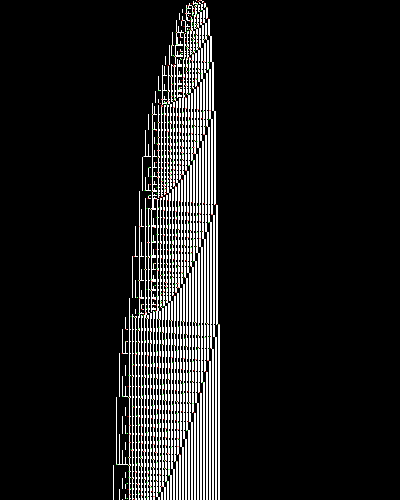
About this picture
The standard picture (bbchallenge.org's Default view): each row is the whole tape at one step, time runs downward, and the head's path draws the pattern.
Overview
In one sentence
tm10 sibling: 3-cell binary counter eats a unary run; 9 round rules predict 100% of rounds to 1e10
- Upstream
- The blank-start machine never halts: BECv10.v.TM32 ↗. Recorded commit time: 2026-10-13T13:42:06Z. First public push time is not established.
- Status
- Externally Solvedprove l9 (L9 open; flagged cryptid with #10) · updated 2026-10-12Parked · Parked 2026-10-12 (Dennis: apply recommendations (2026-10-12)): Park with #10 as one cryptid candidate. The 3 open questions are optional.idle since Oct 12 08:59 · status.json 2026-10-12
- Informal proof
- proof.mdconditional; see Proof for what is still open
- Class
- Bell eats counterours: Bell eats counter (sheet) · ours adds: BECv1 tm10 with E1 = 1LB (3-cell binary counter with fillers + unary marker; eats shift the counter) · med confidence
- On the list
- not on
BB6_holdouts_663.txt(line 596 of the previous list) · historical 740 line 596
Your calls on file 8
- priority call (answered)
- Park #28 with #10 as one cryptid candidate, fund the shared Rocq rule reduction, or fund research on the shared Lemma X?
- parked
- Parked 2026-10-12 (Dennis: apply recommendations (2026-10-12)): Park with #10 as one cryptid candidate.
- funded
- option: prove_l9 · date: 2026-10-11
- next
- Cryptid protocol: AntiHydra-style Rocq rule reduction of the rule layer, shared with #10 and its twin, at low priority (decision.json).
- 2026-10-10 · close_chain
- Fund one more stage to close the chain case and then write proof.md, write proof.md now with the chain case as a stated open lemma, or park? (auto-applied: Claude's recommendation, under Dennis's standing instruction 'do your recommendations and continuously orchestrate' (2026-10-10, while he was away). Override any time.)
- 2026-10-10 · flush_proof
- Fund one stage for the flush lemma and proof.md (hand route, BECv7-style carry relation), run a native CTL search first, or park? (auto-applied: Claude's recommendation, under Dennis's standing instruction 'do your recommendations and continuously orchestrate' (2026-10-10, while he was at lunch). Override any time.)
- 2026-10-11 · prove_l9
- Fund one more stage to prove L9 (PC < 2^(D+1) for words that start with 1) and then write proof.md, write proof.md now with L9 as an open lemma, or park? (Dennis: go with recommendations (2026-10-11))
- decision.json · answered 2026-10-12: park_with_10
- #28 is #10 mirrored and started in E, and the two orbits merge: park it with #10 as one cryptid candidate, fund the shared Rocq rule reduction now, or fund research on the shared Lemma X? Decisions →
Mechanism
How it works: 3 notes
- Left: a binary counter in 3-cell blocks (1=100, 0=000, filler f=010 that carries skip). Right: tm10's 011 unary run with a 00 marker. Each round adds 1 and moves the marker one block left.
- When the marker reaches the counter, one of 3 eats fires. EAT0f drops the low digit and fillers into the unary. EAT0z and EAT1 absorb the marker and shift the counter one cell right (phi).
- The shifted blocks are debris (s=001). A carry that reaches an s re-encodes them (CARRY_S, recursive). On the blank run the debris is always gone before the next eat.
Figures for Checkpoint A
The site's view: the counter sits at the left edge, the unary run to its right.
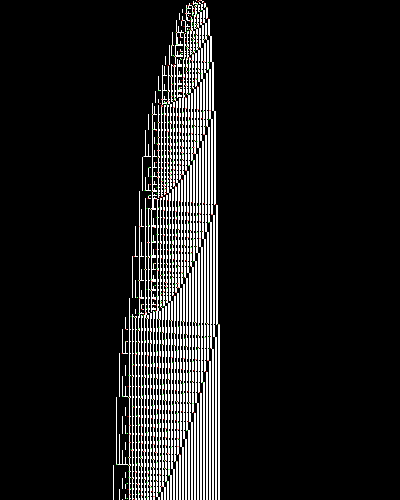
Left edge pinned. Follow one dark diagonal down to the left band, then watch the band and the next diagonal.
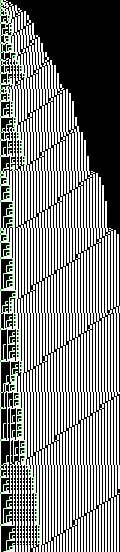
Compare the counter's 1-cells (columns left of the start head) in the top row and below the first left sweep.
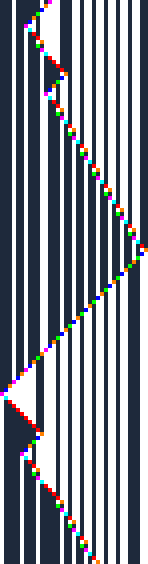
More figures (2)Fig 4–5: Blaze, 100 million steps · Left records, left edge pinned, 1e9
Whole run at a glance: left edge grows like a bell, the right edge slowly.

Left edge pinned. Each row is a new leftmost cell; the counter digits sit in the first columns.

Rules (10/10 validated)exact tape rewrites the proof will formalize, each re-checked by simulation
| rule | from ⟶ to | cases | steps | checked |
|---|---|---|---|---|
| R1 A-sweep (= BECv1 HR1) | l A> (011)n r ⟶ l (010)n A> r | — | 5n | ✓25/25 |
| R2 marker step (= HR2) | l A> 011 00 011 r ⟶ l <B 00 011 011 r | — | — | ✓25/25 |
| R3 B-sweep (= HR3) | l (010)n <B r ⟶ l <B (011)n r | — | 3n | ✓25/25 |
| INC0 | RS(W,0,n+1,m) ⟶ RS(W,1,n,m+1) | RS(W,b,n,m) = 0^inf W b <E 11 (011)^n 00 (011)^m 0^inf; W over blocks 1=100 0=000 f=010 s=001 | 8n+16 | ✓100/100 |
| CARRY | RS(W,1,n+1,m) ⟶ RS(inc W,0,n,m+1) | inc = binary +1 from the right: f skip, 1->0, 0->1 stop, overflow prepends 1 | 8n+16+carry | ✓100/100 |
| CARRY_S (carry meets debris) | RS(X s Y,1,n+1,m) ⟶ RS(inc(incC X) f Y0,0,n,m+1) | Y in {1,f}*, Y0 = Y with 1->0; incC = +1 with f=1, 0=0, s skipped (overflow prepends f); recursive when inc meets another s | — | ✓200/200 |
| BIRTH (marker reborn at the right end) | NM(W,0,n+1) ⟶ RS(W,1,n,1) | NM(W,b,n) = 0^inf W b <E 11 (011)^n 0^inf; BIRTHC: NM(W,1,n+1) -> RS(inc W,0,n,1) (validated, never fires from blank) | 8n+16 | ✓200/200 |
| EAT0f | RS(W' d f^k 1j,0,0,m) ⟶ RS(W',d,k-1,m+2+j) | k >= 1, d in {0,1}, j >= 0; marker stays at the counter | — | ✓100/100 |
| EAT0z | RS(W' 0 1j,0,0,m) ⟶ NM(phi W',0,m+2+j) | phi: 1->f, 0->0, f->s (each block shifted one cell right); W = 1^j uses W' empty | — | ✓200/200 |
| EAT1 | RS(W,1,0,m) ⟶ NM(phi(inc W),0,m+1) | W in {1,0,f}* | — | ✓100/100 |
Compressed historythe tape as 0∞ W 0 <E 11 (011)n 0∞ at 26 moments: where the rules are read off
| step | n (unary blocks; the next epoch lasts about n rounds) | |W| (blocks) | #s (shifted debris blocks) | W (1=100 0=000 f=010 s=001) |
|---|---|---|---|---|
| 120 | 5 | 1 | 0 | f |
| 337 | 6 | 3 | 1 | f f s |
| 664 | 9 | 3 | 1 | f s 0 |
| 1,191 | 10 | 5 | 2 | f s 0 s f |
| 2,118 | 19 | 1 | 0 | f |
| 6,335 | 30 | 0 | 0 | — |
| 10,475 | 36 | 0 | 0 | — |
| 22,976 | 41 | 5 | 1 | f 0 f s 0 |
| 52,983 | 54 | 8 | 3 | f f 0 f f s s s |
| 100,967 | 68 | 8 | 3 | f 0 s 0 s f s 0 |
| 191,998 | 79 | 13 | 8 | f 0 f s s s s 0 0 s s s s |
| 415,534 | 111 | 7 | 3 | f f s f 0 s s |
| 880,399 | 138 | 17 | 10 | f 0 0 0 f s 0 s f s s s s s s s s |
| 1,884,030 | 189 | 10 | 4 | f f s 0 0 s f s f s |
| 3,995,447 | 248 | 10 | 3 | f f f s f f s 0 s 0 |
| 8,577,850 | 313 | 20 | 13 | f 0 0 f f f s s f s s s s s s s s s s s |
| 18,895,844 | 429 | 15 | 8 | f f s 0 f 0 f s s s s f s s s |
| 39,652,245 | 560 | 10 | 1 | f 0 0 0 f f 0 0 s 0 |
| 84,498,575 | 720 | 20 | 12 | f 0 f f 0 s s f 0 s s s s 0 s s s s s s |
| 178,862,950 | 973 | 5 | 0 | f f f f f |
| 385,954,048 | 1,225 | 14 | 5 | f 0 0 f f s 0 0 s s s f f s |
| 820,471,330 | 1,589 | 29 | 21 | f f 0 0 f 0 0 s s s 0 s s s s s s s s s s s s s ... |
| 1,738,588,788 | 2,071 | 18 | 8 | f 0 0 0 0 0 s f 0 0 0 s s s s s s s |
| 3,720,429,457 | 2,668 | 18 | 8 | f 0 f 0 0 s f s s f f s f s s s 0 s |
| 7,958,424,339 | 3,518 | 20 | 10 | f f 0 s s s f f 0 f f s s s f s f s s s |
| 9,996,109,695 | 3,804 | 22 | 12 | f f f 0 f f 0 f f s s s f s s s s s s s s s |
n (unary blocks; the next epoch lasts about n rounds)last 3,804|W| (blocks)last 22#s (shifted debris blocks)last 12W (1=100 0=000 f=010 s=001)last f f f 0 f f 0 f f s s s f s s s s s s s s sTemplate comparisonBECv1_6x2_solved.v tm10: partly applies · the nearest solved proof, what carries over, and the transitions that differ
| 0 | 1 | |
|---|---|---|
| A | 1RB | 0RA |
| B | 1LC | 0LD |
| C | 1LE | 1LD |
| D | 0LB | 0RE |
| E | 1RF | 1LBtpl 1LE |
| F | --- | 0RA |
differs from the template
- file
BECv1_6x2_solved.v:88(+BECv1.vSection; structure:BECv7.v)- module
tm10 / nonhalt10, cert Build_BEC_cert_v1 B A E A [0] [1] [1] [0] [1] ... 1 0 0- machine
1RB0RA_1LC0LD_1LE1LD_0LB0RE_1RF1LE_---0RA(1 transition apart)- diff
E1: 1LB (ours) vs 1LE (tm10); the other 11 transitions are equal (#7 has E1 = 0LA)- note
- Our TM on tm10's cert: 10/11 hypotheses hold (HL1, HL3-5, HR1-3, HE0-3: 25/25 each); HL2, the 1-cell carry 1<E1 -> <E11, fails 0/25 (E1 = 1LB sends the carry through B and C, so digits are 3 cells apart). The unary half carries over; LeftBinaryCounter becomes a block-list counter with fillers and a phase-shifted debris region, closest to BECv7.v's inductive RIncs carry relation over 110/000/100 blocks.
Proof strategy & riskshow the formal proof will go · 3 risks to watch
Proof on round starts RS/NM, with W over {1,0,f,s}. Invariant: no 1 left of an s, and no s at an eat (the flush lemma). Unary lemmas from BECv1; inc/incC/CARRY_S as an inductive carry relation in BECv7 style. Then progress_nonhalt_cond. The open piece is the flush lemma: before the marker returns, the counter carries through every s block.
- ▲The flush lemma is a size bound (2^(digits right of the leftmost s) < epoch length, about m+1); it holds with slack on the blank run (worst ratio 0.44, below 0.11 after 1e9) but is not proved.
- ▲An eat with s still present leaves the block alphabet; random words that do this can halt (26 of 1,200 fuzz samples), so the invariant must carry the bound.
- ▲CARRY_S is recursive (debris inside debris), so the Coq carry relation must be mutually inductive, like BECv7's RIncs.
Stats & provenance1010 steps simulated · 11,492 cells · the status in full · files
- simulated
- 1010 steps
- tape
- 11,492 cells · 5,201 nonzeros
- growth
- span ~t^0.34 (5,197 cells at 1e9, 11,492 at 1e10); epoch length n ~t^0.35 (1,589 at 8.2e8, 3,804 at 1e10)
- status now
- Parked 2026-10-12 (Dennis: apply recommendations (2026-10-12)): Park with #10 as one cryptid candidate. Funded stage prove_l9 (Dennis 2026-10-11, 'go with recommendations') ended at its stop rule: L9 did not close, and it cannot close by a local invariant. Proved: after the flush the normalized debris weight s = sigma/2^D never grows (W1); sigma after the flush = g(PC) + h (W2); s < 1 passes from S1 to S1 in every case except the hard case H (exact carry PC = 2^D + sparse Y with N < 2^(D+1)) (W3-W5); so L9 reduces to Lemma H. Checks: 100,000 random states, 0 violations. Found: #28 is #10 (CRYPTID_CANDIDATE) mirrored with A..F -> E,A,B,F,C,D, started in #10's E (12/12 entries, 3e6 steps lock-step), and the orbits merge at our epoch 350,328 = #10's t = 350,272. #10's counter-family sigma0(B), translated, satisfies INV (L9 included) and then breaks L9 and the flush (an eat sees an s block) for every B = 8..18; on #28's own TM at B = 8: 779/779 rounds match, unsafe eat at N = 194, then recovery. Safety therefore rests on exact coincidences along one orbit (ground rule 6), as for #10. proof.md is the conditional write-up with L9 open. decision.json: park with #10 (recommended) vs shared Rocq rule reduction vs research. (status.json, 2026-10-12)
- observer's note
- Mechanism found: 9 round rules (1,000/1,000 random-instance sims) predict all 1,008,130 rounds to 1e10, 0 mismatches. Not cryptid. Non-halting needs the unproved flush lemma, so confidence is med.
- files
- observe.json · notes.md · proof.md · status.json
Proof & checks
- proof.md · the informal proof
Files
machines/<tm>/: 10 entries · raw notes, status, scripts, images
| name | size | changed |
|---|---|---|
| notes.md ↓ | 30 KB | 2026-10-12 08:59 |
| proof.md ↓ | 17 KB | 2026-10-11 08:58 |
| status.json ↓ | 2.0 KB | 2026-10-12 08:59 |
| observe.json ↓ | 13 KB | 2026-10-10 13:25 |
| deepen.json ↓ | 8.3 KB | 2026-10-11 08:57 |
| decision.json ↓ | 3.1 KB | 2026-10-12 08:59 |
| data/ | 10 items | 2026-10-11 08:57 |
| decisions/ | 3 items | 2026-10-11 08:58 |
| img/ | 6 items | 2026-10-10 13:21 |
| scripts/ | 42 items | 2026-10-11 08:54 |
status.json in full
{
 "tm": "1RB0RA_1LC0LD_1LE1LD_0LB0RE_1RF1LB_---0RA",
 "status": "CRYPTID_CANDIDATE",
 "stage": "prove_l9 (L9 open; flagged cryptid with #10)",
 "confidence": "med",
 "updated": "2026-10-12",
 "cryptid_flag": true,
 "twin": "1RB0RF_1RC1RF_1LD1RA_---0LE_1LA0LE_0RA0LC",
 "reason": "Parked 2026-10-12 (Dennis: apply recommendations (2026-10-12)): Park with #10 as one cryptid candidate. Funded stage prove_l9 (Dennis 2026-10-11, 'go with recommendations') ended at its stop rule: L9 did not close, and it cannot close by a local invariant. Proved: after the flush the normalized debris weight s = sigma/2^D never grows (W1); sigma after the flush = g(PC) + h (W2); s < 1 passes from S1 to S1 in every case except the hard case H (exact carry PC = 2^D + sparse Y with N < 2^(D+1)) (W3-W5); so L9 reduces to Lemma H. Checks: 100,000 random states, 0 violations. Found: #28 is #10 (CRYPTID_CANDIDATE) mirrored with A..F -> E,A,B,F,C,D, started in #10's E (12/12 entries, 3e6 steps lock-step), and the orbits merge at our epoch 350,328 = #10's t = 350,272. #10's counter-family sigma0(B), translated, satisfies INV (L9 included) and then breaks L9 and the flush (an eat sees an s block) for every B = 8..18; on #28's own TM at B = 8: 779/779 rounds match, unsafe eat at N = 194, then recovery. Safety therefore rests on exact coincidences along one orbit (ground rule 6), as for #10. proof.md is the conditional write-up with L9 open. decision.json: park with #10 (recommended) vs shared Rocq rule reduction vs research.",
 "funded": {
  "option": "prove_l9",
  "date": "2026-10-11"
 },
 "next": "Cryptid protocol: AntiHydra-style Rocq rule reduction of the rule layer, shared with #10 and its twin, at low priority (decision.json).",
 "priority_call_answered": "Park #28 with #10 as one cryptid candidate, fund the shared Rocq rule reduction, or fund research on the shared Lemma X?",
 "parked": "Parked 2026-10-12 (Dennis: apply recommendations (2026-10-12)): Park with #10 as one cryptid candidate."
}