tools/rebuild_pages.sh rebuilds the site within 5 minutes of a change; by hand: python3 -B tools/site.py.1RB0RF_1RC0RE_1LD1RA_1LA0LD_1RA---_0RA0LB
Upstream result
Claimed elsewhere
The blank-start machine never halts: BECv10.v.TM28 ↗. Recorded commit time: 2026-10-13T13:42:06Z. First public push time is not established.
Absent from the current 663 holdout list. Earlier local observations remain below.
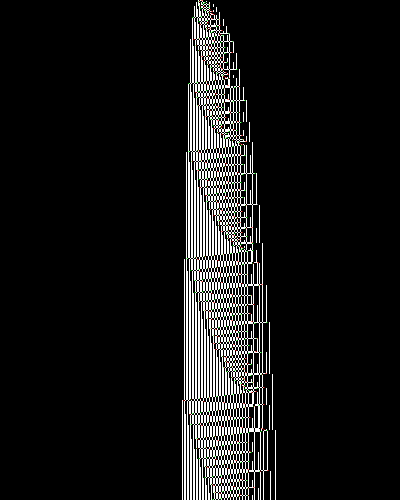
About this picture
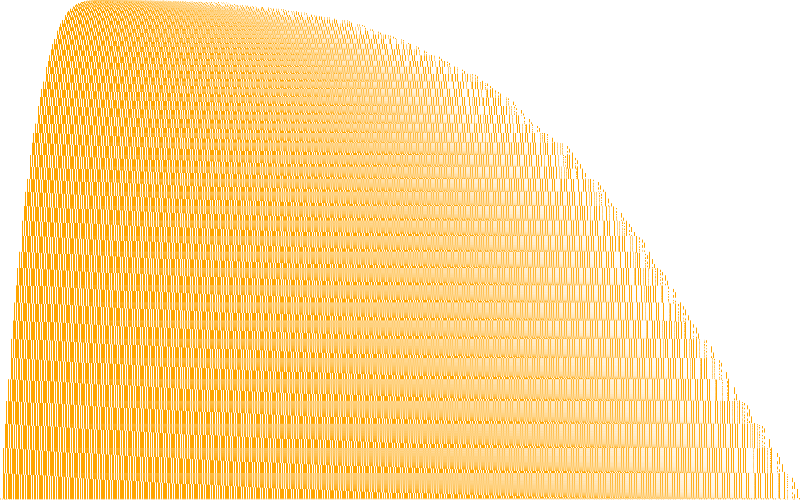
The standard picture (bbchallenge.org's Default view): each row is the whole tape at one step, time runs downward, and the head's path draws the pattern.
Overview
In one sentence
Gap bounces in (101)^a 00 (101)^b, counter counts; at b=0 the low digits pick eat E or bell B0/B1
- Upstream
- The blank-start machine never halts: BECv10.v.TM28 ↗. Recorded commit time: 2026-10-13T13:42:06Z. First public push time is not established.
- Status
- Externally Solvedcrossing · updated 2026-10-11Not blocking · Stuck at the crossing stage. Answer Q1–Q3 whenever; a “no” redirects the work.idle since Oct 11 08:19 · status.json 2026-10-11
- Class
- Bell eats counterours: Bell eats counter (sheet) · ours adds: FractalBEC-like 101/00 bouncer plus a 3-cell binary counter with transparent J blocks; the bell shifts the counter one cell · med confidence
- On the list
- not on
BB6_holdouts_663.txt(line 202 of the previous list) · historical 740 line 202
Your calls on file 6
- priority call (answered)
- R3's cleanup is now exact and safety reduces to one per-epoch inequality (2^P <= N, via L*), the same crossing arithmetic R2 is stuck on: fund one joint crossing-lemma stage, start Rocq on the exact rules, or park?
- parked
- Parked 2026-10-11 (Dennis: go with recommendations): Park R3 with R2 (stop rule).
- funded
- option: crossing · date: 2026-10-10 · auto: true
- 2026-10-10 · crossing
- R3's cleanup is now exact and safety reduces to one per-epoch inequality (2^P <= N, via L*), the same crossing arithmetic R2 is stuck on: fund one joint crossing-lemma stage, start Rocq on the exact rules, or park? (auto-applied: Claude's recommendation, under Dennis's standing instruction 'do your recommendations and continuously orchestrate' (2026-10-10, while he was away). Override any time.)
- 2026-10-10 · prep
- Should R3 get a proof-prep stage on the cleanup lemma (x/z/w marks left by the bell vanish before the next b=0), done together with R2's size invariant, or be parked? (auto-applied: Claude's recommendation, under Dennis's standing instruction 'do your recommendations and continuously orchestrate' (2026-10-10, while he was at lunch). Override any time.)
- decision.json · answered 2026-10-11: park
- The crossing stage hit its stop rule (Lemma S proven, the Big-Y lemma open, with 3 instances in 1e7 epochs): park R3 with R2, fund one Big-Y stage, or start Rocq with Big-Y as the one hypothesis? Decisions →
Mechanism
How it works: 3 notes
- Hub
K(a,b,G) = 0^inf (101)^a 00 (101)^b A> 0 enc(G) 0^inf(enc 0=000, 1=010, J=100). R1: each bounce moves the 00 gap one block right and adds 1 to the counter G (J skipped). - At b=0 the low digits decide:
0 1^r J^k= partial eat E (J's become k-1 fresh blocks);0 1^r 0/1...= bell B0/B1: sweep to the left end, counter shifted one cell (σ). - σ leaves x/z/w marks that the carry cleans within 2^q <= 2^floor(log2 N) increments (19,773/19,773 macro epochs); lockstep from blank holds to 1e9 (all hubs) and 3e10 (b=0 hubs).
Figures for Checkpoint A
Time runs down. Follow the diagonal bands and note where each one starts and ends.
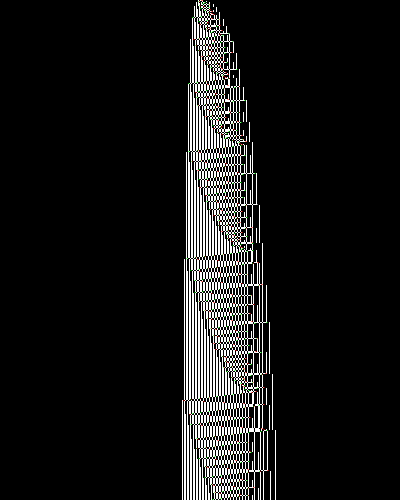
Left: where the cyan gap sits. Right: the counter word. Compare the rows just before and after each cyan bar.
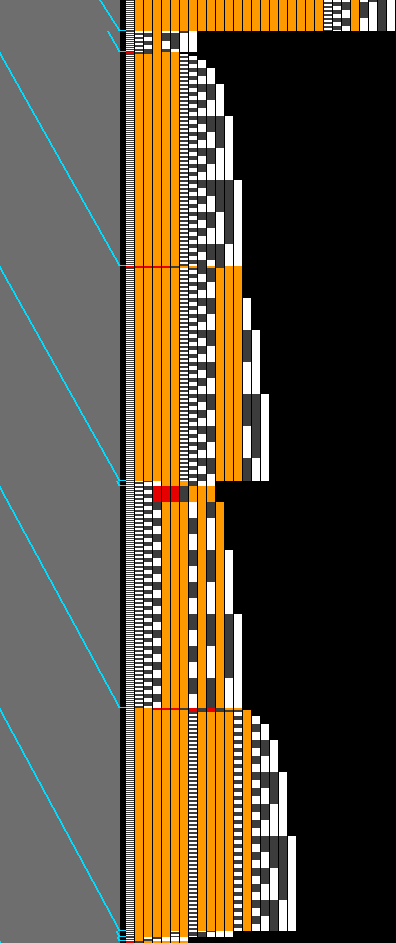
Count the bounces; watch where the right end jumps left and where the head runs to the far left.

More figures (2)Fig 4–5: Records to 100 million steps · Blaze, 10 million steps
Each run of left records is one bell sweep (epoch start); right records are counter growth.
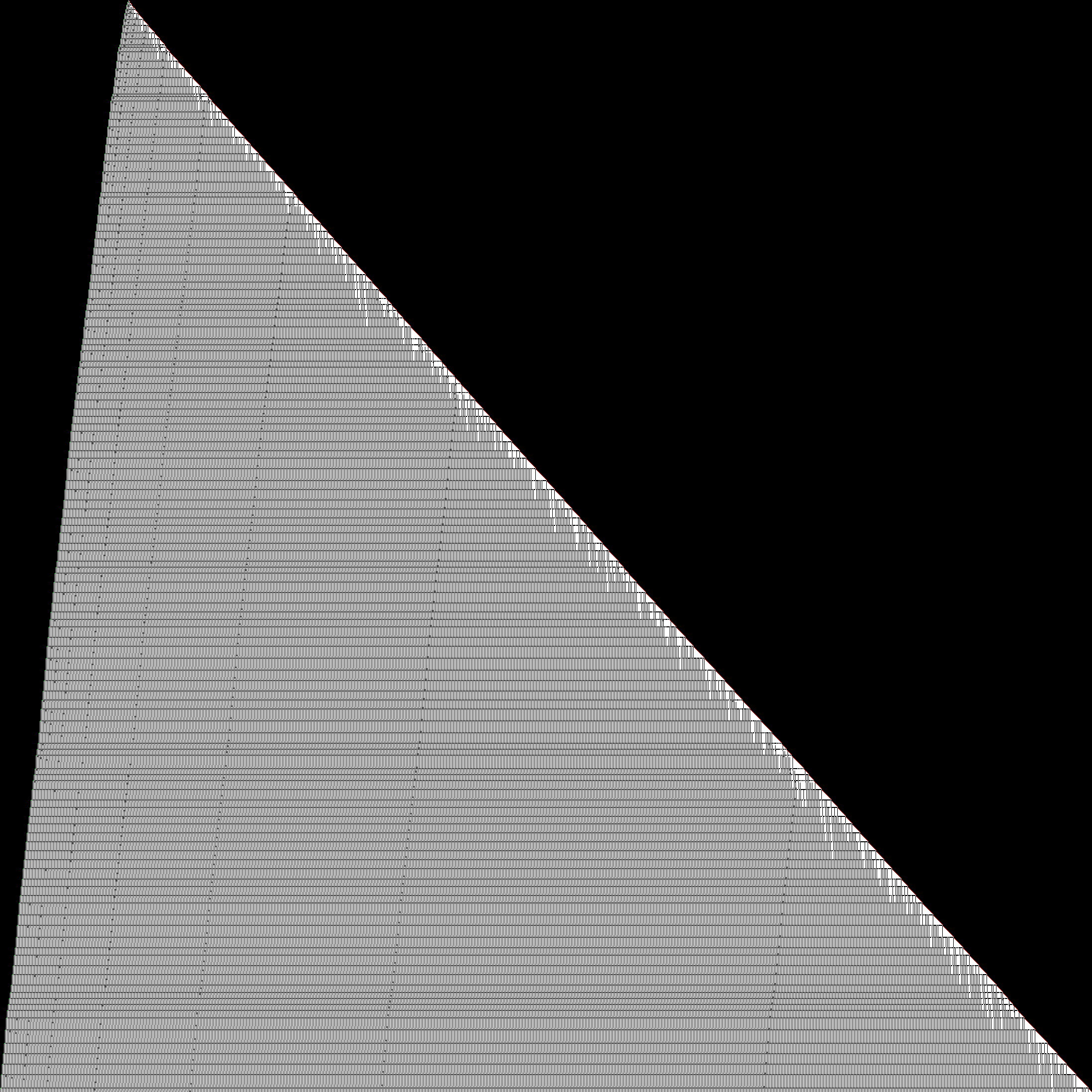
Overall shape: slow growth to the right, where the counter and the block region grow.
Rules (6/6 validated)exact tape rewrites the proof will formalize, each re-checked by simulation
| rule | from ⟶ to | cases | steps | checked |
|---|---|---|---|---|
| init | 0∞ A> 0∞ ⟶ K(0, 2, ε) = 0∞ (101)2 A> 0 0∞ | — | 12 | ✓1/1 |
| R1 bounce | K(a, b+1, G) ⟶ K(a+1, b, inc G) | a >= 0, b >= 0, G in {0,1}{0,1,J}*; inc = +1 on the digit groups (LSB first), J skipped, a new top digit appended after the last group; a = 0 is the bell sweep to the left end. Orbit: 189,846/189,846 to 1e9 | — | ✓1800/1800 |
| R1x bounce on marked words | K(a, b+1, G), G with x/z/w groups ⟶ K(a+1, b, T(G)) | T = the counter's own carry transducer, the same for every a, b (x -> z on a carry; z then x-runs -> 0 J... on the next). Orbit: 2,196/2,196 to 1e9 | — | ✓900/900 |
| E partial eat | K(a, 0, 0 1r J^k G') ⟶ K(a+2+r, k-1, G') | r >= 0, k >= 1, G' empty or starting with a digit. Orbit: 229/229 to 1e9 | — | ✓1048/1048 |
| B0 bell (low digit 0) | K(a, 0, 0 1r 0 G'') ⟶ K(0, a+2+r, σ(0 G'')) | r >= 0, also G = 0 1^r with nothing after; σ = shift every 1-cell of enc one cell left. Orbit: 36/36 to 1e9 | — | ✓1244/1244 |
| B1 bell (low digit 1) | K(a, 0, 1 G') ⟶ K(0, a+1, σ(inc(1 G'))) | any standard G'. Orbit: 222/222 to 1e9 | — | ✓2208/2208 |
Compressed historythe tape as 0∞ (101)a 00 (101)b A> 0 enc(G) 0∞ at 40 moments: where the rules are read off
| step | a | b | G |
|---|---|---|---|
| 2,858,672 | 188 | 0 | 0JJJJJJJJJJJJJJJJJJJJJ011J1101 |
| 2,861,162 | 210 | 0 | 010J0111 |
| 2,861,177 | 0 | 213 | x00JJJ |
| 2,867,625 | 3 | 210 | 1JJJJJ1 |
| 2,876,115 | 7 | 206 | 1JJJJJ11 |
| 2,892,621 | 15 | 198 | 1JJJJJ111 |
| 2,923,719 | 31 | 182 | 1JJJJJ1111 |
| 2,978,241 | 63 | 150 | 1JJJJJ11111 |
| 3,056,571 | 127 | 86 | 1JJJJJ111111 |
| 3,097,347 | 213 | 0 | 1JJJJJ0101011 |
| 3,097,412 | 0 | 214 | xxxxx0JJ0J0JJ |
| 3,104,064 | 3 | 211 | 1JJJJJ1000JJJ |
| 3,112,594 | 7 | 207 | 1JJJJJ1100JJJ |
| 3,129,180 | 15 | 199 | 1JJJJJ1110JJJ |
| 3,160,438 | 31 | 183 | 1JJJJJ1111JJJ |
| 3,215,310 | 63 | 151 | 1JJJJJ1111JJJ1 |
| 3,294,340 | 127 | 87 | 1JJJJJ1111JJJ11 |
| 3,336,140 | 214 | 0 | 0JJJJJ1101JJJ011 |
| 3,336,316 | 220 | 0 | 1111JJJ011 |
| 3,336,379 | 0 | 221 | 000xxx0JJJ |
| 3,343,009 | 3 | 218 | 110xxx0JJJ |
| 3,351,719 | 7 | 214 | 111xxx0JJJ |
| 3,368,665 | 15 | 206 | 111zxx0JJJ |
| 3,400,751 | 31 | 190 | 1111JJJ1J0J |
| 3,457,103 | 63 | 158 | 1111JJJ1J1J |
| 3,539,103 | 127 | 94 | 1111JJJ1J1J1 |
| 3,585,305 | 221 | 0 | 1011JJJ1J0J11 |
| 3,585,320 | 0 | 222 | 0JJwxx0w0x0JJ |
| 3,592,154 | 3 | 219 | 1JJJJJJz0x000J |
| 3,601,080 | 7 | 215 | 1JJJJJJ1JJJJ1J |
| 3,618,436 | 15 | 207 | 1JJJJJJ1JJJJ1J1 |
| 3,651,234 | 31 | 191 | 1JJJJJJ1JJJJ1J11 |
| 3,709,156 | 63 | 159 | 1JJJJJJ1JJJJ1J111 |
| 3,794,286 | 127 | 95 | 1JJJJJJ1JJJJ1J1111 |
| 3,845,182 | 222 | 0 | 0JJJJJJ1JJJJ1J11011 |
| 3,845,583 | 229 | 0 | 0JJJJ0J10111 |
| 3,845,712 | 234 | 0 | 1J01111 |
| 3,845,737 | 0 | 235 | x0JJJJJ |
| 3,852,835 | 3 | 232 | 1J10000J |
| 3,862,125 | 7 | 228 | 1J11000J |
alast 7blast 228Glast 1J11000JTemplate comparisonFractalBEC.v Section: partly applies · the nearest solved proof, what carries over, and the transitions that differ
| 0 | 1 | |
|---|---|---|
| A | 1RB | 0RF |
| B | 1RC | 0RE |
| C | 1LD | 1RAtpl 1RB |
| D | 1LA | 0LD |
| E | 1RA | --- |
| F | 0RA | 0LB |
differs from the template
- file
FractalBEC.v:206- module
Section FractalBEC, instance tm1 / nonhalt1, cert1 B D [1] [0] [0;1] [1;0;1] [0;0] (mirrored L<->R)- machine
1RB0RF_1RC0RE_1LD1RB_1LA0LD_1RA---_0RA0LB(1 transition apart)- diff
C1: 1RA (ours) vs 1RB (tm1 mirrored)- note
- Same bouncer: w1 = 101, w0 = 00, and the gap step of R1 is the template's RInc. The counter differs: 3-cell digits 000/010 with transparent J = 100 blocks instead of 2-cell digits (LInc not run on ours: the encoding does not match). No overflow Ov and no fractal recursion: the b=0 step is E/B0/B1 by the low digits, with the one-cell shift σ, and epoch lengths are irregular (2, 5, 6, 11, 18, 44, ...) instead of 2^i - 1. Same family as R2 (BECv1 tm108 twin: 'drop a suffix, shift one cell' eat, pending-size invariant).
Proof strategy & riskshow the formal proof will go · 3 risks to watch
Proof plan: K(a,b,G) with G an Inductive group list; R1 by a carry lemma (ind over digits, J transparent); E/B0/B1 as finite case lemmas with σ as a list shift. Invariant: G is standard at every b=0 hub. Open: the cleanup lemma on σ-words (x -> z on the first carry, z x^j -> 0 J^(j+1) on the second; time 2^(p+1) <= N). Start from FractalBEC.v for the bouncer and a BECv1-style digit list for the counter; share the size lemma with R2.
- ▲Cleanup lemma unproved: arbitrary x/z/w words halt (K(5,6,1z0101) halts in 19 steps), so the invariant must track where σ puts x/w.
- ▲The carry through z/w is a cell-level transducer with context (z followed by x-runs); formalizing it may take many small lemmas.
- ▲Same family as R2 and the #10/#30 sibling, which got stuck on a size invariant; that invariant may be hard here too.
Stats & provenance3·1010 steps simulated · 15,368 cells · the status in full · files
- simulated
- 3·1010 steps
- tape
- 15,368 cells
- growth
- span ~ t^(1/3): 677 cells at 3e6, 4,850 at 1e9 (3,147 nonzeros), 15,368 at 3e10; N = 1,603 at 1e9; macro model to 20,000 epochs (N = 192,042, about 1e15 steps by a 3N^2-per-epoch estimate)
- status now
- Parked 2026-10-11 (Dennis: go with recommendations): Park R3 with R2 (stop rule). Funded crossing stage (2026-10-10) ended STUCK by its stop rule (no inductive form found), so R3 parks with R2; confidence stays med. New exact integer model (word = digit value v + multiset M of j depths; matches the token model on 100,000/100,000 epochs from blank) runs 1e7 epochs to N = 1.44e8: every epoch safe. Proved on paper and checked (100,000 trajectory epochs, 59,887 random states): Lemma S, the bell after epoch e is safe whenever zb(Y_e) <= bitlen(N_e) - 1 + s_e (s = eat shift) or s = 0 and Y_e = 2^bitlen(N_e); in particular whenever Y_e < 2^(bitlen N_e + 1). This replaces L*, which fails at 6 epochs to 1e7 (7, 8, 14, 15, 350,273, 350,274; all Y = 2^m exactly). Open: the Big-Y lemma, Y_e >= 2^(bitlen N_e + 1) => zb(Y_e) <= bitlen(N_e) - 1 + s_e. Its hypothesis holds only at epochs 9, 16 and 350,275 to 1e7 (C-margins 3, 3, 15), each right after an exact-power pair; the candidate C0 is not inductive on random near-crossing states. The safety margin is not 2.3 bits: it falls to 1.000 bit at epoch 350,274 (N = 2^22 - 4,693), a structural case covered by Lemma S. Not a cryptid. (status.json, 2026-10-11)
- observer's note
- Med confidence: rules R1/E/B0/B1 cover every hub from blank (lockstep to 1e9, b=0 hubs to 3e10, macro to N=192,042); non-halting still needs the cleanup lemma for x/z/w words. Not a cryptid: the eat choice is a regular function of the low digits.
- files
- observe.json · notes.md · status.json
Proof & checks
No proof work yet.
Files
machines/<tm>/: 10 entries · raw notes, status, scripts, images
| name | size | changed |
|---|---|---|
| notes.md ↓ | 23 KB | 2026-10-11 08:19 |
| status.json ↓ | 1.7 KB | 2026-10-11 08:19 |
| observe.json ↓ | 13 KB | 2026-10-10 13:24 |
| deepen.json ↓ | 7.5 KB | 2026-10-10 15:10 |
| decision.json ↓ | 2.6 KB | 2026-10-11 08:19 |
| data/ | 4 items | 2026-10-10 13:16 |
| decisions/ | 2 items | 2026-10-10 15:08 |
| img/ | 5 items | 2026-10-10 13:21 |
| scripts/ | 11 items | 2026-10-10 14:56 |
| sim_1e9.jsonl ↓ | 149 B | 2026-10-10 12:55 |
status.json in full
{
 "tm": "1RB0RF_1RC0RE_1LD1RA_1LA0LD_1RA---_0RA0LB",
 "status": "STUCK",
 "stage": "crossing",
 "updated": "2026-10-11",
 "confidence": "med",
 "cryptid_flag": false,
 "reason": "Parked 2026-10-11 (Dennis: go with recommendations): Park R3 with R2 (stop rule). Funded crossing stage (2026-10-10) ended STUCK by its stop rule (no inductive form found), so R3 parks with R2; confidence stays med. New exact integer model (word = digit value v + multiset M of j depths; matches the token model on 100,000/100,000 epochs from blank) runs 1e7 epochs to N = 1.44e8: every epoch safe. Proved on paper and checked (100,000 trajectory epochs, 59,887 random states): Lemma S, the bell after epoch e is safe whenever zb(Y_e) <= bitlen(N_e) - 1 + s_e (s = eat shift) or s = 0 and Y_e = 2^bitlen(N_e); in particular whenever Y_e < 2^(bitlen N_e + 1). This replaces L*, which fails at 6 epochs to 1e7 (7, 8, 14, 15, 350,273, 350,274; all Y = 2^m exactly). Open: the Big-Y lemma, Y_e >= 2^(bitlen N_e + 1) => zb(Y_e) <= bitlen(N_e) - 1 + s_e. Its hypothesis holds only at epochs 9, 16 and 350,275 to 1e7 (C-margins 3, 3, 15), each right after an exact-power pair; the candidate C0 is not inductive on random near-crossing states. The safety margin is not 2.3 bits: it falls to 1.000 bit at epoch 350,274 (N = 2^22 - 4,693), a structural case covered by Lemma S. Not a cryptid.",
 "funded": {
  "option": "crossing",
  "date": "2026-10-10",
  "auto": true
 },
 "parked": "Parked 2026-10-11 (Dennis: go with recommendations): Park R3 with R2 (stop rule).",
 "priority_call_answered": "R3's cleanup is now exact and safety reduces to one per-epoch inequality (2^P <= N, via L*), the same crossing arithmetic R2 is stuck on: fund one joint crossing-lemma stage, start Rocq on the exact rules, or park?"
}1 contract warning
- rank: not an int