tools/rebuild_pages.sh rebuilds the site within 5 minutes of a change; by hand: python3 -B tools/site.py.1RB0RE_1LC0RD_1LD0LD_1RA0LC_1RA1RF_1RA---
Where it stands
Cryptid candidate, parked at the observation
Class 2 close-out stage 3 of 3 (2026-10-12), joint with #32 (write-up in #32's notes.md): flagged CRYPTID_CANDIDATE, proof work stops. Halting is decided by modular conditions on fuel values at a hierarchy of exhaustions.
Read the full status
A regime-I top halts exactly when its fuel N runs out at N = 2 (mod 5) (N = 0..44 from #32's I(N,360): only 2, 7, 12, 17, 22 halt by 1e80). A lower digit that runs out first switches that outcome irregularly (N = 12: 14 of 24 small u1 values halt, 10 do not; N = 11, 13: 0 of 50). Wide-integer simulator c2s3_tsim.c (validated byte for byte against stage 2 to 1e37): R4 no halt to 1e80, first 40 defects frozen from 4.8e17 to 1e80; its top cycle started at N = 27 = 2 (mod 5) and waits behind deep levels. No invariant. Heuristic (random residues) leans to an astronomically late halt, not non-halting. decision.json: stop_cryptid (recommended) / recursive_model / formalize_rules. Stage-2 re-run (2026-10-12): replay of an already-run stage, no new proof work (cryptid protocol, decision pending). Kept simulators reproduce R4's stage-3 dump to 1e80 byte for byte (no halt). New probe on #32's base (same table): the second lower digit also switches the halting outcome, non-monotonically; N = 11/13 0 of 42 halts. Still CRYPTID_CANDIDATE; decision.json unchanged.
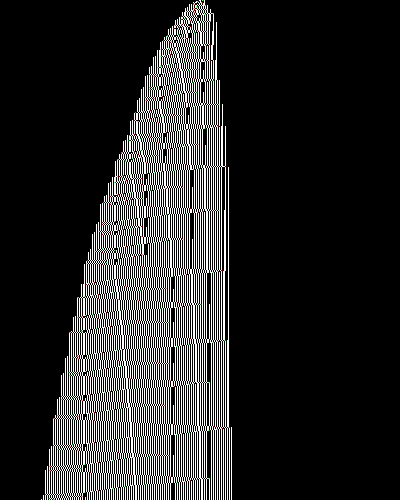
About this picture
The standard picture (bbchallenge.org's Default view): each row is the whole tape at one step, time runs downward, and the head's path draws the pattern.
Waiting on you: R4 and #32 are flagged CRYPTID_CANDIDATE: stop here, or fund a recursive abstract model to follow R4's real orbit, whose top already has the halting residue?
See the question →Overview
Needs you
In one sentence
#32's table, D-start: #11's counter plus nested walls whose fuel drops 1 per lower overflow; no proof idea yet.
- Status
- Cryptid candidateobserving · updated 2026-10-12Waiting on you · R4 and #32 are flagged CRYPTID_CANDIDATE: stop here, or fund a recursive abstract model to follow R4's real orbit, whose top already has the halting residue?idle since Oct 12 23:02 · status.json 2026-10-12
- Class
- Skelet 1-like Class 2ours: sheet Skelet 1-like Class 2 ≠ ours hierarchical binary counter: #33/#11's counter whose u=1 digits freeze into fossil-K walls with decrementing fuel (= #32's table, D-start) · low confidence
- On the list
- line 506 of
BB6_holdouts_663.txt· historical 740 line 561
Your calls on file 6
- priority call (open)
- R4 and #32 are flagged CRYPTID_CANDIDATE: stop here, or fund a recursive abstract model to follow R4's real orbit, whose top already has the halting residue?
- priority call (answered)
- R4 and #32 share one table and one hierarchical-counter mechanism. Invest in a joint #32/R4 recursive invariant, or park both?
- parked
- Stopped by Dennis 2026-10-12 (decision queue: go with recommendations: stop_cryptid): kept as CRYPTID_CANDIDATE, rules written up, no more compute.
- funded
- option: class2_closeout · date: 2026-10-12
- 2026-10-10 · park_both
- R4 and #32 are one table with one open mechanism: a hierarchical counter whose fossil-K walls lose one unit of fuel per lower overflow. Invest in a joint #32/R4 recursive invariant, or park both? (Dennis: go with all recommendations (2026-10-10))
- 2026-10-12 · stop_cryptid
- R4 and #32 are flagged CRYPTID_CANDIDATE (halting decided by fuel residues at nested exhaustions, no invariant): stop here, or fund a recursive abstract model to follow R4's real orbit, whose top already has the halting residue? (Dennis 2026-10-12: 'go with recommendations')
Mechanism
How it works: 3 notes
- Level 1 is #33's / kill #11's binary counter (carry M_k, same formula, 12,350/12,350 exact to 3e8). One cell differs (B1 0RD vs 0RE): a carry reaching a bit-1 digit with u = 1 turns back and does a partial overflow P (#32's rule, exact).
- P leaves misaligned text that acts as a fossil K-block wall (01)^w 000 (01)^x with a slow level-2 counter behind it. Each level-1 overflow lowers the wall gap by exactly 1 (217 at 1.8e7, 179 at 2.8e8, 151 at 2e10); a far wall (gap 52-53) sits at the end. Halting needs A> 111.
- Fuel cut to 9 or 5 in a real config: the wall dissolves, the far wall keeps burning, new walls form with fresh fuel (109, 164); no halt to 2e8. 54 of 12,438 macro steps to 3e8 still have no rule (far-end terminators, the wall's v = 1 shape, Z3 junctions), as for #32.
Figures for Checkpoint A
Each band is half a digit. Compare the bands right of the pinch near row 600 with those above.
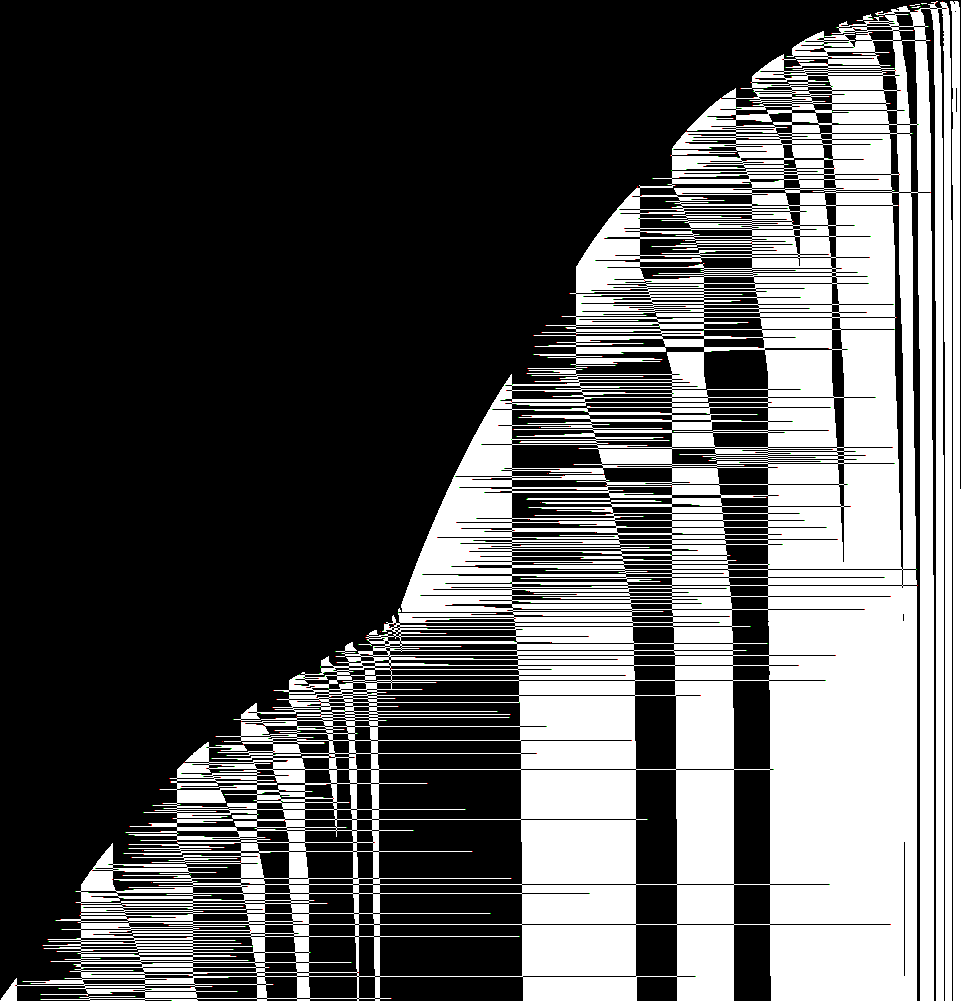
Inner wall: the thin line near x = 640 px. To its right: level-2 digits, then the far end.
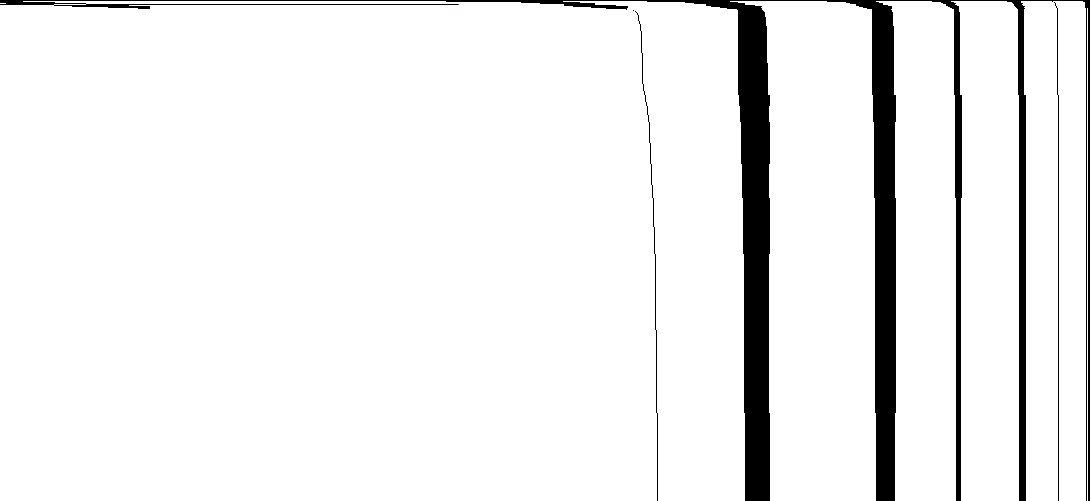
Start K: block, LSB digit (u=1, v=4), bit-0 digit (4,0,3), 1001. Watch where the first rightward sweep turns.

More figures (2)Fig 4–5: First 10,000 steps (site view) · #33 from the same start
The site's own picture, for orientation: the tape grows to the left, the right end barely moves.
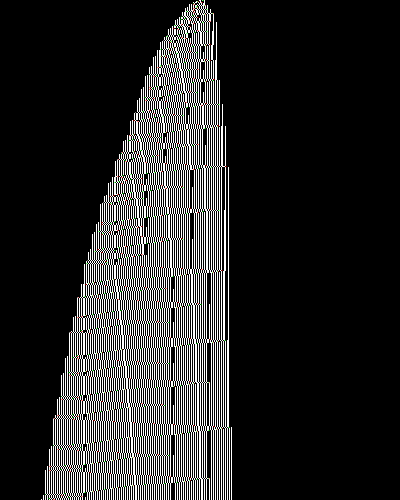
Same start and window as the R4 figure, machine #33 (one cell differs). Compare rows 40-60.

Rules (3/4 validated)exact tape rewrites the proof will formalize, each re-checked by simulation
| rule | from ⟶ to | cases | steps | checked |
|---|---|---|---|---|
| M_k carry (= #33's M_k) | 0∞ <C (01)b 000 (01)a [(10)vj (01)uj]_{j=m..j*+1} (10)v 00 (01)u S ⟶ 0∞ <C (01)b+2 000 (01)a+1 [(10)vj-1 00 (01)uj]_{j=m..j*+1} (10)v-1 (01)u+1 S | needs a >= 1, v >= 1, every trailing digit uj >= 2 and vj >= 1; S never read. v = 1: the digit drops (fuses). 300 random (k = 0..5, sizes to 300) + all 12,350 M steps of the real run to 3e8. Control: one trailing uj = 1 -> formula fails 60/60 | 32+8a+8b+4v+sum_j(8uj+4vj) | ✓12650/12650 |
| P partial overflow at the first u = 1 digit (#32's P, mirrored) | 0∞ <C (01)b 000 (01)a [(10)vi (01)ui]_{i=m..p+1} (10)vp 01 S ⟶ 0∞ <C 01 000 (01)b+3 (10)a (01)vm [(10)u(i+1) 00 (01)vi-1]_{i=m-1..p+1} (10)u(p+1) 00 (01)vp-1 10 S' | k = m-p+1 digits, up = 1, ui >= 2 (i > p), a >= 1, S starts with 1 and S' = S minus that 1; p = m: ... (01)^vm 10 S'. 300 random (k = 1..5) + all 34 P steps of the real run to 3e8 | 77-4k+8a+20b+4*sum_{i>=p}ui+8*sum_{i>=p}vi | ✓334/334 |
| O full overflow (= #33's O), all u >= 2, bare 1001 end | 0∞ <C (01)b 000 (01)a [(10)vj (01)uj]_{j=m..1} 1001 0∞ ⟶ 0∞ <C 01 000 (01)b+3 (10)a (01)vm [(10)uj 00 (01)v(j-1)-1]_{j=m..2} (10)u1 00 1001 0∞ | a >= 1, all uj >= 2. Never fires from blank to 3e8 (the far end is never the bare 1001). Control: one uj = 1 -> fails 200/200 (P happens instead) | 89-4m+8a+20b+4*sum(u)+8*sum(v) | ✓200/200 |
| wall fuel law (empirical, real run only) | reset that ends at the inner wall W(L), shape Z2 0 O2 | O2 0 Z2 | Z3 ⟶ inner wall W'(L-1), next shape in the cycle | all 38 resets from 1.8e7 to 2.84e8 (L 217 -> 179); 2e10 sample L = 151. Not a formula yet; not tested on random instances | — | –untested |
Compressed historythe tape as pre-reset K: 0∞ <C (01)b 000 (01)a [level-1 digits] W1 [level-2 digits] W2 0∞ (W = wall shape + gap) at 40 moments: where the rules are read off
| step | b | a | hi | inner wall W1 | far wall W2 |
|---|---|---|---|---|---|
| 70 | 1 | 3 | 4 | - | - |
| 809 | 5 | 12 | 16 | - | - |
| 2,407 | 1 | 12 | 22 | - | - |
| 8,306 | 13 | 22 | 28 | - | - |
| 15,544 | 13 | 14 | 37 | - | - |
| 40,950 | 37 | 50 | 43 | - | - |
| 61,193 | 29 | 73 | 52 | - | - |
| 97,511 | 13 | 54 | 58 | - | - |
| 207,074 | 61 | 94 | 64 | - | O2 0 Z2 66 |
| 261,200 | 29 | 30 | 67 | - | O2 0 Z2 67 |
| 378,922 | 61 | 94 | 73 | - | Z3 64 |
| 615,221 | 125 | 205 | 76 | - | Z2 0 O2 62 |
| 1,128,940 | 125 | 190 | 76 | - | O2 0 Z2 59 |
| 2,271,498 | 253 | 190 | 76 | - | Z3 58 |
| 4,427,656 | 509 | 382 | 79 | - | Z3 59 |
| 11,159,235 | 509 | 766 | 82 | - | Z2 0 O2 56 |
| 18,115,616 | 885 | 954 | 85 | Z3 218 | Z3 54 |
| 18,388,227 | 29 | 921 | 85 | Z2 0 O2 216 | Z2 0 O2 53 |
| 18,695,766 | 29 | 46 | 85 | O2 0 Z2 213 | Z2 0 O2 53 |
| 19,204,521 | 125 | 126 | 85 | Z2 0 O2 210 | Z2 0 O2 53 |
| 19,804,212 | 61 | 158 | 85 | O2 0 Z2 207 | Z2 0 O2 53 |
| 21,032,655 | 253 | 254 | 85 | Z2 0 O2 204 | Z2 0 O2 53 |
| 23,053,530 | 253 | 382 | 85 | O2 0 Z2 201 | Z2 0 O2 53 |
| 29,254,917 | 509 | 510 | 85 | Z2 0 O2 198 | Z2 0 O2 53 |
| 43,094,560 | 253 | 1,150 | 85 | O2 0 Z2 195 | Z2 0 O2 53 |
| 61,261,763 | 1,021 | 1,022 | 85 | Z2 0 O2 192 | Z2 0 O2 53 |
| 124,890,854 | 1,021 | 2,558 | 85 | O2 0 Z2 189 | Z2 0 O2 53 |
| 181,235,665 | 509 | 510 | 85 | Z2 0 O2 186 | Z2 0 O2 53 |
| 202,004,399 | 253 | 1,150 | 85 | Z2 0 O2 183 | O2 0 Z2 52 |
| 264,408,730 | 2,045 | 1,534 | 85 | Z3 180 | O2 0 Z2 52 |
| 2,000,000,000 | - | - | 85 | O2 0 Z2 166 | O2 0 Z2 52 |
| 4,000,000,000 | - | - | 85 | O2 0 Z2 162 | O2 0 Z2 52 |
| 6,000,000,000 | - | - | 85 | O2 0 Z2 158 | O2 0 Z2 52 |
| 8,000,000,000 | - | - | 85 | Z2 0 O2 157 | O2 0 Z2 52 |
| 10,000,000,000 | - | - | 85 | O2 0 Z2 156 | O2 0 Z2 52 |
| 12,000,000,000 | - | - | 85 | Z2 0 O2 155 | O2 0 Z2 52 |
| 14,000,000,000 | - | - | 85 | O2 0 Z2 152 | O2 0 Z2 52 |
| 16,000,000,000 | - | - | 88 | Z3 153 | Z3 53 |
| 18,000,000,000 | - | - | 88 | O2 0 Z2 151 | Z3 53 |
| 20,000,000,000 | - | - | 88 | Z3 151 | Z3 53 |
blast -alast -hilast 88inner wall W1last Z3 151far wall W2last Z3 53Template comparisonour: partly applies · the nearest solved proof, what carries over, and the transitions that differ
| 0 | 1 | |
|---|---|---|
| A | 1RB | 0RE |
| B | 1LC | 0RD |
| C | 1LD | 0LD |
| D | 1RA | 0LC |
| E | 1RA | 1RF |
| F | 1RA | --- |
differs from the template
- file
- —
- module
our kill #11 (machines/1RB0LE_1RC0RC_1LD0RB_1LA0LE_1LD1LF_1LD---/, check_kill PASS); same table as pool #32 (OPEN)- machine
1RB0LE_1RC0RC_1LD0RB_1LA0LE_1LD1LF_1LD---(9 transitions apart)- diff
1 transition after mirror + renaming (#11's A,B,C,D,E,F = R4's B,C,D,A,E,F): #11 A1 0LE vs 0LC here (= R4's B1 0RE vs 0RD). With that change the table is exactly #32's; R4 starts in #32's D- note
- M and O carry over verbatim when every digit has u >= 2. #11's INV does not survive: u = 1 digits appear right away (O's new MSB digit (0,0,u1) flips to u = 1), P replaces O, and the fossil walls are outside #11's family. #32 hit the same wall (notes there). SBCv6 TM21 / TCv3 are loose relatives only.
Proof strategy & riskshow the formal proof will go · 3 risks to watch
Joint with #32 (same table). Model one level as K-block + digits + fossil K-block, get exact rules for the 3 open event types and the fuel law, then find a recursive invariant (each level a counter whose wall fuel is refilled when a new wall forms). Constructed small-fuel runs first.
- ▲Recursive structure: walls form, burn fuel and dissolve; a proof needs a multi-level invariant, which is far beyond a delta of #11.
- ▲54 of 12,438 macro steps (3 event types) have no rule yet; #32 hit the same ones.
- ▲The long-run regime is unobservable: inner-wall fuel 151 at 2e10, burning at slowing rate.
Stats & provenance2·1010 steps simulated · 87,460 cells · the status in full · files
- simulated
- 2·1010 steps
- tape
- 87,460 cells · 43,726 nonzeros
- growth
- left edge ~2.8 t^0.5 at 1e9 (-87,374), -398,788 at 2e10; right edge 85 from 1.8e7 to 1.4e10, 88 after the level-2 overflow (~1.5e10). cells/nonzeros are at 1e9
- status now
- Class 2 close-out stage 3 of 3 (2026-10-12), joint with #32 (write-up in #32's notes.md): flagged CRYPTID_CANDIDATE, proof work stops. Halting is decided by modular conditions on fuel values at a hierarchy of exhaustions. A regime-I top halts exactly when its fuel N runs out at N = 2 (mod 5) (N = 0..44 from #32's I(N,360): only 2, 7, 12, 17, 22 halt by 1e80). A lower digit that runs out first switches that outcome irregularly (N = 12: 14 of 24 small u1 values halt, 10 do not; N = 11, 13: 0 of 50). Wide-integer simulator c2s3_tsim.c (validated byte for byte against stage 2 to 1e37): R4 no halt to 1e80, first 40 defects frozen from 4.8e17 to 1e80; its top cycle started at N = 27 = 2 (mod 5) and waits behind deep levels. No invariant. Heuristic (random residues) leans to an astronomically late halt, not non-halting. decision.json: stop_cryptid (recommended) / recursive_model / formalize_rules. Stage-2 re-run (2026-10-12): replay of an already-run stage, no new proof work (cryptid protocol, decision pending). Kept simulators reproduce R4's stage-3 dump to 1e80 byte for byte (no halt). New probe on #32's base (same table): the second lower digit also switches the halting outcome, non-monotonically; N = 11/13 0 of 42 halts. Still CRYPTID_CANDIDATE; decision.json unchanged. (status.json, 2026-10-12)
- observer's note
- Mechanism partly understood (M, P, O validated; nested fossil-K walls observed); 54/12,438 macro steps to 3e8 uncovered and no non-halting argument. Confidence low: waits on Dennis's priority call.
- files
- observe.json · notes.md · status.json
Proof & checks
No proof work yet.
Files
machines/<tm>/: 10 entries · raw notes, status, scripts, images
| name | size | changed |
|---|---|---|
| notes.md ↓ | 17 KB | 2026-10-12 21:04 |
| status.json ↓ | 2.0 KB | 2026-10-12 23:02 |
| observe.json ↓ | 14 KB | 2026-10-10 10:36 |
| decisions/ | 2 items | 2026-10-12 23:02 |
| img/ | 6 items | 2026-10-10 10:30 |
| scripts/ | 21 items | 2026-10-10 10:36 |
| qsim.err ↓ | 0 B | 2026-10-10 10:00 |
| qsim.jsonl ↓ | 6.3 KB | 2026-10-10 10:00 |
| sim_1e9.err ↓ | 0 B | 2026-10-10 10:00 |
| sim_records_1e9.jsonl ↓ | 8.4 MB | 2026-10-10 10:00 |
status.json in full
{
 "tm": "1RB0RE_1LC0RD_1LD0LD_1RA0LC_1RA1RF_1RA---",
 "status": "CRYPTID_CANDIDATE",
 "stage": "observe",
 "updated": "2026-10-12",
 "reason": "Class 2 close-out stage 3 of 3 (2026-10-12), joint with #32 (write-up in #32's notes.md): flagged CRYPTID_CANDIDATE, proof work stops. Halting is decided by modular conditions on fuel values at a hierarchy of exhaustions. A regime-I top halts exactly when its fuel N runs out at N = 2 (mod 5) (N = 0..44 from #32's I(N,360): only 2, 7, 12, 17, 22 halt by 1e80). A lower digit that runs out first switches that outcome irregularly (N = 12: 14 of 24 small u1 values halt, 10 do not; N = 11, 13: 0 of 50). Wide-integer simulator c2s3_tsim.c (validated byte for byte against stage 2 to 1e37): R4 no halt to 1e80, first 40 defects frozen from 4.8e17 to 1e80; its top cycle started at N = 27 = 2 (mod 5) and waits behind deep levels. No invariant. Heuristic (random residues) leans to an astronomically late halt, not non-halting. decision.json: stop_cryptid (recommended) / recursive_model / formalize_rules. Stage-2 re-run (2026-10-12): replay of an already-run stage, no new proof work (cryptid protocol, decision pending). Kept simulators reproduce R4's stage-3 dump to 1e80 byte for byte (no halt). New probe on #32's base (same table): the second lower digit also switches the halting outcome, non-monotonically; N = 11/13 0 of 42 halts. Still CRYPTID_CANDIDATE; decision.json unchanged.",
 "priority_call_answered": "R4 and #32 share one table and one hierarchical-counter mechanism. Invest in a joint #32/R4 recursive invariant, or park both?",
 "funded": {
  "option": "class2_closeout",
  "date": "2026-10-12"
 },
 "confidence": "med",
 "priority_call": "R4 and #32 are flagged CRYPTID_CANDIDATE: stop here, or fund a recursive abstract model to follow R4's real orbit, whose top already has the halting residue?",
 "parked": "Stopped by Dennis 2026-10-12 (decision queue: go with recommendations: stop_cryptid): kept as CRYPTID_CANDIDATE, rules written up, no more compute."
}1 contract warning
- rank: not an int