tools/rebuild_pages.sh rebuilds the site within 5 minutes of a change; by hand: python3 -B tools/site.py.1RB0LC_1RC0RC_1LD0RB_1LA0LE_1LD1LF_1LD---
Where it stands
Cryptid candidate, parked at the informal proof
Class 2 close-out stage 3 of 3 (2026-10-12): flagged CRYPTID_CANDIDATE together with R4 (same table), proof work stops. New wide-integer simulator scripts/c2s3_tsim.c (2048-bit steps, 512-bit counts; JCAP=40 reproduces stage 2 byte for byte to 1e37, and every earlier halting step count). #32: no halt to 1e80, first 40 defects frozen from 5.8e14 to 1e80.
Read the full status
N cuts from I(N,360), N = 0..44, to 1e80: exactly N = 2, 7, 12, 17, 22 halt; N >= 23 freeze because the first lower digit (u = 48) runs out in cycle 5. Cutting that digit's u1 too: N = 12 halts for 14 of 24 small u1 and not for 10 (u1 = 1 mod 3 tends to halt, with exceptions); N = 17: 7 of 25; N = 11, 13: 0 of 50. So halting is a residue condition at every level of an unbounded 2-adic/5-adic hierarchy; no invariant. Decision in R4's decision.json (stop_cryptid recommended). Earlier: rule G + sweep case analysis (proof.md), check_proof.py 12/12. Stage-2 re-run (2026-10-12): the workflow re-issued stage 2 after the track had already ended at stage 3; no new proof work (cryptid protocol, decision pending). The kept simulators reproduce the stage-2 and stage-3 dumps byte for byte (1e37, 1e80) and the cut halts (N = 2: 202,227,190). New probe (scripts/c2s2r_mkcut3.py): the second lower digit u2 also switches the outcome (N = 12: a fixed halt for u2 >= 40 moves or disappears once u2 runs out; u1 = 11 halts at u2 = 47..98 and 5 but not 13..40); N = 11/13: 0 of 42 halts. Still CRYPTID_CANDIDATE.
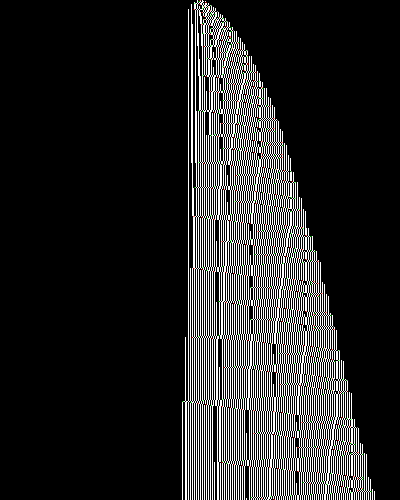
About this picture
The standard picture (bbchallenge.org's Default view): each row is the whole tape at one step, time runs downward, and the head's path draws the pattern.
Overview
Needs you
1RB0RE_1LC0RD_1LD0LD_1RA0LC_1RA1RF_1RA--- R4In one sentence
neighbour of #11: one transition away; its run differs (90,039 vs 77,685 cells at 1e9) (status.json relation)
- Status
- Cryptid candidateinformal proof · updated 2026-10-12Parked · Class 2 close-out stage 3 of 3 (2026-10-12): flagged CRYPTID_CANDIDATE together with R4 (same table), proof work stops.idle since Oct 12 23:02 · status.json 2026-10-12
- Informal proof
- proof.mdconditional; see Proof for what is still open
- Class
- Skelet 1-like Class 2
- On the list
- line 336 of
BB6_holdouts_663.txt· historical 740 line 372 - Derived from
1RB0LE_#11 Kill claimed1RC0RC_ 1LD0RB_ 1LA0LE_ 1LD1LF_ 1LD---
Your calls on file 3
- priority call (answered)
- Shared with R4: invest in a joint #32/R4 multi-level invariant (proof.md 5 route), or park both?
- parked
- Stopped by Dennis 2026-10-12 (decision queue: go with recommendations: stop_cryptid): kept as CRYPTID_CANDIDATE, rules written up, no more compute. (decision filed on R4, same table.)
- funded
- option: class2_closeout · date: 2026-10-12
Mechanism
Figures
Every 10 steps from a built counter tape. Dotted diagonals are head sweeps; compare how deep each one goes.
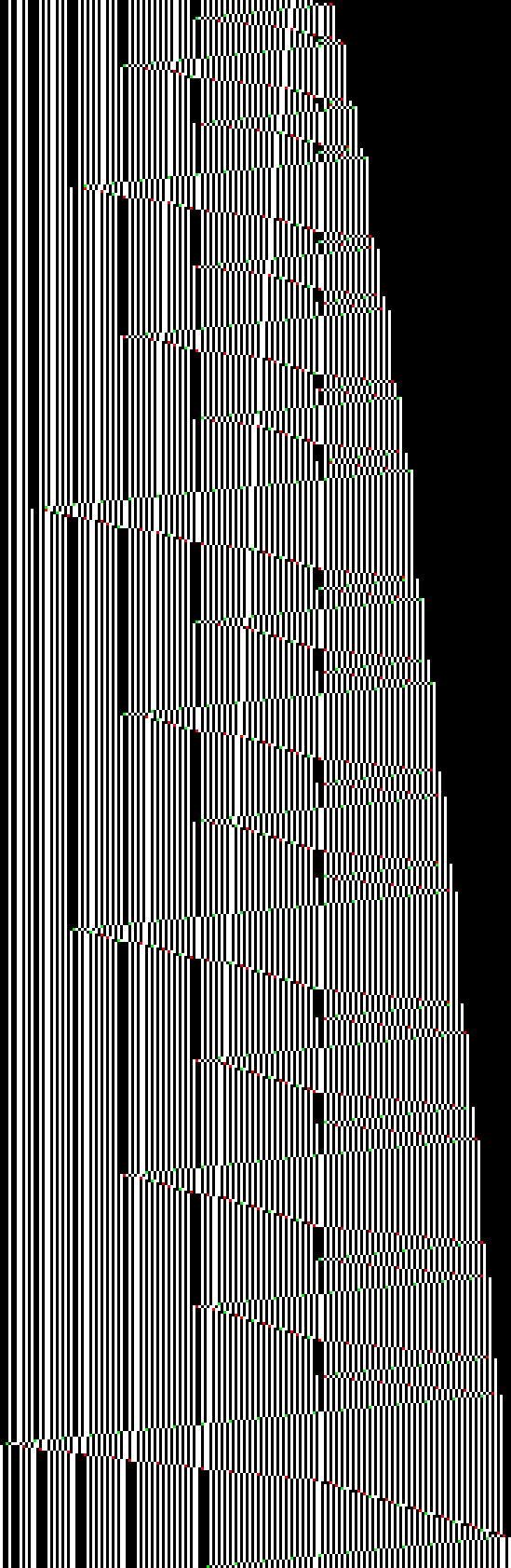
Edge records to 300,000 steps. Look at the dashed vertical walls and each band break (left edge steps out).
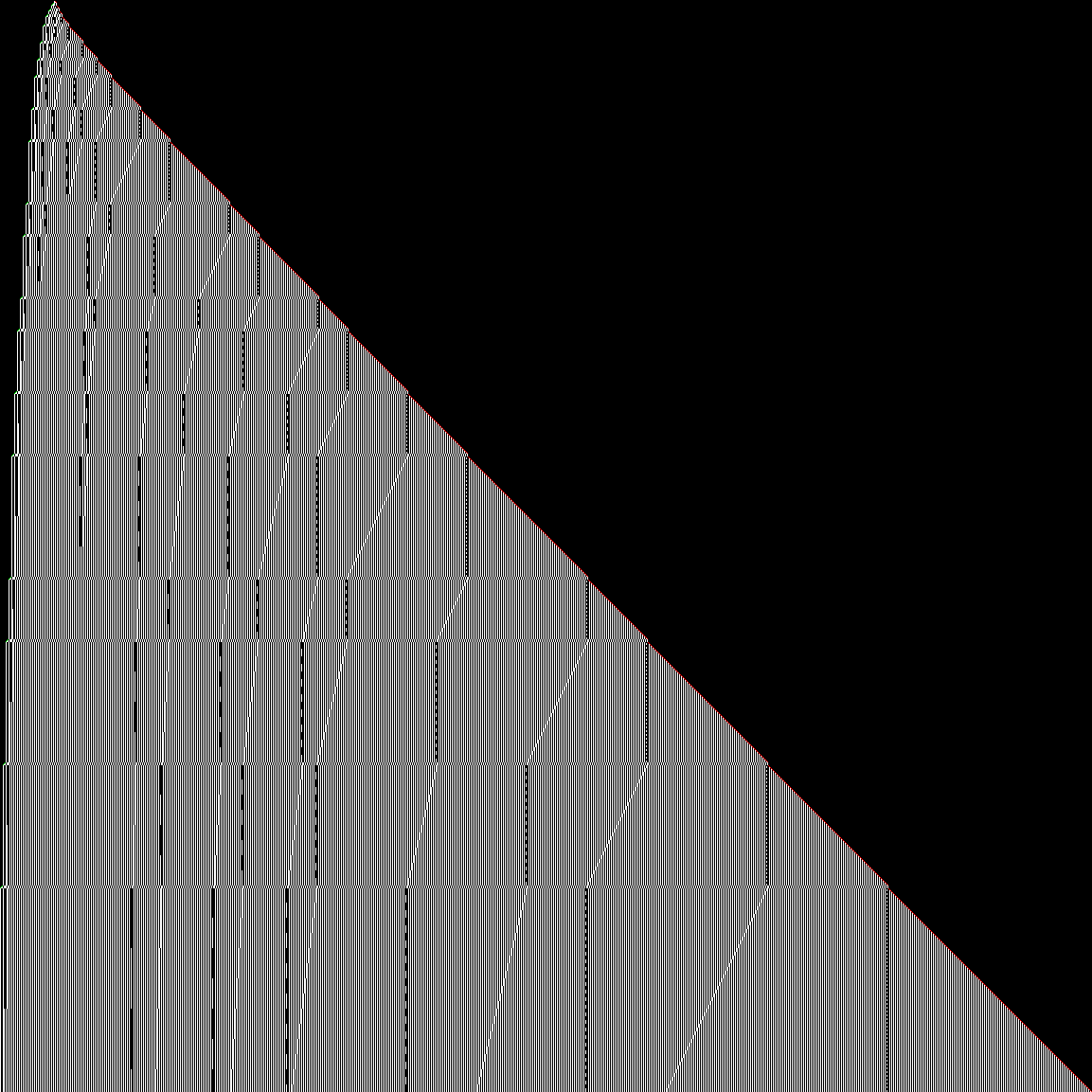
The same view to 5.1M steps. Compare its walls and band breaks with Fig 2.
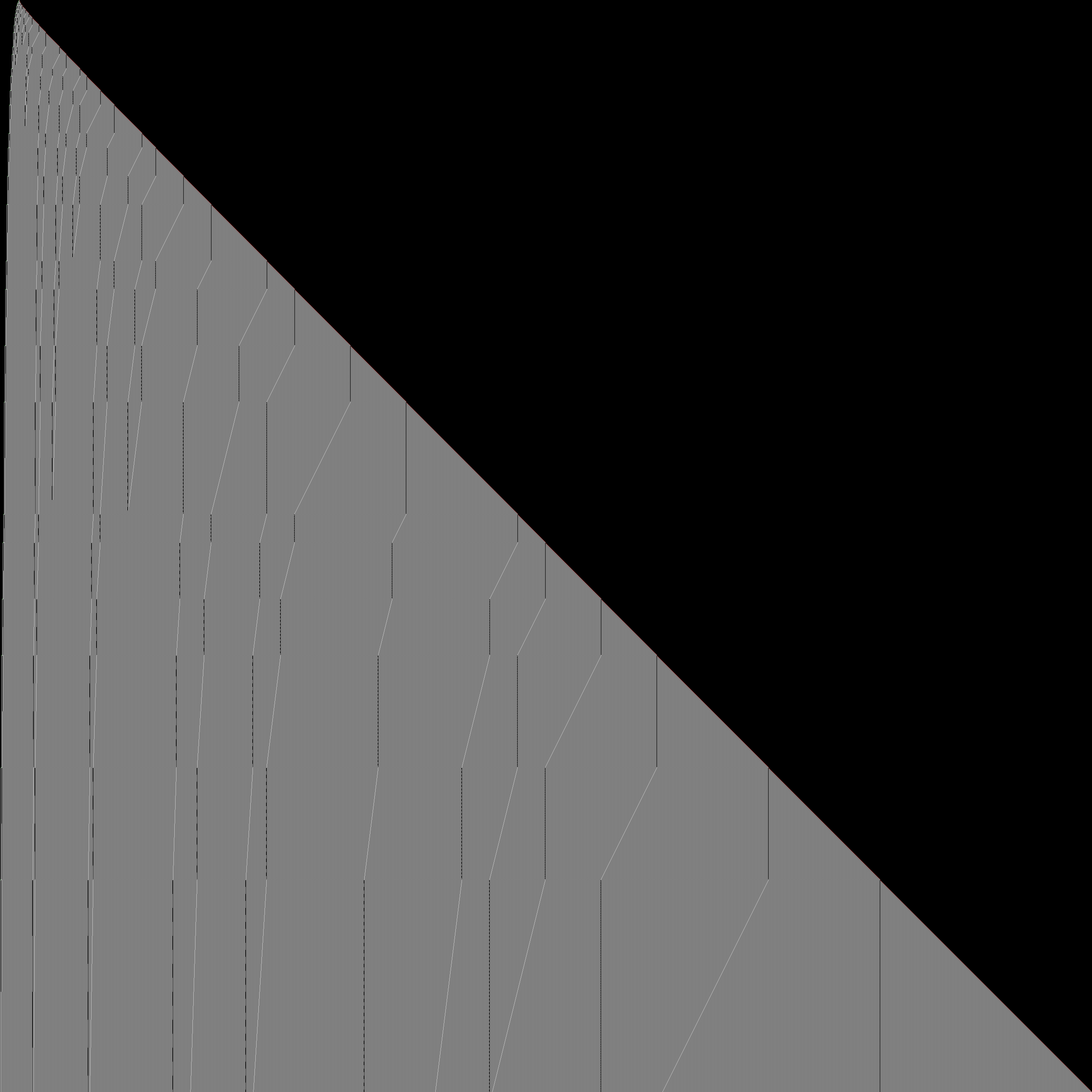
More figures (2)Fig 4–5: bbchallenge Default view, first 10,000 steps · Blaze view, 10 million steps
For orientation: the start of the run as bbchallenge.org shows it.
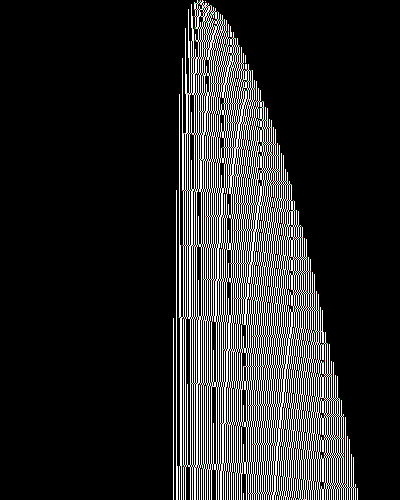
The right edge grows like the square root of time; the faint vertical lines are digit walls.

Rules (5/5 validated)exact tape rewrites the proof will formalize, each re-checked by simulation
| rule | from ⟶ to | cases | steps | checked |
|---|---|---|---|---|
| M_k carry (k = trailing 1-bits) | l (10)u_k 02 (01)v_k [(10)u_i (01)v_i]_{i=k-1..0} (10)a 03 (10)b B> 0∞ ⟶ l (10)u_k+1 (01)v_k-1 [(10)u_i 02 (01)v_i-1]_{i=k-1..0} (10)a+1 03 (10)b+2 B> 0∞ | k=0..5 tested; needs v_i>=1 (i<=k), u_i>=1 (i<k), u_k>=0, a>=1, b>=0; v=1 gives a fused (merged) digit | 32 + 8a + 8b + 8*sum_{i<k} u_i + 4*sum_{i<=k} v_i | ✓84/84 |
| O overflow (all bits 1) | 0∞ 10 01 [(10)u_i (01)v_i]_{i=1..n} (10)a 03 (10)b B> 0∞ ⟶ 0∞ 10 01 00 (01)u_1 [(10)v_i-1 02 (01)u_(i+1)]_{i=1..n-1} (10)v_n (01)a (10)b+3 03 10 B> 0∞ | n=1..7 tested; needs v_i>=1 (i<n); left edge moves 3 cells; counter restarts at 1 | 89 - 4n + 8a + 20b + 4*sum u_i + 8*sum v_i | ✓118/118 |
| init (blank tape to first K) | 0∞ A> 0∞ ⟶ 0∞ 10 01 (10)3 01 (10)2 03 10 B> 0∞ | twins: start B -> K((1,2);2,1) in 122 steps; start C -> K((1,1);2,1) in 101 steps | 142 | ✓1/1 |
| B sweep right | B> (01)n ⟶ (10)n B> | — | 2n | ✓10/10 |
| D sweep left | (01)n <D ⟶ <D (10)n | — | 2n | ✓10/10 |
Compressed historythe tape as 0∞ 10 01 [(10)u_i (01)v_i]_{i=1..n} (10)a 03 (10)b B> 0∞ at 40 moments: where the rules are read off
| step | n | u_1..u_n | v_1..v_n | a | b |
|---|---|---|---|---|---|
| 148,244 | 4 | 67,313,163 | 1,412,848 | 62 | 61 |
| 196,569 | 5 | 115,151,563 | 6,628,244,832 | 94 | 61 |
| 323,918 | 4 | 68,319,463 | 1,283,232 | 126 | 125 |
| 398,427 | 5 | 113,113,947 | 6,728,874,896 | 158 | 61 |
| 561,920 | 5 | 69,319,463,127 | 104,241,696 | 126 | 125 |
| 755,701 | 6 | 11,173,131,127 | 682,887,489,664 | 190 | 125 |
| 1,267,210 | 4 | 70,125,190,127 | 8,166,464 | 254 | 253 |
| 1,406,407 | 5 | 19,197,179 | 6.91·1013 | 286 | 61 |
| 1,659,148 | 5 | 7.11·1013 | 6,125,648,224 | 126 | 125 |
| 1,917,105 | 6 | 17,156,363,255 | 7.01·1015 | 190 | 125 |
| 2,517,862 | 6 | 7.21·1016 | 48,483,219,264 | 254 | 253 |
| 3,255,155 | 7 | 1.51·1013 | 7.11·1018 | 382 | 253 |
| 5,250,968 | 6 | 7.31·1016 | 244,016,160,128 | 510 | 509 |
| 6,469,645 | 7 | 1.37·1012 | 7.21·1019 | 638 | 253 |
| 9,142,178 | 4 | 389,382,382,511 | 3,212,864,384 | 510 | 509 |
| 9,463,015 | 5 | 13,313,171,399 | 3.88·1014 | 542 | 61 |
| 9,966,524 | 5 | 3.9·1014 | 3.01·1012 | 126 | 125 |
| 10,405,097 | 6 | 1.31·1013 | 3.89·1016 | 190 | 125 |
| 11,256,622 | 6 | 3.91·1017 | 2.81·1014 | 254 | 253 |
| 12,174,531 | 7 | 1.29·1016 | 3.9·1019 | 382 | 253 |
| 14,421,112 | 6 | 3.92·1017 | 2.61·1015 | 510 | 509 |
| 15,820,405 | 7 | 1.27·1016 | 3.91·1020 | 638 | 253 |
| 18,743,706 | 7 | 3.93·1020 | 2.41·1017 | 510 | 509 |
| 22,061,823 | 8 | 1.25·1019 | 3.92·1023 | 766 | 509 |
| 30,571,412 | 7 | 3.94·1020 | 2.21·1018 | 1,022 | 1,021 |
| 35,551,585 | 8 | 1.23·1019 | 3.93·1023 | 1,278 | 509 |
| 46,376,294 | 8 | 3.95·1024 | 2.01·1021 | 1,022 | 1,021 |
| 59,038,875 | 9 | 1.21·1023 | 3.94·1026 | 1,534 | 1,021 |
| 92,220,944 | 8 | 3.96·1025 | 1.81·1020 | 2,046 | 2,045 |
| 111,528,109 | 9 | 1.19·1022 | 3.95·1028 | 2,558 | 1,021 |
| 153,971,602 | 8 | 3.97·1026 | 1.69·1021 | 2,046 | 2,045 |
| 176,217,463 | 9 | 1.17·1022 | 3.96·1029 | 2,558 | 1,021 |
| 222,615,948 | 9 | 3.98·1030 | 1.49·1025 | 2,046 | 2,045 |
| 275,605,721 | 10 | 1.15·1026 | 3.97·1033 | 3,070 | 2,045 |
| 411,458,142 | 8 | 3.99·1027 | 1.28·1024 | 4,094 | 4,093 |
| 447,518,227 | 9 | 1.13·1025 | 3.98·1031 | 4,606 | 1,021 |
| 513,030,920 | 9 | 4·1031 | 1.08·1025 | 2,046 | 2,045 |
| 579,826,725 | 10 | 1.11·1029 | 3.99·1035 | 3,070 | 2,045 |
| 734,793,354 | 10 | 4.01·1035 | 8.8·1028 | 4,094 | 4,093 |
| 924,601,615 | 11 | 1.98·1029 | 4·1039 | 6,142 | 4,093 |
nlast 11u_1..u_nlast 1.98·1029v_1..v_nlast 4·1039alast 6,142blast 4,093Template comparisonSBCv6.v TM21: partly applies · the nearest solved proof, what carries over, and the transitions that differ
| 0 | 1 | |
|---|---|---|
| A | 1RB | 0LE |
| B | 1RC | 0RC |
| C | 1LD | 0RB |
| D | 1LA | 0LE |
| E | 1LD | 1LF |
| F | 1LD | --- |
- file
SBCv6.v:3702- module
TM21- machine
1RB1LB_0LC1RD_0RA1LC_0RB1RE_0RD0LF_---1LE(11 transitions apart)- diff
10 of 12 transitions differ under the best renaming/mirror (Sk1like_TC_v2 TM1: 9 of 12)- note
- Same architecture (LIncs = carries, Ov = re-pairing overflow, BigStep), but TM21's S' configs never recur here (0 real hits in 2e5 steps, all 6 states). Its LWF invariant fails: here digits run out and merge.
1Same machine as #11?
What to check here: whether this machine is its parent's table under a renaming, and whether its run follows the parent's (computed from the two machine strings).
status.json names #11 as the parent (1RB0LE_1RC0RC_1LD0RB_1LA0LE_1LD1LF_1LD---); relation: “neighbour of #11: one transition away; its run differs (90,039 vs 77,685 cells at 1e9)”. Everything below is computed from the two machine strings, not read from notes.
✗ Not the same table. No renaming of #11's states, with or without mirroring, gives this machine's table. Closest: A→A, B→B, C→C, D→D, E→E, F→F (#11's state → this machine's), no mirror, where 1 of 12 transitions differ:
- #11's A1 =
0LEpredicts this machine's A1 =0LE; it is0LC.
Under that map: This machine starts in #11's state A, the same start as #11.
| #11 | #11's row (read 0, read 1) | σ | predicted row: renamed by σ | this machine's actual row | ||
|---|---|---|---|---|---|---|
| A | 1RB 0LE | → A | 1RB 0LE | 1RB 0LC | ✗ | start of #11start of this machine |
| B | 1RC 0RC | → B | 1RC 0RC | 1RC 0RC | ✓ | |
| C | 1LD 0RB | → C | 1LD 0RB | 1LD 0RB | ✓ | |
| D | 1LA 0LE | → D | 1LA 0LE | 1LA 0LE | ✓ | |
| E | 1LD 1LF | → E | 1LD 1LF | 1LD 1LF | ✓ | |
| F | 1LD --- | → F | 1LD --- | 1LD --- | ✓ |
Rows aligned by σ: each of #11's states X sits next to this machine's state σ(X). ✓ = the actual row equals #11's row with every target state renamed by σ; --- (halt) must stay ---. Searched: all 720 renamings × with/without mirror.
Same view, same settings on both sides. Look for the same band structure: the tables differ in 1 transition(s) (listed above).
The macro behaviour, identical settings on both sides: each picture is its machine's own visited span stretched to 800 px, so compare the shape and order of the bands, not their absolute width. Speed mode samples one cell per column, so a one-cell shift can swap orange and white inside a band; compare band edges, not colours.
Trajectory numbers not computed yet: run python3 -B tools/killreview.py 1RB0LC_1RC0RC_1LD0RB_1LA0LE_1LD1LF_1LD--- (about 10 s; cached in img/vs-parent.json).
Proof & checks
- proof.md · the informal proof
- check_proof.py · the numeric checks of proof.md
Files
machines/<tm>/: 6 entries · raw notes, status, scripts, images
| name | size | changed |
|---|---|---|
| notes.md ↓ | 41 KB | 2026-10-12 21:04 |
| proof.md ↓ | 33 KB | 2026-10-10 12:45 |
| status.json ↓ | 2.3 KB | 2026-10-12 23:02 |
| img/ | 4 items | 2026-10-10 06:10 |
| scripts/ | 29 items | 2026-10-12 21:04 |
| check_proof.py ↓ | 41 KB | 2026-10-10 12:40 |
status.json in full
{
 "tm": "1RB0LC_1RC0RC_1LD0RB_1LA0LE_1LD1LF_1LD---",
 "status": "CRYPTID_CANDIDATE",
 "stage": "informal_proof",
 "updated": "2026-10-12",
 "reason": "Class 2 close-out stage 3 of 3 (2026-10-12): flagged CRYPTID_CANDIDATE together with R4 (same table), proof work stops. New wide-integer simulator scripts/c2s3_tsim.c (2048-bit steps, 512-bit counts; JCAP=40 reproduces stage 2 byte for byte to 1e37, and every earlier halting step count). #32: no halt to 1e80, first 40 defects frozen from 5.8e14 to 1e80. N cuts from I(N,360), N = 0..44, to 1e80: exactly N = 2, 7, 12, 17, 22 halt; N >= 23 freeze because the first lower digit (u = 48) runs out in cycle 5. Cutting that digit's u1 too: N = 12 halts for 14 of 24 small u1 and not for 10 (u1 = 1 mod 3 tends to halt, with exceptions); N = 17: 7 of 25; N = 11, 13: 0 of 50. So halting is a residue condition at every level of an unbounded 2-adic/5-adic hierarchy; no invariant. Decision in R4's decision.json (stop_cryptid recommended). Earlier: rule G + sweep case analysis (proof.md), check_proof.py 12/12. Stage-2 re-run (2026-10-12): the workflow re-issued stage 2 after the track had already ended at stage 3; no new proof work (cryptid protocol, decision pending). The kept simulators reproduce the stage-2 and stage-3 dumps byte for byte (1e37, 1e80) and the cut halts (N = 2: 202,227,190). New probe (scripts/c2s2r_mkcut3.py): the second lower digit u2 also switches the outcome (N = 12: a fixed halt for u2 >= 40 moves or disappears once u2 runs out; u1 = 11 halts at u2 = 47..98 and 5 but not 13..40); N = 11/13: 0 of 42 halts. Still CRYPTID_CANDIDATE.",
 "note": "check_proof.py 12/12 PASS (default seed 79 s; --seed 2026 --n 1000 --quick 52 s). Unclaimed. Same open problem as R4 (mirror, D-start).",
 "priority_call_answered": "Shared with R4: invest in a joint #32/R4 multi-level invariant (proof.md 5 route), or park both?",
 "parent": "1RB0LE_1RC0RC_1LD0RB_1LA0LE_1LD1LF_1LD---",
 "relation": "neighbour of #11: one transition away; its run differs (90,039 vs 77,685 cells at 1e9)",
 "funded": {
  "option": "class2_closeout",
  "date": "2026-10-12"
 },
 "confidence": "med",
 "parked": "Stopped by Dennis 2026-10-12 (decision queue: go with recommendations: stop_cryptid): kept as CRYPTID_CANDIDATE, rules written up, no more compute. (decision filed on R4, same table.)"
}