tools/rebuild_pages.sh rebuilds the site within 5 minutes of a change; by hand: python3 -B tools/site.py.1RB0LF_1RC0LB_1RD1RB_1RE1RF_1LA---_0RC1LA
Where it stands
Parked at the deeper analysis
Parked after the funded inv_search stage (2026-10-11), as its exit rule says. Covers holdouts 469 (start A) and 599 (start D).
Read the full status
No inductive invariant found. Precise obstruction: splice the closed-block stacks of two reachable E-events at a common window, keeping one's head and window, and the TM halts. This happens for windows of 1-4 exact blocks, 1-5 when both stacks are spliced, and 1-7 with blocks read as exact below 8, else mod 4. 45/45 halting splices were confirmed by direct simulation (halts at steps 2,595-279,060); right-side splices never halt (0/560). So no product n-gram/CPS invariant with such windows exists, under any value abstraction; all 173 macro-level closure settings fail accordingly. The defect surfaces 47-6,628 macro steps after the head reaches the splice. A global parity GP (0 at all 6e6 sampled E-events) explains 24/45 halting splices; the rest need more global information. TM-level CTL: 300 settings false. The mechanism is still exact: macro model 34.5M/34.5M E-events, no halt to 1e11. Resume only with coupled left/right automata, a non-regular invariant, or a compiled closure with exact windows of 6+ on both sides.
About this picture
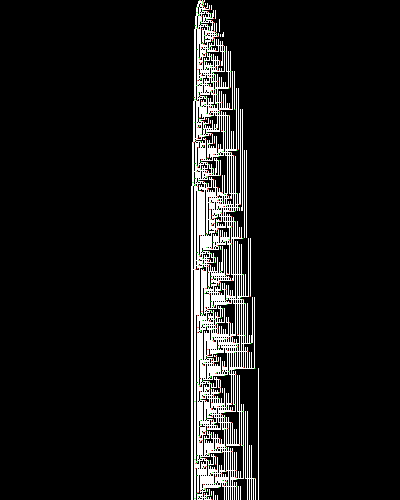
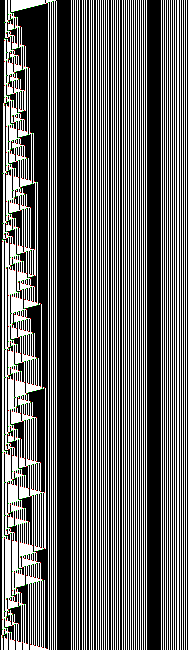
The standard picture (bbchallenge.org's Default view): each row is the whole tape at one step, time runs downward, and the head's path draws the pattern.
Overview
In one sentence
Blocks left of the head, pairs right of it; exact macro rules; halting needs an even zero run; parity holds, proof open.
- Status
- Parkedinv search · updated 2026-10-11Not blocking · Stuck at the inv search stage. Answer Q1–Q3 whenever; a “no” redirects the work.idle since Oct 11 09:06 · status.json 2026-10-11
- Class
- Counter Class 2ours: sheet Counter Class 2 ≠ ours two-zone block/pair shuffler (chaotic two-stack list machine), not a counter · med confidence
- On the list
- line 426 of
BB6_holdouts_663.txt· historical 740 line 469 · observe.json rank #469
Your calls on file 3
- priority call (answered)
- Fund one ~2 h stage to search for an inductive context invariant over the macro model (covers 469 and 599), or park both?
- funded
- option: inv_search · date: 2026-10-11
- 2026-10-11 · inv_search
- W4-5 (469) and its same-table sibling 599 have an exact macro model where halting needs one parity defect: fund one ~2 h stage to search for an inductive context invariant, or park both? (Dennis: go with recommendations (2026-10-11))
Mechanism
How it works: 3 notes
- Two zones split at the head: left = 1-blocks split by single 0s, right = (10)-pairs split by zero runs (plus a rare lone 1). A/F sweeps left turn a block into pairs; B/C passes right turn pairs into blocks. E-event K(L; a; r; R) =
L 1^a E> 0^r R. - Exact rules (12,000/12,000 random, all 34.5M E-events from blank to 1e9): even a -> Ee eats the last two closed blocks y, b:
K(L; y+3; b+1; (10)^(a/2) 0^(r-2) R). Odd a -> Eo closes a block 2, then a C-pass turns pairs into blocks until a run 0^n, n >= 3 (a = x+2, r = n-2) or a lone 1 (a = y+3, r = x+1). The block list is shuffled chaotically. - Halting needs a C-pass to meet exactly 0^2. Closed blocks stay even and zero runs odd (1.7M E-events to 5e7), and every rule keeps this, but only under side conditions (no lone pair before a run; a = 2 only at the edge) that are not yet shown inductive.
Figures for Checkpoint A
The site's own picture. The head zigzags inside the tape; the right edge advances in small steps.
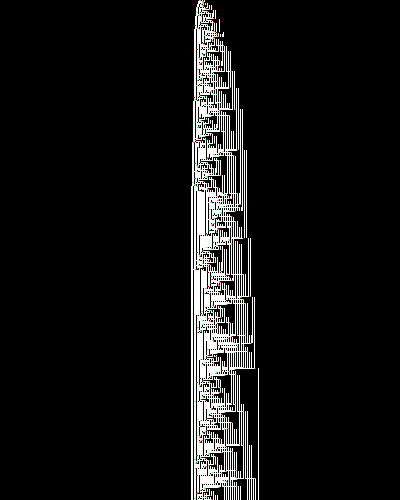
Left of the zigzag: solid 1-blocks. Right: fine (10) stripes and black zero runs. Compare both sides of each turn.

Each row is one E-event of the model. Follow the red head: rows drifting left, then jumps right.

More figures (3)Fig 4–6: Records view to 2e9 · Long run to 1e9 (sampled) · Spliced block stack halts at step 2,595
At records the tape is all 1-blocks; black dots are the single-0 separators. Compare neighbouring rows.
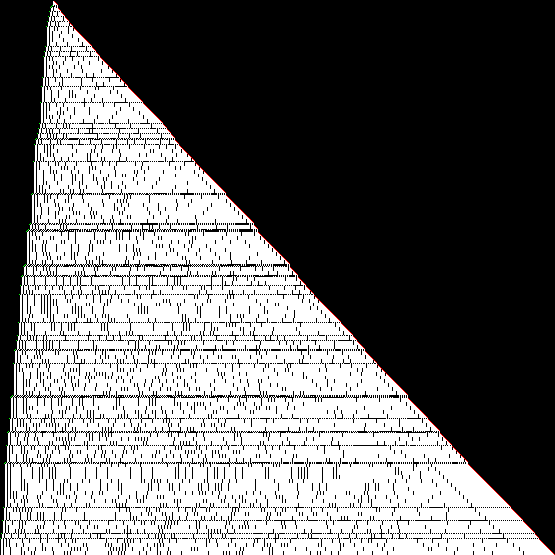
Speckle = tape caught mid-conversion between block and pair form. The span grows slowly.
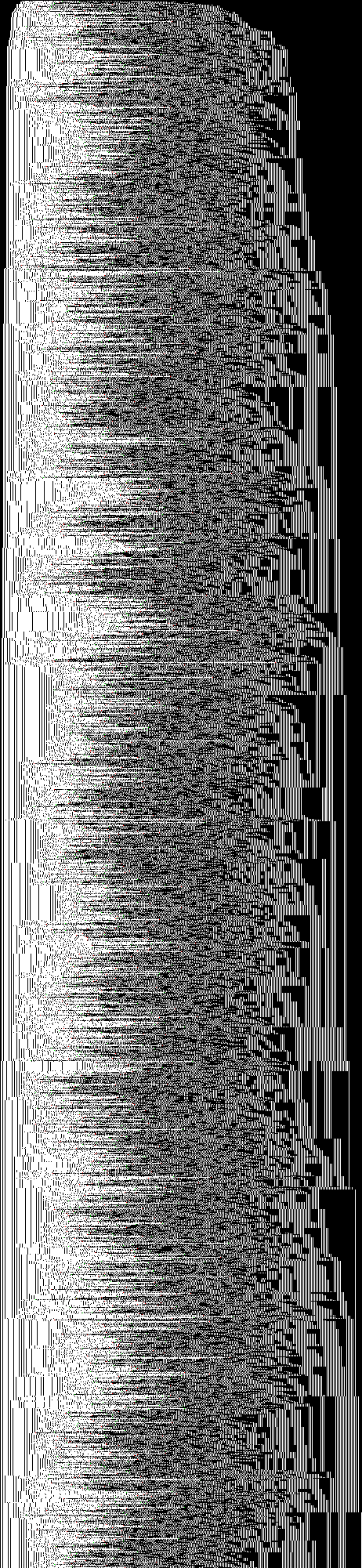
Both halves occur on the real run; the bottom row is the halt. Compare the left zigzag with Fig 2.
Rules (6/6 validated)exact tape rewrites the proof will formalize, each re-checked by simulation
| rule | from ⟶ to | cases | steps | checked |
|---|---|---|---|---|
| Ee (even head block, a = 2k) | L 1y 0 1b 0 12k E> 0r R ⟶ L 1y+3 E> 0b+1 (10)k 0r-2 R | k >= 1, r >= 3. r = 1: tail (10)^(k-1) 1 R (creates a lone 1). r = inf: tail (10)^k 0^inf. Missing y, b count as 0 (left edge: a' = 3, r' = 1, tape grows left by 1). | a + b + 7 | ✓6398/6398 |
| Eo (odd head block, a = 2k+1) | L 12k+1 E> 0r R ⟶ L 12 0 C> (10)k 0r-2 R (then the C-pass) | r = 1: L 1^2 0 C> (10)^(k-1) 1 R. r = inf: L 1^2 0 C> (10)^k 0^inf. | a + 4 + C-pass | ✓5289/5289 |
| C1-C2 (C-pass over pairs) | 1x C> (10)j Q | 1x C> 0 (10)j Q ⟶ 1x+2j C> Q | 1x+2 0 12j-2 C> Q | C2 closes the block x+2 at a single 0; needs j >= 1 after it (always so). | 2j | 2j + 1 | ✓5289/5289 |
| C3 (C-pass meets 0^n, n >= 3 or inf) | L 1x C> 0n Q ⟶ K(L; x+2; n-2; Q) = L 1x+2 E> 0n-2 Q | n = 3 gives r = 1; n = inf is the right edge (right record, +4 cells). | 2 | ✓4364/4364 |
| C4 (C-pass meets a lone 1) | L 1y 0 1x C> 1 (10)j Q ⟶ L 1y+3 E> 0x+1 (10)j-1 Q | A zero run at the front of (10)^(j-1) Q merges into r. A missing y counts as 0. | x + 5 | ✓925/925 |
| H (halting pattern) | 1x C> 0 0 1 ⟶ halt: C, D write 1, E reads 1 | The only way E reads 1. It needs an even zero run of length 2 after a pair, which INV excludes. | 3 | ✓313/313 |
Compressed historythe tape as right-edge E-events (r = inf, R empty): 0∞ 1b1 0 1b2 0 ... 0 1bp 0 1a E> 0∞ at 40 moments: where the rules are read off
| step | p (closed blocks) | a (head block) | span (cells) | closed blocks = 0 mod 4 |
|---|---|---|---|---|
| 4 | 0 | 4 | 5 | 0 |
| 195 | 3 | 4 | 21 | 1 |
| 912 | 4 | 10 | 34 | 1 |
| 2,182 | 5 | 8 | 51 | 1 |
| 5,934 | 7 | 4 | 65 | 1 |
| 15,754 | 8 | 2 | 82 | 1 |
| 28,563 | 8 | 16 | 94 | 0 |
| 41,765 | 9 | 16 | 111 | 1 |
| 64,855 | 9 | 14 | 123 | 0 |
| 190,061 | 14 | 8 | 144 | 2 |
| 279,077 | 15 | 2 | 157 | 0 |
| 437,383 | 16 | 2 | 174 | 1 |
| 581,748 | 15 | 10 | 185 | 0 |
| 1,034,022 | 17 | 6 | 203 | 0 |
| 1,481,322 | 17 | 6 | 215 | 0 |
| 2,339,126 | 19 | 6 | 229 | 0 |
| 2,748,634 | 22 | 4 | 248 | 0 |
| 3,370,370 | 22 | 4 | 260 | 0 |
| 7,378,184 | 27 | 4 | 281 | 1 |
| 10,589,382 | 28 | 2 | 294 | 1 |
| 17,823,345 | 28 | 10 | 310 | 1 |
| 19,332,473 | 28 | 10 | 322 | 1 |
| 23,873,217 | 30 | 6 | 340 | 1 |
| 29,338,813 | 33 | 6 | 355 | 2 |
| 58,601,289 | 34 | 2 | 372 | 1 |
| 123,457,390 | 33 | 10 | 383 | 0 |
| 172,853,682 | 36 | 10 | 402 | 1 |
| 184,161,220 | 36 | 8 | 414 | 0 |
| 246,727,084 | 37 | 8 | 427 | 1 |
| 676,875,382 | 39 | 4 | 445 | 1 |
| 890,627,926 | 40 | 2 | 458 | 1 |
| 1,341,079,131 | 41 | 38 | 475 | 0 |
| 1,347,364,851 | 41 | 38 | 487 | 0 |
| 1,356,744,367 | 41 | 38 | 503 | 0 |
| 1,363,195,717 | 42 | 38 | 516 | 1 |
| 1,539,011,869 | 43 | 34 | 533 | 0 |
| 1,605,475,733 | 45 | 32 | 547 | 1 |
| 2,290,941,963 | 47 | 30 | 565 | 0 |
| 2,738,645,111 | 51 | 30 | 581 | 2 |
| 3,561,025,639 | 52 | 24 | 598 | 0 |
p (closed blocks)last 52a (head block)last 24span (cells)last 598closed blocks = 0 mod 4last 0Template comparisonCounterClass2v1.v: does not apply · the nearest solved proof, what carries over, and the transitions that differ
| 0 | 1 | |
|---|---|---|
| A | 1RB | 0LF |
| B | 1RC | 0LB |
| C | 1RD | 1RB |
| D | 1RE | 1RF |
| E | 1LA | --- |
| F | 0RC | 1LA |
differs from the template
- file
CounterClass2v1.v- module
- —
- machine
1RB1RD_1LC---_1LE0LD_0RE1LC_1RA1RF_1RE0LF(11 transitions apart)- diff
1 transition: our A0 = 1RB, template (in our names) A0 = 1LC; v2-v4 have 0LB there (v4 also E0 = 1LD)- note
- All four proved neighbours differ exactly at A0, the turn that starts rule Ee. v1 is a deterministic counter on a fixed skeleton (SkelE n, Bnext on (n, j, b), ClosedCall, GoodB). Here the block list is a shuffled stack, so only the top-level shape (progress_nonhalt_cond + an invariant) carries over.
Proof strategy & riskshow the formal proof will go · 3 risks to watch
Find an inductive invariant over the validated macro model: closed blocks even, runs odd, plus local context conditions. Search it mechanically (regular/bigram closure over abstract tokens, or a TM-level CTL certificate). Then write rules Ee/Eo/C1-C4 as es/ind lemmas and close with progress_nonhalt_cond; one proof would cover 469 and 599 (start D).
- ▲The context conditions may not be local: simple versions fail random closure (~2% of steps), and 'r = 1 implies next group >= 3 pairs' fails on the real run at step 2,403,364.
- ▲Chaotic list dynamics: if no small invariant closes, a CTL certificate may be large; 85 small RWL_mod/NG settings returned false.
- ▲No template help: the proved neighbours differ exactly in the slot that drives rule Ee.
Stats & provenance1011 steps simulated · 779 cells · the status in full · files
- simulated
- 1011 steps
- tape
- 779 cells · 349 nonzeros
- growth
- span 462 at 1e9, 779 at 1e11 (about t^0.23); +4 cells per right record
- status now
- Parked after the funded inv_search stage (2026-10-11), as its exit rule says. Covers holdouts 469 (start A) and 599 (start D). No inductive invariant found. Precise obstruction: splice the closed-block stacks of two reachable E-events at a common window, keeping one's head and window, and the TM halts. This happens for windows of 1-4 exact blocks, 1-5 when both stacks are spliced, and 1-7 with blocks read as exact below 8, else mod 4. 45/45 halting splices were confirmed by direct simulation (halts at steps 2,595-279,060); right-side splices never halt (0/560). So no product n-gram/CPS invariant with such windows exists, under any value abstraction; all 173 macro-level closure settings fail accordingly. The defect surfaces 47-6,628 macro steps after the head reaches the splice. A global parity GP (0 at all 6e6 sampled E-events) explains 24/45 halting splices; the rest need more global information. TM-level CTL: 300 settings false. The mechanism is still exact: macro model 34.5M/34.5M E-events, no halt to 1e11. Resume only with coupled left/right automata, a non-regular invariant, or a compiled closure with exact windows of 6+ on both sides. (status.json, 2026-10-11)
- observer's note
- Observe done at med confidence: exact macro model (34.5M/34.5M E-events from blank to 1e9, 12,000 random), halting reduced to one parity pattern; inductive invariant open.
- files
- observe.json · notes.md · status.json
Proof & checks
No proof work yet.
Files
machines/<tm>/: 7 entries · raw notes, status, scripts, images
| name | size | changed |
|---|---|---|
| notes.md ↓ | 15 KB | 2026-10-11 09:06 |
| status.json ↓ | 1.9 KB | 2026-10-11 09:06 |
| observe.json ↓ | 13 KB | 2026-10-11 09:00 |
| deepen.json ↓ | 7.2 KB | 2026-10-11 09:06 |
| decisions/ | 1 item | 2026-10-11 09:03 |
| img/ | 6 items | 2026-10-11 08:55 |
| scripts/ | 27 items | 2026-10-11 08:53 |
status.json in full
{
 "tm": "1RB0LF_1RC0LB_1RD1RB_1RE1RF_1LA---_0RC1LA",
 "label": "W4-5",
 "status": "STUCK",
 "stage": "inv_search",
 "updated": "2026-10-11",
 "confidence": "med",
 "reason": "Parked after the funded inv_search stage (2026-10-11), as its exit rule says. Covers holdouts 469 (start A) and 599 (start D). No inductive invariant found. Precise obstruction: splice the closed-block stacks of two reachable E-events at a common window, keeping one's head and window, and the TM halts. This happens for windows of 1-4 exact blocks, 1-5 when both stacks are spliced, and 1-7 with blocks read as exact below 8, else mod 4. 45/45 halting splices were confirmed by direct simulation (halts at steps 2,595-279,060); right-side splices never halt (0/560). So no product n-gram/CPS invariant with such windows exists, under any value abstraction; all 173 macro-level closure settings fail accordingly. The defect surfaces 47-6,628 macro steps after the head reaches the splice. A global parity GP (0 at all 6e6 sampled E-events) explains 24/45 halting splices; the rest need more global information. TM-level CTL: 300 settings false. The mechanism is still exact: macro model 34.5M/34.5M E-events, no halt to 1e11. Resume only with coupled left/right automata, a non-regular invariant, or a compiled closure with exact windows of 6+ on both sides.",
 "relation": "one table, two holdout starts: A = 469 (this), D = 599",
 "siblings": [
  "1RB1RD_1LC---_1RF0LD_0RE1LC_1RA1RF_1RE0LF"
 ],
 "holdout_line_740": 469,
 "existing_work": "none found: sheet Results row is class Counter Class 2 only (no status/notes/done-by); Direct Simulation tab lists it as not simulated to 1e14/1e15; no Discord hit; upstream has only the Eqv_v3 TM540 / Eqv_v2 TM359 equivalences to other unproved tables.",
 "priority_call_answered": "Fund one ~2 h stage to search for an inductive context invariant over the macro model (covers 469 and 599), or park both?",
 "funded": {
  "option": "inv_search",
  "date": "2026-10-11"
 }
}1 contract warning
- diagrams: 6 (want 3-5)