tools/rebuild_pages.sh rebuilds the site within 5 minutes of a change; by hand: python3 -B tools/site.py.1RB0LD_0RC---_0RD0RF_1LE0LA_1LF1LE_1RA0RD
Where it stands
Cryptid candidate, parked at the observation
Observe done (about 1 h 45 min). A glider runs between two 8-cell fields (11010100 left, 11110001 right): 32 steps per block going right, 36 going left (GR, GL, 200/200 each).
Read the full status
It bounces between a wall and the right end (+2 cells per bounce) in two phases. Phase S: the wall moves right 18 cells per bounce and leaves an 18-cell wake piece (S1, exact, 68b+388 steps; 200/200 random, 830/830 real bounces). Phase G: the wake, rewritten into 72-cell units, is turned back into field, 18 blocks per unit per 36 bounces (G36, exact, 2448b+26828 steps; 150/150 random, 86/86 real). So the field at each S start follows b' = 9b/4 + c: b mod 8 picks the S->G branch (b mod 2 the G alignment), and c (-14..+42 over 9 cycles to 1.3e12) comes from the junk edge, which every G->S transition digs into and rewrites (its counters ran 6->0 and 17->7; left edge -52 -> -111 after 1e10). That is pseudo-random arithmetic driving a chaotic edge, so the cryptid protocol applies: rules formalized in observe.json, flagged, stopped. No halting branch known: halting needs C> 1001; no halt to 4.2e13 (exact accelerated simulator, tape-identical to direct at 1.2e8, 1e9, 3e9).
About this picture
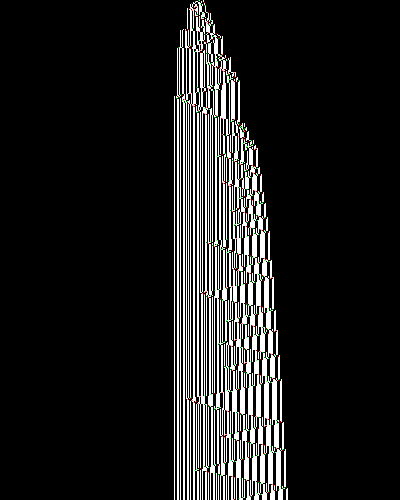
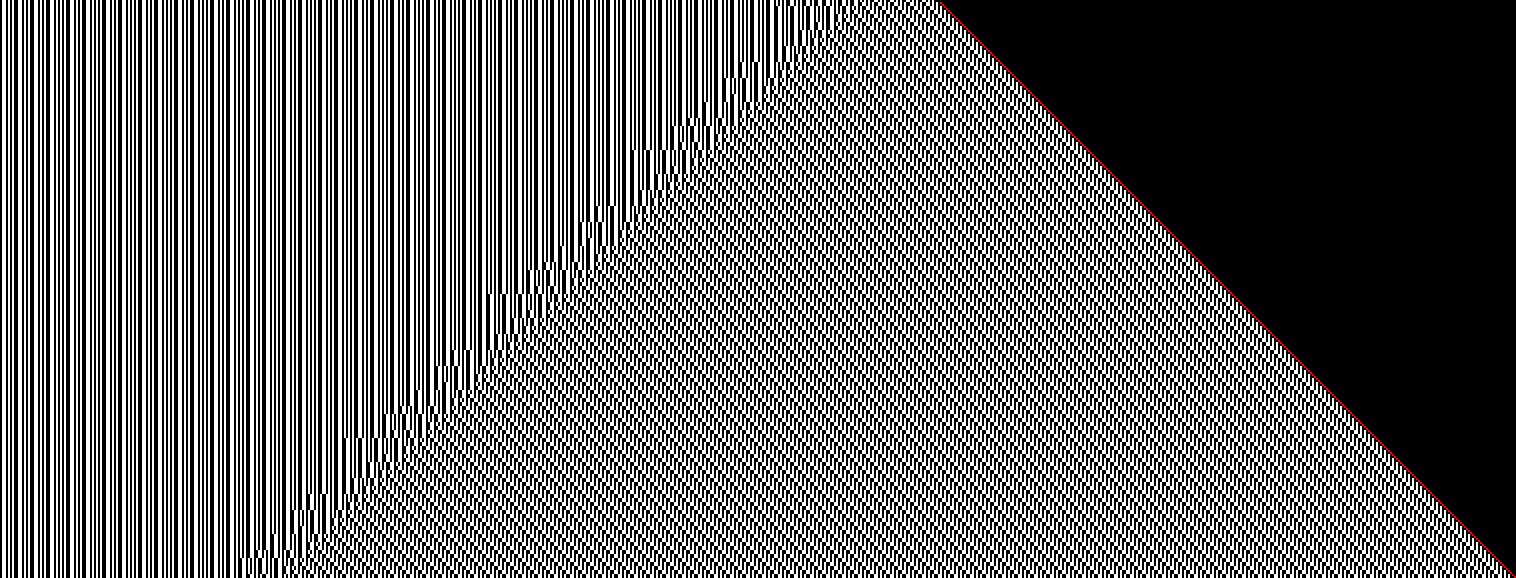
The standard picture (bbchallenge.org's Default view): each row is the whole tape at one step, time runs downward, and the head's path draws the pattern.
Overview
In one sentence
Glider bounces between two 8-cell fields; field grows x9/4 per cycle; a chaotic junk edge sets the remainder
- Status
- Cryptid candidateobserving · updated 2026-10-14Parked · Observe done (about 1 h 45 min). The 3 open questions are optional.idle since Oct 14 16:43 (44 h ago) · status.json 2026-10-14
- Class
- Unknownours: sheet Unknown ≠ ours Chaotic Bell (bouncer type): glider between two 8-cell fields, x9/4 cycles, chaotic junk edge on the left · med confidence
- On the list
- line 201 of
BB6_holdouts_663.txt· historical 740 line 221 · observe.json rank #221
Your calls on file 3
- priority call (answered)
- Cryptid-like: b' = 9b/4 + c with an 8-way remainder split and a junk-dependent c; no halting branch known. Park it, or fund one 2 h stage for an exact cycle accelerator (GR/GL/S1/G36 + measured transitions) and a census of junk shapes for closure?
- parked
- Dennis 2026-10-14: park
- 2026-10-14 · park
- W6-6 looks cryptid-like (b' = 9b/4 + c with an 8-way remainder split): park it, or fund one 2 h stage?
Mechanism
How it works: 3 notes
- Two fields of 8-cell blocks, W = 11010100 left of the head and R = 11110001 right of it. The head is a glider between them: moving right it turns R into W (32 steps per block, GR), moving left W into R (36 steps per block, GL). It bounces between a wall on the left and the tape end, which grows 2 cells per bounce.
- Phase S: the wall moves right 18 cells per bounce, leaving an 18-cell wake piece Y (rule S1, exact, 830/830 real bounces). Then one sweep rewrites the wake into 72-cell units V. Phase G: the wall moves back left one unit per 36 bounces while the field gains 18 blocks per unit (rule G36, exact, 86/86 real periods). So the field at the next S start is b' = 9b/4 + c.
- The remainder b mod 8 picks the S->G branch (b mod 2 picks the G alignment) and c (-14..+42 seen) comes from the junk left of the wake, which each G->S transition digs into and rewrites: counters inside it are eaten (6,4,3,1,0, then 17,14,12,10,9,7) and the left edge moved from -52 to -111 after 1e10. Halting needs C> 1001; no halt to 4.2e13 (exact accelerated run).
Figures for Checkpoint A
The standard site picture: a block field whose right edge grows in steps.
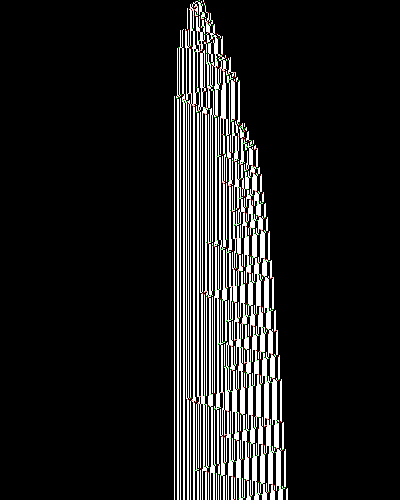
Vertical stripes: frozen wake and junk. Flat rows: the 8-cell fields. Follow the boundary between them down the picture.
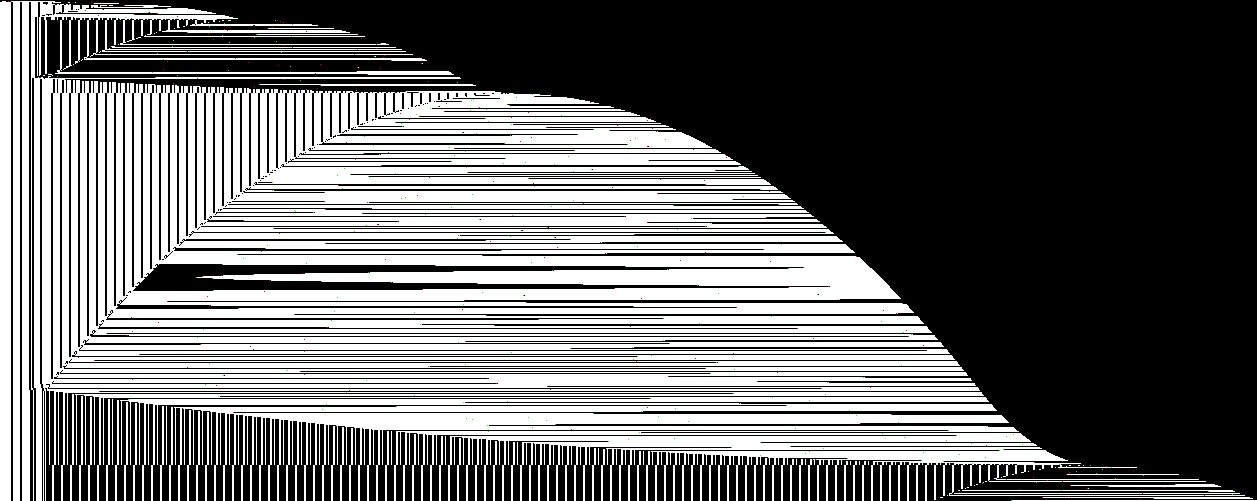
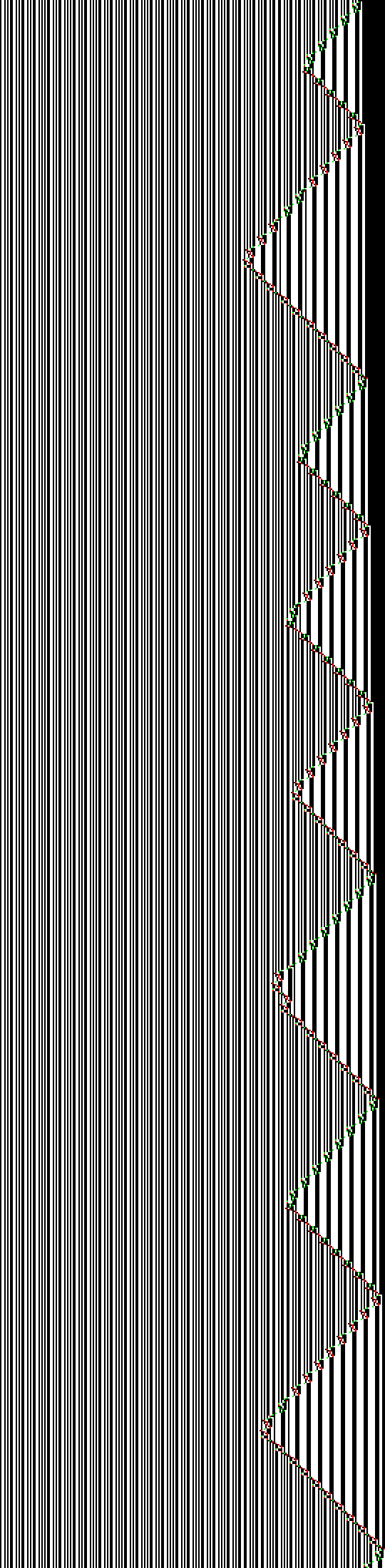
Green zigzags: the glider going left; red diagonals: going right. Compare where each left turn lands.
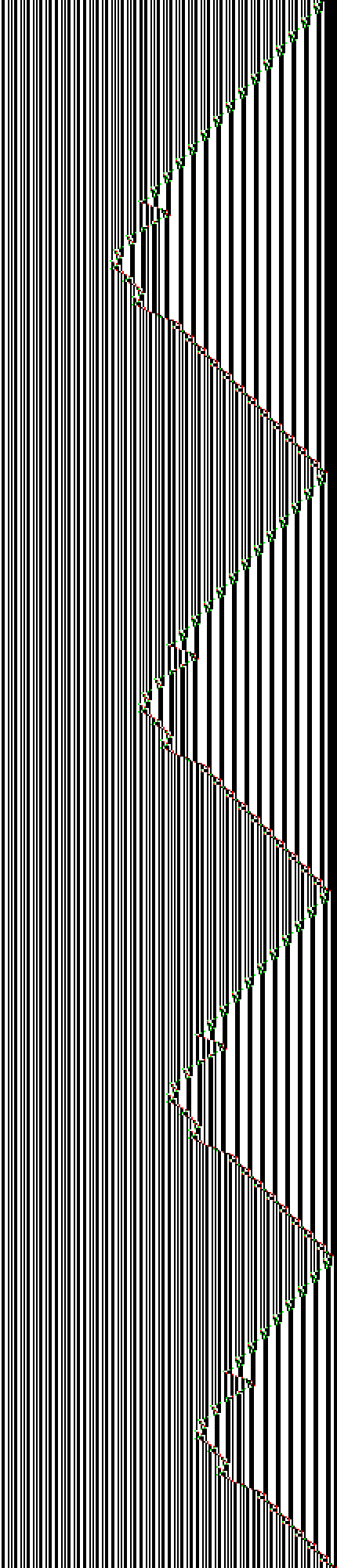
More figures (2)Fig 4–5: Phase G: four unit periods · Phase G close-up: probe bounces
Left: wake units (vertical stripes). Right: the field, whose stripes slant because it is anchored to the growing right end.
Left turns alternate between shallow and deep: the deep ones are the probes into the next unit.
Rules (5/6 validated)exact tape rewrites the proof will formalize, each re-checked by simulation
| rule | from ⟶ to | cases | steps | checked |
|---|---|---|---|---|
| GR (glider right) | (11010100)m+1 100 D> 00 (11111000)n+k 11 0∞ ⟶ (11010100)m+k+1 100 D> 00 (11111000)n 11 0∞ | m, n, k >= 0; left context never read | 32k | ✓200/200 |
| GL (glider left) | 1 (11010100)m+k <E (11110001)n 1 0∞ ⟶ 1 (11010100)m <E (11110001)n+k 1 0∞ | m, n, k >= 0 | 36k | ✓200/200 |
| S1 (one phase-S bounce) | l 0110 (10101001)2 (100)2 (11010100)b+2 D> 0∞ ⟶ l 011001101010011010 0110 (10101001)2 (100)2 (11010100)b D> 0∞ | b >= 0; wall +18 cells, edge +2; plus 830/830 real bounces to 1.2e8 | 68b+388 | ✓200/200 |
| S4 (four S bounces, = qsim's rule) | l 0110 (10101001)2 (100)2 (11010100)b+8 D> 0∞ ⟶ l (011001101010011010)4 0110 (10101001)2 (100)2 (11010100)b D> 0∞ | b >= 0 | 272b+2368 | ✓200/200 |
| G36 (one phase-G unit, 36 bounces) | l ((10011010)2 (10100110)2 (10101001)2 (10)4 (01101010)2)a+1 (10011010)2 (0110)2 (101001)2 (10)4 0 (11010100)b D> 0∞ ⟶ l ((10011010)2 (10100110)2 (10101001)2 (10)4 (01101010)2)a (10011010)2 (0110)2 (101001)2 (10)4 0 (11010100)b+18 D> 0∞ | a, b >= 0; alignment of even-b cycles; plus 86/86 real periods to 1.2e8 | 2448b+26828 | ✓150/150 |
| Cycle law (observed) | l 0110 (10101001)2 (100)2 (11010100)b D> 0∞ (S start) ⟶ l' 0110 (10101001)2 (100)2 (11010100)9b/4 + c D> 0∞ (next S start) | b mod 8 picks the S->G branch; c = -14..+42 depends on the junk l, which is rewritten (l -> l'); 9 cycles to 1.3e12 fit | — | –untested |
Compressed historythe tape as phase-S start: l 0110 (10101001)2 (100)2 (11010100)b D> 0∞ (l = junk, lo = left edge) at 9 moments: where the rules are read off
| step | b (field blocks at S start) | b mod 8 | lo (left edge) |
|---|---|---|---|
| 3,311,129 | 173 | 5 | -52 |
| 15,667,118 | 408 | 0 | -52 |
| 78,104,903 | 928 | 0 | -52 |
| 395,843,382 | 2,104 | 0 | -52 |
| 2,007,488,939 | 4,720 | 0 | -52 |
| 10,081,940,898 | 10,630 | 6 | -52 |
| 51,081,997,453 | 23,959 | 7 | -78 |
| 258,741,221,346 | 53,939 | 3 | -91 |
| 1.31·1012 | 121,394 | 2 | -104 |
b (field blocks at S start)last 121,394b mod 8last 2lo (left edge)last -104Template comparisontemplate: does not apply · the nearest solved proof, what carries over, and the transitions that differ
| 0 | 1 | |
|---|---|---|
| A | 1RB | 0LD |
| B | 0RC | --- |
| C | 0RD | 0RF |
| D | 1LE | 0LA |
| E | 1LF | 1LE |
| F | 1RA | 0RD |
- file
- —
- module
- —
- machine
1RB---_1LC0LA_1LD0LC_1RE0LB_1RF0RE_1LC0RD(10 transitions apart)- diff
7 transitions (nearest proved table, W4-3c); nothing within 5- note
- W4-3c (our kill) is a base-3 odometer of flaws in a 0101 stripe; its visit lemmas share nothing with the glider/bounce rules here beyond the picture of defects in a periodic background. Upstream has this table only in Eqv_v2.v TM2413 (an equivalence with our start E), no proof.
Proof strategy & riskshow the formal proof will go · 3 risks to watch
Not a proof yet. Next: an exact cycle accelerator (GR, GL, S1, G36 plus measured S->G branches by b mod 8 and direct runs of G->S) to follow 100+ cycles and census the junk shapes. If they close up (finitely many shapes up to counters), write the branch table and an invariant; otherwise park as a cryptid.
- ▲The junk edge is rewritten every cycle by a branch chosen by b mod 8 under b' = 9b/4 + c: pseudo-random input, so the junk shapes may never close up.
- ▲Two counters in the junk were eaten down (6 to 0, then 17 to 7); when the second runs out, around 1e14-1e16, the regime may change.
- ▲The odd-b G alignment and the S->G and G->S transitions are observed only, not written as rules.
Stats & provenance4.2·1013 steps simulated · 6,215,534 cells · the status in full · files
- simulated
- 4.2·1013 steps
- tape
- 6,215,534 cells
- growth
- right edge ~ sqrt(t); field x9/4 per cycle, cycle time about x5; direct C run to 1e9 (span -52..30411, 16,609 ones), exact accelerated run to 4.2e13 (span -111..6,215,422)
- status now
- Observe done (about 1 h 45 min). A glider runs between two 8-cell fields (11010100 left, 11110001 right): 32 steps per block going right, 36 going left (GR, GL, 200/200 each). It bounces between a wall and the right end (+2 cells per bounce) in two phases. Phase S: the wall moves right 18 cells per bounce and leaves an 18-cell wake piece (S1, exact, 68b+388 steps; 200/200 random, 830/830 real bounces). Phase G: the wake, rewritten into 72-cell units, is turned back into field, 18 blocks per unit per 36 bounces (G36, exact, 2448b+26828 steps; 150/150 random, 86/86 real). So the field at each S start follows b' = 9b/4 + c: b mod 8 picks the S->G branch (b mod 2 the G alignment), and c (-14..+42 over 9 cycles to 1.3e12) comes from the junk edge, which every G->S transition digs into and rewrites (its counters ran 6->0 and 17->7; left edge -52 -> -111 after 1e10). That is pseudo-random arithmetic driving a chaotic edge, so the cryptid protocol applies: rules formalized in observe.json, flagged, stopped. No halting branch known: halting needs C> 1001; no halt to 4.2e13 (exact accelerated simulator, tape-identical to direct at 1.2e8, 1e9, 3e9). (status.json, 2026-10-14)
- observer's note
- Mechanism found and the phase rules are exact (GR, GL, S1, G36 validated on random and real instances), but the cycle law b' = 9b/4 + c branches on b mod 8 and on a junk edge that each cycle rewrites; cryptid protocol: rules formalized, flagged, stopped. No halting branch known (halting needs C> 1001).
- files
- observe.json · notes.md · status.json
Proof & checks
No proof work yet.
Files
machines/<tm>/: 7 entries · raw notes, status, scripts, images
| name | size | changed |
|---|---|---|
| notes.md ↓ | 8.1 KB | 2026-10-14 14:59 |
| status.json ↓ | 2.4 KB | 2026-10-14 16:43 |
| observe.json ↓ | 11 KB | 2026-10-14 15:00 |
| decisions/ | 1 item | 2026-10-14 16:43 |
| img/ | 6 items | 2026-10-14 14:51 |
| scripts/ | 22 items | 2026-10-14 14:55 |
| work/ | 8 items | 2026-10-14 14:57 |
status.json in full
{
 "tm": "1RB0LD_0RC---_0RD0RF_1LE0LA_1LF1LE_1RA0RD",
 "label": "W6-6",
 "status": "CRYPTID_CANDIDATE",
 "stage": "observe",
 "updated": "2026-10-14",
 "confidence": "med",
 "holdout_line_740": 221,
 "reason": "Observe done (about 1 h 45 min). A glider runs between two 8-cell fields (11010100 left, 11110001 right): 32 steps per block going right, 36 going left (GR, GL, 200/200 each). It bounces between a wall and the right end (+2 cells per bounce) in two phases. Phase S: the wall moves right 18 cells per bounce and leaves an 18-cell wake piece (S1, exact, 68b+388 steps; 200/200 random, 830/830 real bounces). Phase G: the wake, rewritten into 72-cell units, is turned back into field, 18 blocks per unit per 36 bounces (G36, exact, 2448b+26828 steps; 150/150 random, 86/86 real). So the field at each S start follows b' = 9b/4 + c: b mod 8 picks the S->G branch (b mod 2 the G alignment), and c (-14..+42 over 9 cycles to 1.3e12) comes from the junk edge, which every G->S transition digs into and rewrites (its counters ran 6->0 and 17->7; left edge -52 -> -111 after 1e10). That is pseudo-random arithmetic driving a chaotic edge, so the cryptid protocol applies: rules formalized in observe.json, flagged, stopped. No halting branch known: halting needs C> 1001; no halt to 4.2e13 (exact accelerated simulator, tape-identical to direct at 1.2e8, 1e9, 3e9).",
 "siblings": [
  "416 1RB0RE_1RC0LE_0RD---_0RE0RA_1LF0LB_1LA1LF",
  "455 1RB0RD_1RC1RB_1LD0LA_1LE0RA_0LF---_0LA0LC"
 ],
 "sibling_note": "Same table up to renaming + mirror (canon over all 6 starts): 416 = start F, 455 = start D; both show the same two 8-cell fields at 1e9, with their own junk. Start E is an eqv-1590 member off the list (upstream Eqv_v2.v TM2413 links it to 221: an equivalence, not a verdict). Starts B and C are on no list.",
 "upstream": "No upstream proof of this table at cdaf693; only Eqv_v2.v TM2413. No claim in data/discord or data/sheet (results row 74 and classifications row 93: Unknown only).",
 "template": "None within 5 transitions; nearest proved table W4-3c (7 transitions, base-3 flaw odometer) shares no rules.",
 "priority_call_answered": "Cryptid-like: b' = 9b/4 + c with an 8-way remainder split and a junk-dependent c; no halting branch known. Park it, or fund one 2 h stage for an exact cycle accelerator (GR/GL/S1/G36 + measured transitions) and a census of junk shapes for closure?",
 "parked": "Dennis 2026-10-14: park"
}