tools/rebuild_pages.sh rebuilds the site within 5 minutes of a change; by hand: python3 -B tools/site.py.1RB1RF_1LC0RF_1LE0LD_1RC0LB_---1RA_1LB1RA
Where it stands
Parked at the observation
Parked 2026-10-10 with #13 (auto-applied recommendation): same edge lemma (E'); an (E') proof would now pay #13, #34, #35, #36. Observe done.
Read the full status
The mechanism is exact and validated, and it is identical to parked #13 at the cycle level: the same bulk (1101101101)^a, the same 7 junction words, and the same tail orbit D_n (1,952/1,952 shared cycles; probe map equal on 217/217 tested D, 0 disagree). #35 is this table renamed. Edge map clean to 1.5e7 cycles (about 4.9e16 steps), but no non-halting argument exists for the chaotic tail (#13's open edge lemma E'). Confidence med, so proof work waits on Dennis (decision.json).
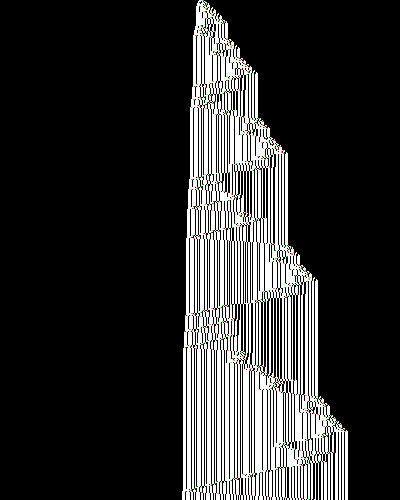
About this picture
The standard picture (bbchallenge.org's Default view): each row is the whole tape at one step, time runs downward, and the head's path draws the pattern.
Overview
In one sentence
#13's twin: same period-10 bouncer, same 7 junction words, same chaotic tail D_n cycle for cycle. Tail = whole problem.
- Status
- Parkedobserving · updated 2026-10-10Not blocking · Stuck at the observing stage. Answer Q1–Q3 whenever; a “no” redirects the work.idle since Oct 10 13:58 · status.json 2026-10-10
- Class
- Bouncer + Chaotic Edgeours: Bouncer + Chaotic Edge (sheet) · ours adds: twin of #13 at the cycle level (same bulk, junction and tail orbit D_n) · med confidence
- On the list
- line 552 of
BB6_holdouts_663.txt· historical 740 line 615
Your calls on file 3
- priority call (answered)
- Park this machine with #13 (same edge lemma), or fund one family stage on that lemma for #13, #34, #35 and #36?
- parked
- Parked 2026-10-10 with #13 (auto-applied recommendation): same edge lemma (E'); an (E') proof would now pay #13, #34, #35, #36.
- decision.json · answered 2026-10-10: park
- Park this machine with #13 (same edge lemma), or fund one family stage on that lemma for #13, #34, #35 and #36? Decisions →
Mechanism
How it works: 3 notes
- Bulk (1101101101)^a on a left wall moves 1 cell left per bounce (62a steps); the junction cycles through #13's 7 words; 1 bounce in 7 touches the tail D.
- D_n equals #13's D_n in all 1,952 shared cycles, and the probe map P is #13's (217/217 tested, 0 disagree). #35 = this table renamed; #34 = #13 mirrored.
- Halt only via B reading 0 with 00 on its left. Never seen: the edge map is clean to 1.5e7 cycles (about 4.9e16 steps). The tail has no proof.
Figures for Checkpoint A
Rows are bounces. Left: striped bulk; middle: diagonal seam; right: ragged part. Compare their widths, top vs bottom.

One row per 7-bounce cycle. Compare left and middle panels row by row; the right panel shows differences in red.

Rows are shifted so the right edge stays put. Compare the ragged band's width at top and bottom.
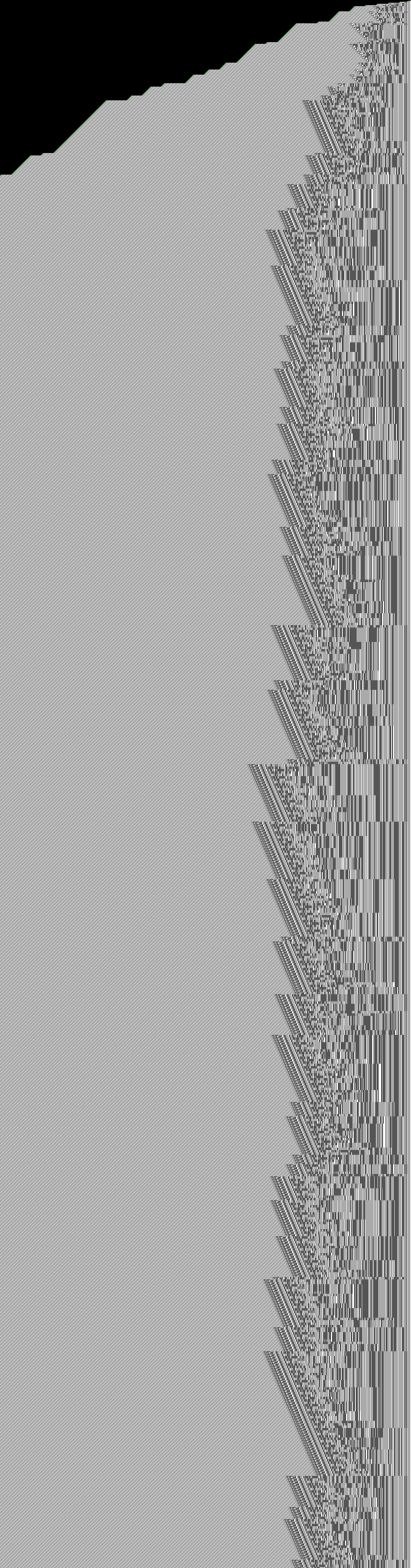
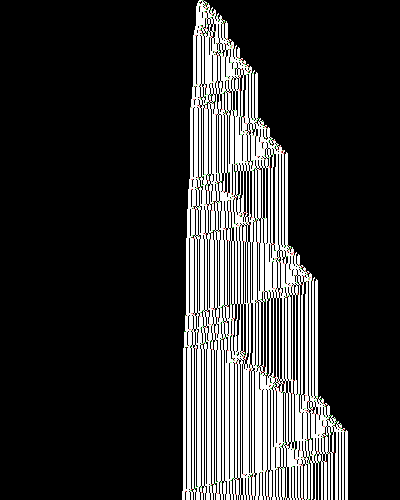
More figures (2)Fig 4–5: Blaze view, 10 million steps · bbchallenge Default view, first 10,000 steps
Whole run to 1e7 steps. Compare the smooth left edge with the ragged right edge.

For orientation: the start of the run as bbchallenge.org shows it.
Rules (9/9 validated)exact tape rewrites the proof will formalize, each re-checked by simulation
| rule | from ⟶ to | cases | steps | checked |
|---|---|---|---|---|
| WALL | 0∞ <D 0 110110 r ⟶ 0∞ 11101111 B> r | — | 12 | ✓30/30 |
| RS right sweep | B> (1101110110)n ⟶ (0110101111)n B> | — | 12n | ✓30/30 |
| LS left sweep | (0111101101)n <D ⟶ <D (0110110111)n | — | 50n | ✓30/30 |
| B_k bounce, k=1..5 | 0∞ <D 0 (1101101101)a X_k D 0∞ ⟶ 0∞ <D 0 (1101101101)a+[k=5] X_(k+1) D 0∞ | any D (random and orbit); X_k = #13's junction words | 62a+b_k, b = 13, 433, 55, 49, 73 | ✓200/200 |
| B_6 cycle close | 0∞ <D 0 (1101101101)a X6 D 0∞ ⟶ 0∞ <D 0 (1101101101)a X0 D 0∞ | any D | 62a+13 | ✓40/40 |
| probe B_0 | 0∞ <D 0 (1101101101)a X0 D 0∞ ⟶ 0∞ <D 0 (1101101101)a X1 P(D) 0∞ | P = #13's probe map: orbit D 120/120 same; random D 97 same + 103 break in both, 0 disagree | 62a+c(D) | ✓120/120 |
| cycle | 0∞ <D 0 (1101101101)a X0 D_n 0∞ ⟶ 0∞ <D 0 (1101101101)a+1 X0 D_(n+1) 0∞ | D_n = #13's D_n; also 2,079/2,079 real cycles to 1e9 | 434a+698+c(D_n) | ✓60/60 |
| halt | 00 B> 0 ⟶ halt | also 000 <B; the only way to halt (B0, C0, E0) | 3 | ✓40/40 |
| init | 0∞ A> 0∞ ⟶ 0∞ <D 0 (1101101101)57 X1 D_0 0∞ | first cycle start C_0(58, D_0) at step 679,041 | 657139 | ✓1/1 |
Compressed historythe tape as 0∞ <D 0 (1101101101)a X0 D 0∞ (X0 = 110111100110011101100100100111101100100110110111010011, #13's X0) at 20 moments: where the rules are read off
| step | a | |D| | D (first 24 cells) |
|---|---|---|---|
| 679,041 | 58 | 261 | 1.1·1022 |
| 710,472 | 59 | 258 | 1.1·1022 |
| 739,157 | 60 | 255 | 1.11·1022 |
| 771,604 | 61 | 252 | 1·1021 |
| 801,867 | 62 | 249 | 1.1·1022 |
| 833,752 | 63 | 246 | 1.11·1022 |
| 864,985 | 64 | 243 | 1·1021 |
| 992,699 | 68 | 231 | 1.1·1022 |
| 1,349,053 | 78 | 201 | 1.1·1022 |
| 2,711,163 | 108 | 321 | 1·1021 |
| 5,831,403 | 158 | 321 | 1.11·1022 |
| 15,317,035 | 258 | 291 | 1.11·1022 |
| 29,137,475 | 358 | 351 | 1.1·1022 |
| 69,822,111 | 558 | 351 | 1·1021 |
| 127,853,013 | 758 | 321 | 1.1·1022 |
| 247,450,499 | 1,058 | 411 | 1·1021 |
| 406,142,429 | 1,358 | 291 | 1.11·1022 |
| 603,885,785 | 1,658 | 321 | 1·1021 |
| 884,868,232 | 2,009 | 348 | 1.1·1022 |
| 999,698,415 | 2,136 | 327 | 1.11·1022 |
alast 2,136|D|last 327D (first 24 cells)last 1.11·1022Template comparisonBouncer_v3.v TM1: partly applies · the nearest solved proof, what carries over, and the transitions that differ
| 0 | 1 | |
|---|---|---|
| A | 1RB | 1RF |
| B | 1LC | 0RF |
| C | 1LE | 0LD |
| D | 1RC | 0LB |
| E | --- | 1RA |
| F | 1LB | 1RA |
- file
Bouncer_v3.v:44- module
TM1- machine
1LB1RA_0RA0RC_---1RD_1RE1RB_1LF0LE_0RD0LE(12 transitions apart)- diff
- —
- note
- sideRLs: a fixed crossing protocol into a one-sided right part fits (ours: 14 fixed round trips 2 cells left of the X0|D cut), but TM1's RC i is an explicit word; our D is chaotic and needs a closed language (#13's lemma E'). The A-C neighbours in RWL_mod_v2.v / CPS_LRU_v1.v are decider certificates: same parameters give false here.
Proof strategy & riskshow the formal proof will go · 3 risks to watch
Everything except the edge is routine (Bouncer_v3/sideRLs shape; init by direct execution, 657,139 steps). A kill needs #13's edge lemma (E'): a closed language for D under P. It is shared by #13, #34, #35 and #36, so one lemma would mean 4 kills. Until then, park with #13.
- ▲Edge lemma open: #13 refuted SFT_k invariants for k <= 36 and plain n-gram CPS (n <= 26); no regular invariant is known.
- ▲mxdys listed the family on UBRRBA_TODO (a halting tool): a late break or halt is possible; edge map clean to 1.5e7 cycles (about 4.9e16 steps).
- ▲Even with (E'), this machine needs its own .v: same architecture, but the wall, the sweeps (62a) and the step constants differ from #13.
Stats & provenance109 steps simulated · 21,745 cells · the status in full · files
- simulated
- 109 steps
- tape
- 21,745 cells · 15,171 nonzeros
- growth
- both edges ~ sqrt(t): lo = -0.47 sqrt(t), hi = +0.22 sqrt(t) at 1e9
- status now
- Parked 2026-10-10 with #13 (auto-applied recommendation): same edge lemma (E'); an (E') proof would now pay #13, #34, #35, #36. Observe done. The mechanism is exact and validated, and it is identical to parked #13 at the cycle level: the same bulk (1101101101)^a, the same 7 junction words, and the same tail orbit D_n (1,952/1,952 shared cycles; probe map equal on 217/217 tested D, 0 disagree). #35 is this table renamed. Edge map clean to 1.5e7 cycles (about 4.9e16 steps), but no non-halting argument exists for the chaotic tail (#13's open edge lemma E'). Confidence med, so proof work waits on Dennis (decision.json). (status.json, 2026-10-10)
- observer's note
- Mechanism exact and validated, and identical to parked #13 at the cycle level; no non-halting argument for the chaotic tail D (shared edge lemma E'). Confidence med: proof work waits on Dennis (decision.json).
- files
- observe.json · notes.md · status.json
Proof & checks
No proof work yet.
Files
machines/<tm>/: 7 entries · raw notes, status, scripts, images
| name | size | changed |
|---|---|---|
| notes.md ↓ | 8.4 KB | 2026-10-10 13:58 |
| status.json ↓ | 1.0 KB | 2026-10-10 13:58 |
| observe.json ↓ | 12 KB | 2026-10-10 13:56 |
| decision.json ↓ | 2.8 KB | 2026-10-10 13:58 |
| img/ | 7 items | 2026-10-10 13:40 |
| scripts/ | 3 items | 2026-10-10 13:44 |
| work/ | 22 items | 2026-10-10 13:47 |
status.json in full
{
 "tm": "1RB1RF_1LC0RF_1LE0LD_1RC0LB_---1RA_1LB1RA",
 "status": "STUCK",
 "stage": "observe",
 "updated": "2026-10-10",
 "confidence": "med",
 "reason": "Parked 2026-10-10 with #13 (auto-applied recommendation): same edge lemma (E'); an (E') proof would now pay #13, #34, #35, #36. Observe done. The mechanism is exact and validated, and it is identical to parked #13 at the cycle level: the same bulk (1101101101)^a, the same 7 junction words, and the same tail orbit D_n (1,952/1,952 shared cycles; probe map equal on 217/217 tested D, 0 disagree). #35 is this table renamed. Edge map clean to 1.5e7 cycles (about 4.9e16 steps), but no non-halting argument exists for the chaotic tail (#13's open edge lemma E'). Confidence med, so proof work waits on Dennis (decision.json).",
 "priority_call_answered": "Park this machine with #13 (same edge lemma), or fund one family stage on that lemma for #13, #34, #35 and #36?",
 "parked": "Parked 2026-10-10 with #13 (auto-applied recommendation): same edge lemma (E'); an (E') proof would now pay #13, #34, #35, #36."
}