tools/rebuild_pages.sh rebuilds the site within 5 minutes of a change; by hand: python3 -B tools/site.py.1RB1RF_1LC0RB_1RD0LC_1LE1RA_0RC1LB_---1RE
Where it stands
Parked at the observation
Parked by Dennis 2026-10-10 (park_sim): niced background sim to 1e12 as a cheap halt check, work/sim_1e12.jsonl. Observe done: period-5 sea with 2-state defect walls forming nested binary counters (7 exact local rules validated on random instances; inner counter laws 33,140/33,140 and 5,545/5,545 on the orbit). Confidence is low because the global law (engine-dissolving epochs, bit creation, edge regions; regime change at ~2.7e9) is unknown, and a halting route (C reading 0 before 110) exists in the defect algebra. Proof work waits for Dennis.
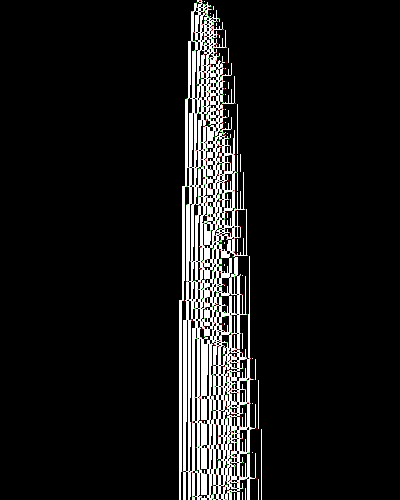
About this picture
The standard picture (bbchallenge.org's Default view): each row is the whole tape at one step, time runs downward, and the head's path draws the pattern.
Overview
In one sentence
Period-5 sea swept by a zig-zag head; defect walls toggle like binary counters; the global epoch law is unknown
- Status
- Parkedobserving · updated 2026-10-10Not blocking · Stuck at the observing stage. Answer Q1–Q3 whenever; a “no” redirects the work.idle since Oct 10 13:59 · status.json 2026-10-10
- Class
- Unknownours: sheet Unknown ≠ ours Nested binary counters of toggling defect walls in a period-5 sea, with engine-dissolving epochs (multi-region) · low confidence
- On the list
- line 562 of
BB6_holdouts_663.txt· historical 740 line 625 · observe.json rank #49
Your calls on file 3
- priority call (answered)
- One more stage on the epoch/bit-creation law (exact wall catalogue + abstract wall simulator), or park as STUCK at observe?
- parked
- Parked by Dennis 2026-10-10 (park_sim): niced background sim to 1e12 as a cheap halt check, work/sim_1e12.jsonl.
- decision.json · answered 2026-10-10: park_sim
- Spend one more stage on the epoch/bit-creation law (wall catalogue plus an abstract wall simulator), or park R9 as STUCK at observe? Decisions →
Mechanism
How it works: 3 notes
- Sea and walls: the tape is mostly the period-5 sea 11100. Right sweeps (B) shift every block 2 cells right and left sweeps (C) shift it back, 7 steps per block. The head turns only at 2-state defect walls. A right-wall bit is the insert 000 (= 0), which reflects a right sweep and becomes 100 (= 1); 100 lets the sweep through and is reset on the way back. Left-wall bits (gap-1 vs run-2) do the same to left sweeps. So the central engine drives a binary counter on each side (counter laws hold on 33,140/33,140 and 5,545/5,545 orbit turns).
- Above that it is not understood. Counter overflows feed a second engine/counter pair at the right end and a structure at the left edge. Up to 2.73e9 the inner engine keeps dissolving (43 epochs between 1e9 and 2.73e9, 29e6 to 56e6 steps apart): a wall walks left one block per bounce, eating a 4/5-density sea (11110) back into 11100, and then the engine re-forms. After 2.73e9 there are none in the inner region. Each edge visit adds 3 cells (2,021 cells at 1e10), and edge visits keep slowing down.
- Halting: every halt is C reading 0 just before 110 (rule H), for example a right sweep meeting B> 1^n 0 1 0, or a D sweep meeting 110. Neither is seen to 1e10. Cryptid check: nothing Collatz-like. Everything observed is binary counting or linear drift, but the unknown epoch/bit-creation law could still hide parity branching.
Figures for Checkpoint A
One row per new edge cell. Compare the two edges' slopes, then follow the wavy grey lines inside.
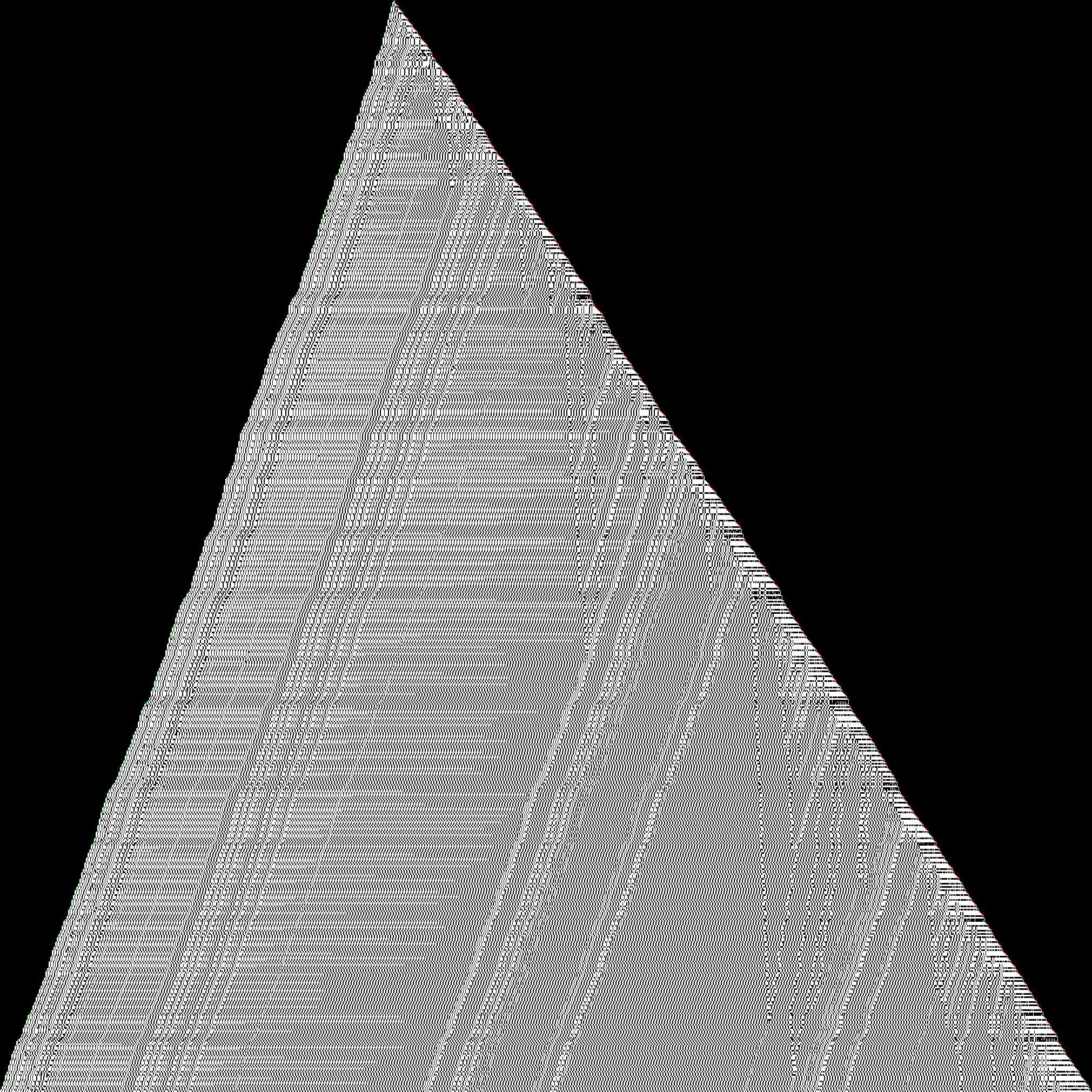
Time runs down. Note which dark column each right excursion from the engine (x ~ 200) stops at.
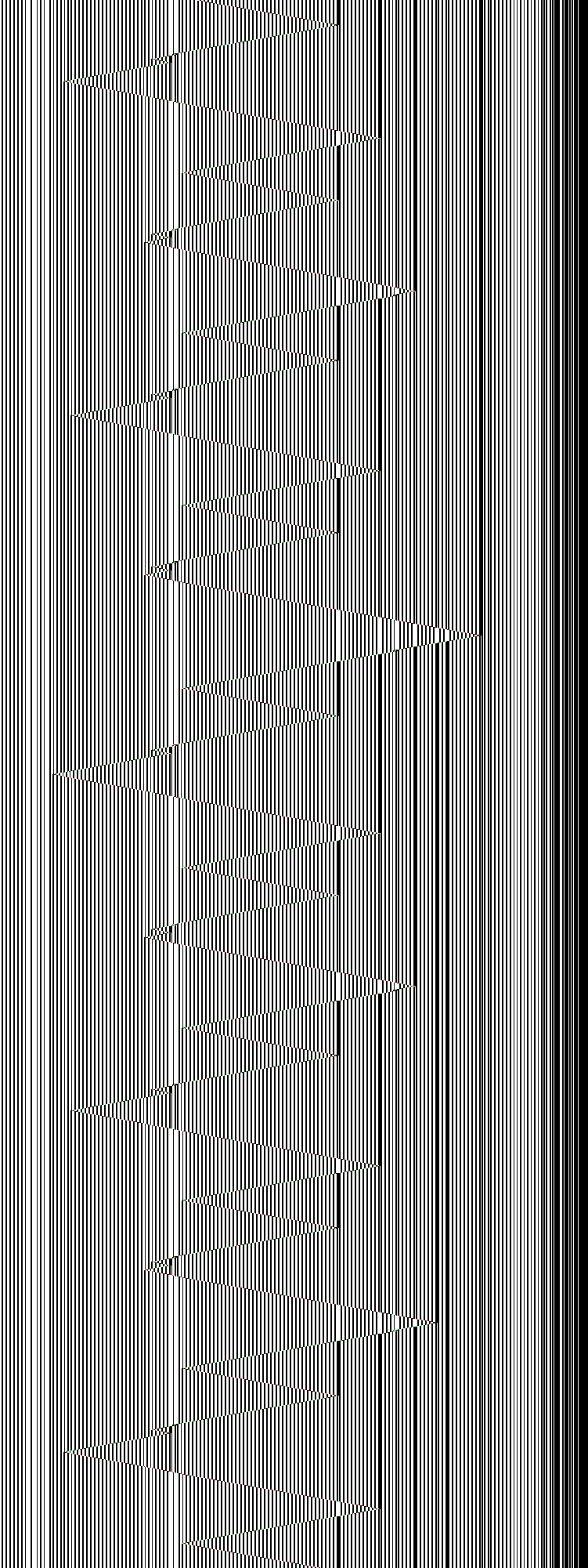
Each line is a wall the head keeps bouncing off. Note where lines are born and which way they drift.

More figures (2)Fig 4–5: Blaze view, 1 billion steps · bbchallenge Default view, first 10,000 steps
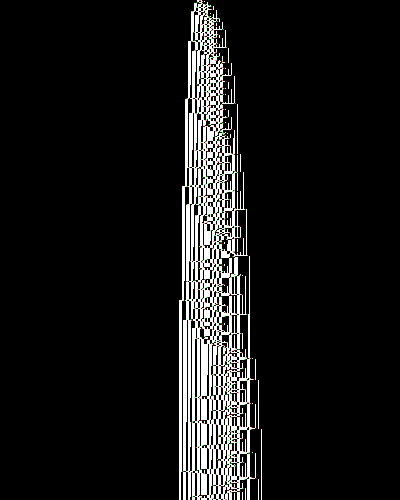
Time runs down. Edges grow on both sides; the paler vertical bands are defect-rich zones.

For orientation: what bbchallenge.org shows for this machine.
Rules (10/11 validated)exact tape rewrites the proof will formalize, each re-checked by simulation
| rule | from ⟶ to | cases | steps | checked |
|---|---|---|---|---|
| S_R right sweep over the sea | B> (11100)n ⟶ (00111)n B> | any n >= 1, random 12-cell contexts on both sides | 7n | ✓200/200 |
| S_L left sweep over the sea | (00111)n <C ⟶ <C (11100)n | any n >= 1, any context | 7n | ✓200/200 |
| RB0 right bit 0 reflects, becomes 1 | (00111)n B> 000 ⟶ <C (11100)n 100 | n >= 1; the turn and the start of the return sweep | 7n+1 | ✓200/200 |
| RB1 right bit 1 passes the sweep | B> 100 ⟶ 111 B> | any context | 5 | ✓200/200 |
| RB1r return sweep resets a passed bit | (00111)n 111 <C ⟶ <C (11100)n 000 | n >= 1; together RB1 then RB1r take bit 1 -> 0 | 7n+3 | ✓200/200 |
| LB0 left bit 0 (gap 1) reflects, becomes run 2 | 00011 10111 (00111)n <C ⟶ 00011 00111 (00111)n B> | n >= 1, constructed context. The pass-through case (left bit 1) depends on the phase of the sea on its right and is not yet an exact rule | 14n+13 | ✓200/200 |
| D_R D sweep: 3/5 sea -> 4/5 sea | D> (11100)n ⟶ (11101)n D> | any n >= 1. A block 110.. instead of 111.. makes F read 0, which halts | 5n | ✓200/200 |
| H the only way to halt | 0 <C 110 or C> 0110 ⟶ halt | C0, D1, A1, then F reads 0. F is entered only by A1, A only by D1 and D only by C0, so every halt has this form (200 random contexts per direction) | 4 | ✓400/400 |
| CR inner right counter = binary +1 | bits b0..b7 = inserts 000 (0) / 100 (1) in the 11100 sea (cells 680..875 at 1e9); a right sweep leaves the engine ⟶ turns at the first 0 bit j; bits < j become 0 and bit j becomes 1 | real orbit, steps 1e9..1.03e9: every right turn in cells 600..900 after a left turn left of cell 600; 33,139/33,139 next states are exact +1. Depth counts 16,634 / 8,318 / 4,158 / 2,080 / 1,040 / 520 / 260 / 130 | — | ✓33140/33140 |
| CL inner left counter = binary +1 | 4 low bits in cells 315..435: run-2 defect (1) / gap-1 defect 3 cells right (0) ⟶ turns at the first 0 bit; lower bits -> 0, that bit -> 1 | real orbit, steps 1e9..1.01e9, every left turn after a right turn right of the zone; 5,371/5,371 exact +1; 346 carries past bit 3 | — | ✓5545/5545 |
| EP engine-dissolving epochs (open) | inner engine + counters ⟶ the engine dissolves; a wall walks left 5 cells per bounce, eating the 11110 sea; the engine re-forms further left | Wall-walk detector (8+ left turns in a row, each 5 cells left of the last): 136 runs from 5e5 to 2.73e9. Between 1e9 and 2.73e9 they form 43 epochs, 2.9e7 to 5.6e7 steps apart. 5 runs near the right end (3.7e9..4.6e9), none after that to 1e10. No exact rule yet | — | –untested |
Compressed historythe tape as span lo..hi of the visited tape; drift = wall-walk runs so far (8+ left turns in a row, each 5 cells left of the last; one epoch can give 2-3 runs) at 15 moments: where the rules are read off
| step | lo | hi | cells | drift |
|---|---|---|---|---|
| 1,000 | -12 | 28 | 41 | 0 |
| 3,000 | -15 | 37 | 53 | 0 |
| 10,000 | -21 | 61 | 83 | 0 |
| 30,000 | -30 | 70 | 101 | 0 |
| 100,000 | -51 | 118 | 170 | 0 |
| 300,000 | -81 | 175 | 257 | 0 |
| 1,000,000 | -123 | 256 | 380 | 2 |
| 3,000,000 | -177 | 361 | 539 | 2 |
| 10,000,000 | -285 | 529 | 815 | 9 |
| 30,000,000 | -381 | 715 | 1,097 | 9 |
| 100,000,000 | -432 | 796 | 1,229 | 9 |
| 300,000,000 | -465 | 844 | 1,310 | 13 |
| 1,000,000,000 | -549 | 988 | 1,538 | 30 |
| 3,000,000,000 | -684 | 1,216 | 1,901 | 136 |
| 10,000,000,000 | -729 | 1,291 | 2,021 | 141 |
lolast -729hilast 1,291cellslast 2,021driftlast 141Template comparisonCPS_LRU_v3.v: does not apply · the nearest solved proof, what carries over, and the transitions that differ
| 0 | 1 | |
|---|---|---|
| A | 1RB | 1RFtpl 0RF |
| B | 1LC | 0RB |
| C | 1RD | 0LC |
| D | 1LE | 1RA |
| E | 0RC | 1LB |
| F | --- | 1REtpl 0LE |
differs from the template
- file
CPS_LRU_v3.v:2133- module
- —
- machine
1RB0RF_1LC0RB_1RD0LC_1LE1RA_0RC1LB_---0LE(2 transitions apart)- diff
A1 1RF->0RF, F1 1RE->0LE- note
- Nearest proved machines by table (2 cells away): a CPS_LRU_v3 certificate (this one; it stops growing at 124 cells by 1e8), CPS_LRU_v4 and RWL_mod_v1. All three are decider certificates, not structural proofs. The targeting row's verify/CounterCmp_v1.v (TM1) compares two unary counters, which is a different mechanism. Kill #12's recursive run-length counter is the closest kill in spirit, but its tape is runs of 1s, not a period-5 sea with toggling walls. No template applies.
Proof strategy & riskshow the formal proof will go · 3 risks to watch
Not ready for a proof. Next: (1) an exact catalogue of every wall shape in both sea phases; (2) an abstract walls-and-counters simulator checked against the TM to 1e10; (3) the epoch and bit-creation law, plus an invariant that rules out C reading 0 before 110 (B> 1^n 0 1 0, D> 110).
- ▲Several levels: two engine/counter pairs, edge structures and engine-dissolving epochs; the regime changed at ~2.7e9, so 1e10 steps may not show every regime.
- ▲The defect algebra has real halting routes (B> 1^n 0 1 0, D> 110), so non-halting needs a global invariant on defect shapes, not just the counter laws.
- ▲Nobody has simulated it to 1e14 (sheet). qsim does not accelerate it (block size 1, 0 rules by 5.4e6 steps), and direct simulation of the growing gaps between edge visits is slow.
Stats & provenance1010 steps simulated · 2,021 cells · the status in full · files
- simulated
- 1010 steps
- tape
- 2,021 cells · 1,224 nonzeros
- growth
- +3 cells per edge visit; visits slow down (left edge about every 4e7 steps near 1.5e9, about every 1.5e9 near 8e9); 1,538 cells at 1e9
- status now
- Parked by Dennis 2026-10-10 (park_sim): niced background sim to 1e12 as a cheap halt check, work/sim_1e12.jsonl. Observe done: period-5 sea with 2-state defect walls forming nested binary counters (7 exact local rules validated on random instances; inner counter laws 33,140/33,140 and 5,545/5,545 on the orbit). Confidence is low because the global law (engine-dissolving epochs, bit creation, edge regions; regime change at ~2.7e9) is unknown, and a halting route (C reading 0 before 110) exists in the defect algebra. Proof work waits for Dennis. (status.json, 2026-10-10)
- observer's note
- Observe done. Low confidence: the sea sweeps, wall toggles and both inner counter laws are validated, but the global epoch/bit-creation law is not, so proof work waits for Dennis.
- files
- observe.json · notes.md · status.json
Proof & checks
No proof work yet.
Files
machines/<tm>/: 6 entries · raw notes, status, scripts, images
| name | size | changed |
|---|---|---|
| notes.md ↓ | 7.4 KB | 2026-10-10 13:59 |
| status.json ↓ | 967 B | 2026-10-10 12:52 |
| observe.json ↓ | 13 KB | 2026-10-10 11:03 |
| decision.json ↓ | 3.6 KB | 2026-10-10 12:49 |
| img/ | 5 items | 2026-10-10 10:59 |
| work/ | 11 items | 2026-10-10 12:49 |
status.json in full
{
 "tm": "1RB1RF_1LC0RB_1RD0LC_1LE1RA_0RC1LB_---1RE",
 "status": "STUCK",
 "stage": "observe",
 "updated": "2026-10-10",
 "reason": "Parked by Dennis 2026-10-10 (park_sim): niced background sim to 1e12 as a cheap halt check, work/sim_1e12.jsonl. Observe done: period-5 sea with 2-state defect walls forming nested binary counters (7 exact local rules validated on random instances; inner counter laws 33,140/33,140 and 5,545/5,545 on the orbit). Confidence is low because the global law (engine-dissolving epochs, bit creation, edge regions; regime change at ~2.7e9) is unknown, and a halting route (C reading 0 before 110) exists in the defect algebra. Proof work waits for Dennis.",
 "parked": "Parked by Dennis 2026-10-10 (park_sim): niced background sim to 1e12 as a cheap halt check, work/sim_1e12.jsonl.",
 "priority_call_answered": "One more stage on the epoch/bit-creation law (exact wall catalogue + abstract wall simulator), or park as STUCK at observe?"
}