tools/rebuild_pages.sh rebuilds the site within 5 minutes of a change; by hand: python3 -B tools/site.py.1RB1RF_0RC0LE_1RD0RF_1LB---_1LB1LE_1RA0LC
Where it stands
Cryptid candidate, parked at the observation
Wave 6 stage 1 (about 1 h). No CTL certificate (extracted CTL62 sweep: 235 runs of NG, NG with history and RWL_mod: 181 false, 54 timeouts, no true).
Read the full status
The bounce map is now an exact particle picture. The head carries no state between runs. Odd defects drift 2 cells left per bounce. Walls (even runs and 00) are parity flips; only the leftmost one moves, one run right per bounce (324/324), and everything right of it stays frozen. A moving wall annihilates with the next frozen wall. A defect reaching the left edge as a leading 1 is born as a wall. The right-end emitter absorbs arriving walls safely (216/216). Halting chain (scripts/stage1/chain_checks.py): a wall reaching a frozen '1:' (run 1 before a 00) leaves an interior 000 (36/36), and a wall reaching a frozen 000 halts the machine (105/105). Keeping each of those frozen needs a birth at exactly the right bounce. The real run had 11 '1:' episodes to 3e10, all unfrozen, and no interior 000 at any left-end bounce. Changing only when 3 defects reach the left edge makes the real tape at step 1,238,230,449 halt 105 bounces later. Birth timing shows no lock (same-bounce birth and annihilation 14 vs 22.7 expected). So non-halting depends on timing coincidences never lining up: cryptid protocol, flagged and stopped. The birth rate falls from 1.55% to 0.54% of bounces by 3e10; the rough halting estimate ranges from about 1e16 steps to astronomically late. Siblings 248/582 share the route (no 000 to 1e10).
About this picture
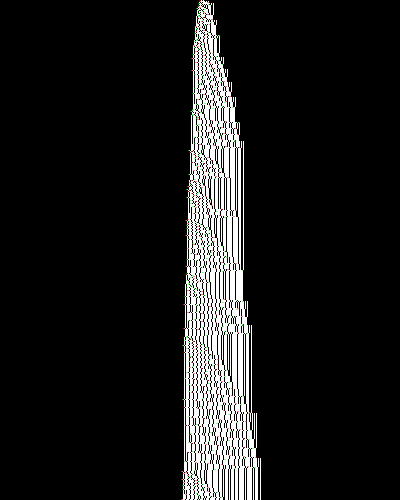
The standard picture (bbchallenge.org's Default view): each row is the whole tape at one step, time runs downward, and the head's path draws the pattern.
Overview
In one sentence
Bouncer over a 0111 field: defects drift left, walls stall growth in irregular phases; no macro law yet
- Status
- Cryptid candidatestage1 · updated 2026-10-14Parked · Wave 6 stage 1 (about 1 h). The 3 open questions are optional.idle since Oct 14 16:43 (44 h ago) · status.json 2026-10-14
- Class
- Unknownours: sheet Unknown ≠ ours Defect-conveyor bouncer with wall phases (1D-CA-like bouncer); no macro law yet · low confidence
- On the list
- line 181 of
BB6_holdouts_663.txt· historical 740 line 198 · observe.json rank #198
Your calls on file 4
- priority call (answered)
- Cryptid-like (timing coincidences decide halting; no lock found). Park it, or fund one stage for an accelerated simulator that hunts for the halt? See decision.json.
- parked
- Dennis 2026-10-14: park
- 2026-10-14 · fund_ctl
- W6-7's mechanism is still low-confidence: fund a 2 h stage, or park it? (Recorded by Claude, not picked by Dennis on this card. The Wave 6 workflow funded stage 1 (CTL sweep first, then the defect-and-wall model) under Dennis's 2026-10-14 request to fund stages and find more candidates. This file was rebuilt from dashboard/decisions.html (built 16:25) after the stage-1 decision.json overwrote it by mistake; the wording is the card's.)
- 2026-10-14 · park
- Park W6-7 as a cryptid candidate, or fund one stage for an accelerated simulator that hunts for the halt?
Mechanism
How it works: 3 notes
- The tape is a field of 0111 blocks (runs of three 1s between single 0s) carrying defects: odd runs 1 and 5 (rarely 7, 9) and even runs 0, 2, 4. The head bounces: the left sweep (state E, rule LS) moves every 0 one cell left; the right sweep (F/A, rules RS3 and RSodd) moves it back, so the 0111 field is unchanged by a bounce. Odd defects are transparent: each bounce toggles 11111 <-> 10111 and the defect drifts 2 cells left per bounce (203/203 real defects at 2.86e6). The left end absorbs arriving defects and grows; the right end emits a periodic defect stream (runs 1 3 1 5 5, 20 cells) and grows about 4 cells per 3 bounces.
- Even runs are reflectors (rule RSeven: A meets a 0 and turns). Walls of this kind appear at the left end and move right about 3-4 cells per bounce; while one stands, the head never reaches the right part, which freezes, and growth stops. Growth and wall phases alternate irregularly (span 6.4k at 1e8, 129k at 2e10). At 2e10 the tape is a chain of periodic regions in run-length form ((1 3 1 5 5)^3142, (5 1 3 1 5)^2043, a 45-run block ^125, older regions); no law for the phase lengths found.
- Halting is possible only as A> 0 0 0 1 (F reading 0000 then 1). The head itself creates four-zero runs inside a sweep (20 times by step 1.3e6), but no 0000 was seen in tape censuses every 1e5 steps to 1e8; no halt to 2e10.
Figures for Checkpoint A
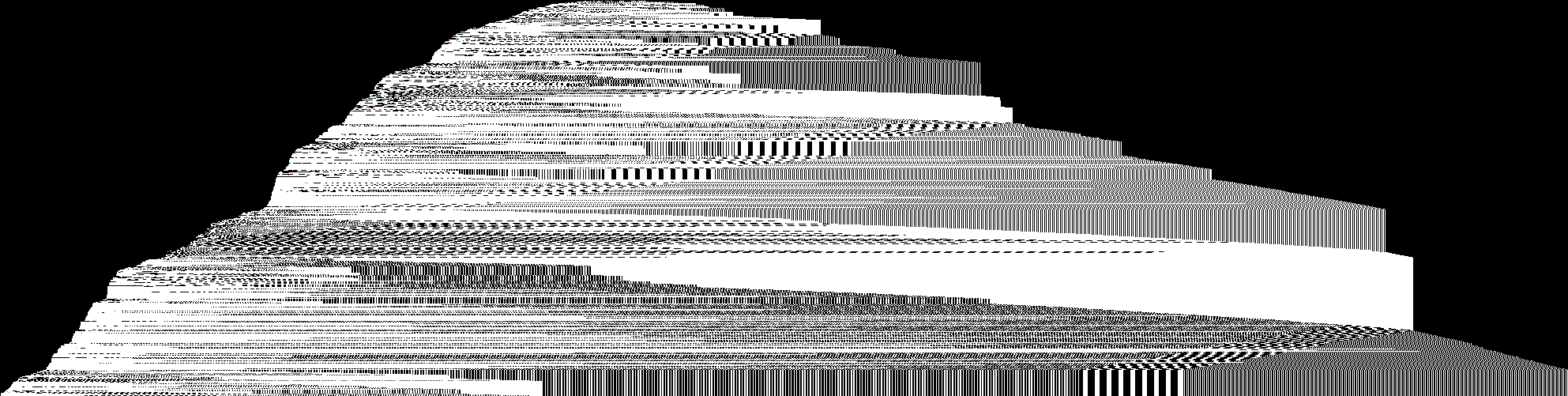
The standard site picture: a dense block field growing on both sides.
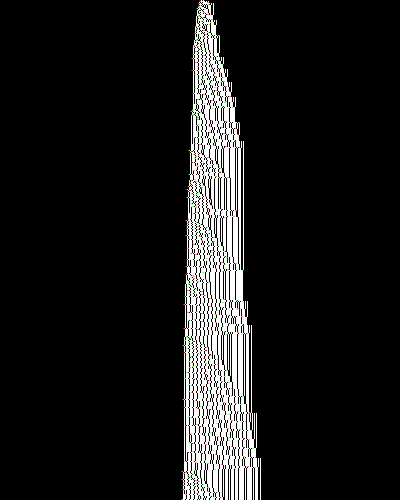
Right of the stepped boundary the columns are vertical (frozen). Watch the boundary move right and restart further left.
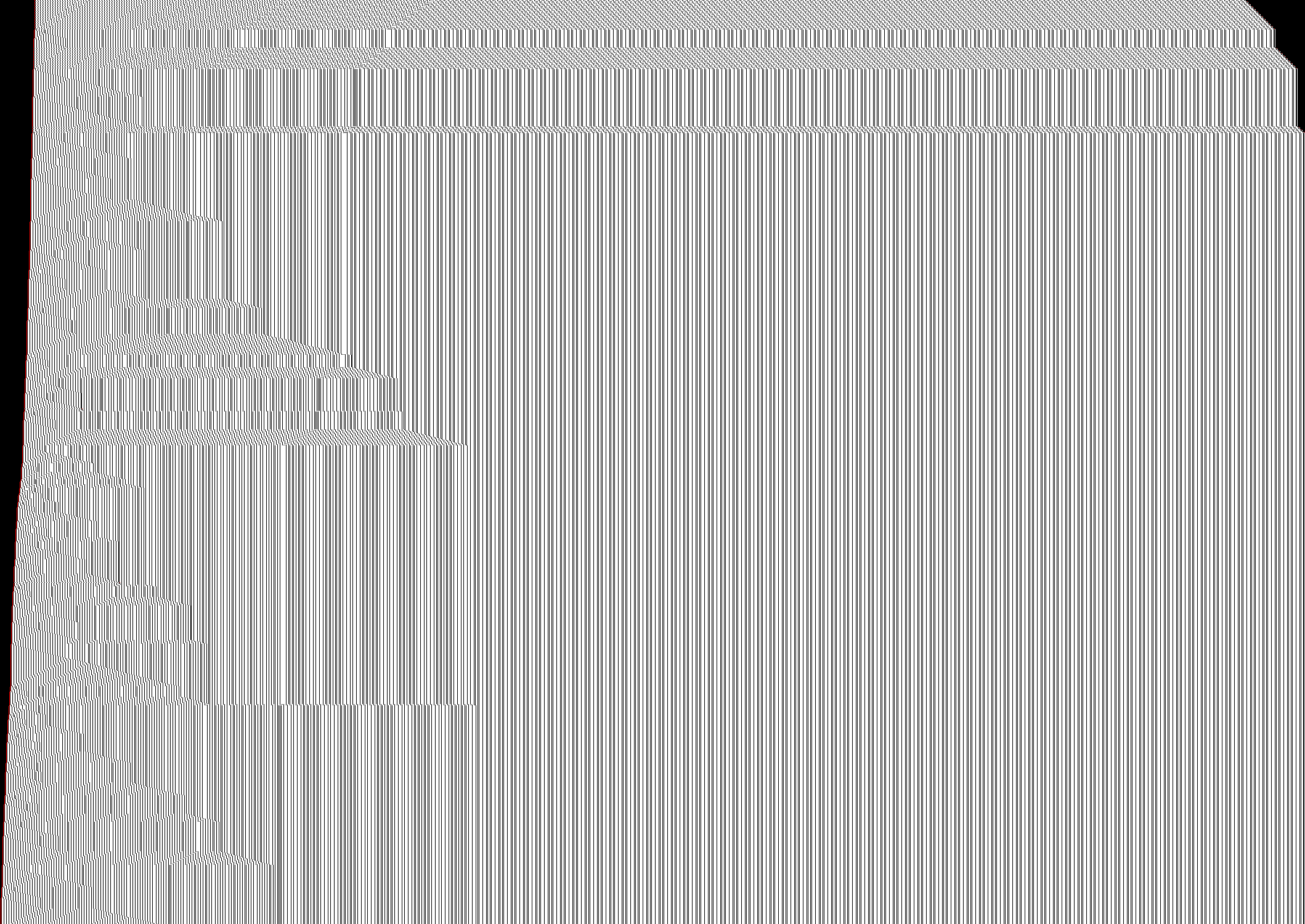
A wall leaves a 000 (red) at row 52; a second wall reaches it at row 105: halt.
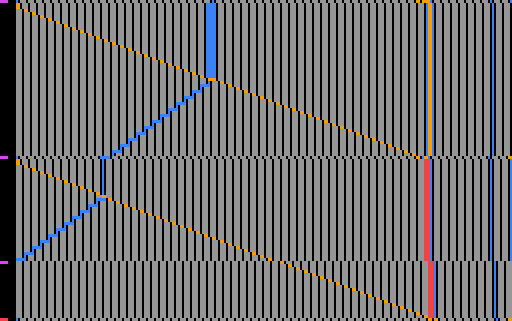
More figures (2)Fig 4–5: Defect conveyor, then wall phase · Long run to 2e9
Top band: head reaches the right end each bounce. Follow the thin diagonal stripes, then the flat wall bands.
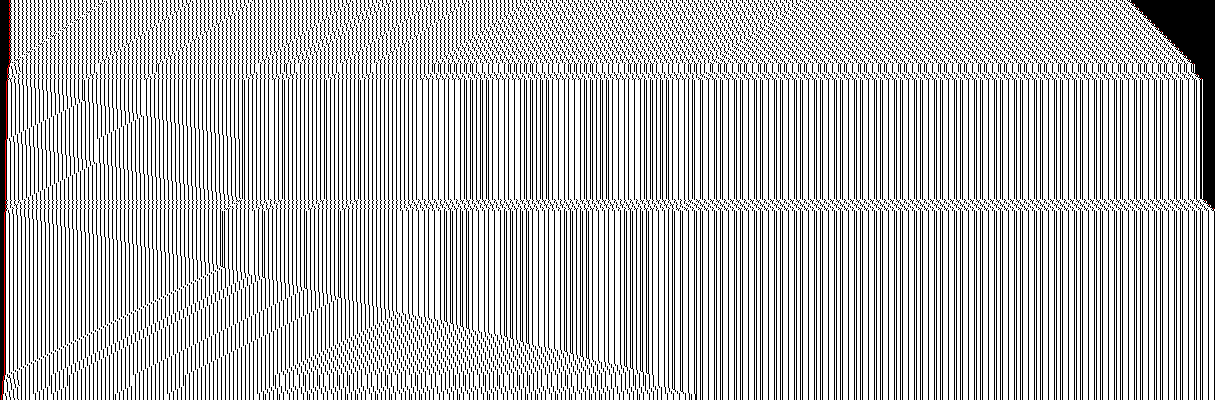
Both edges grow in irregular steps; long stalls on the right are the wall phases.
Rules (8/8 validated)exact tape rewrites the proof will formalize, each re-checked by simulation
| rule | from ⟶ to | cases | steps | checked |
|---|---|---|---|---|
| LS (left sweep step) | L 1a+1 0 1b <E R ⟶ L 1a <E 0 1b+1 R | a, b >= 0; any L, R | b+2 | ✓200/200 |
| WALL (left turn) | L 0 0 <E R ⟶ L 0 0 F> R | also at the left end (L = 0^inf) | 3 | ✓200/200 |
| RS3 (right sweep, field) | L F> (0111)n R ⟶ L (1011)n F> R | n >= 0 | 6n | ✓200/200 |
| RSodd (odd run passes) | L F> 0 12k+1 R ⟶ L 1 (01)k 1 F> R | k >= 0: run 1 merges, run 3 shifts, run 5 splits | 4k+2 | ✓200/200 |
| RSeven (even run reflects) | L F> 0 12k 0 1 R ⟶ L 1 (01)k 1 <E 0 R | k >= 0; k = 0 is a 00 wall | 4k+3 | ✓200/200 |
| HALT (only halting pattern) | L A> 0 0 0 1 R ⟶ halt | table: D1 is reached only via A0, B0, C0; every other entry into B or C reads a 1 that was just written | 3 | ✓200/200 |
| Conveyor (bounce level, observed) | defect run r at cell p (between events) ⟶ same run r at cell p-4 two bounces later | holds away from walls, ends and absorption events; 17,137/19,471 at 9.84e7 including events | 2 bounces | ✓203/203 |
| Left field (rulefit, bounded) | A0(3n+3, -n+19) ⟶ A1(3n+1, -n+19) -> A0(3n, -n+20) | only for 3n+3 <= 60, with a fixed literal history between the fields | — | ✓28/28 |
Compressed historythe tape as 0∞ (1011)a … (15 011 (111010)2)b 15 0 15 (010111)2 A> 0∞ at 8 moments: where the rules are read off
| step | a | b |
|---|---|---|
| 97,903,407 | 21 | 205 |
| 97,996,639 | 18 | 206 |
| 98,089,991 | 15 | 207 |
| 98,183,463 | 12 | 208 |
| 98,277,055 | 9 | 209 |
| 98,370,767 | 6 | 210 |
| 98,464,599 | 3 | 211 |
| 98,558,551 | 0 | 212 |
alast 0blast 212Template comparisontemplate: does not apply · the nearest solved proof, what carries over, and the transitions that differ
| 0 | 1 | |
|---|---|---|
| A | 1RB | 1RF |
| B | 0RC | 0LE |
| C | 1RD | 0RF |
| D | 1LB | --- |
| E | 1LB | 1LE |
| F | 1RA | 0LC |
- file
- —
- module
- —
- machine
- —
- diff
- —
- note
- No proved table within 5 transitions, and no killed machine of ours has this shape (all our templates are counters or Bell eats counter). The closest proof style is upstream's closed-tape-language verifier (CTLv1.v: solve_cert with CPS_LRU / NG / RWL_mod parameters), which fits because halting needs a four-zero run that so far only appears next to the head.
Proof strategy & riskshow the formal proof will go · 3 risks to watch
Two lanes. (a) Certificate lane: a bounded CTL62 parameter sweep (CPS_LRU, NG, RWL_mod) on the three list starts, since halting needs F> 0000 1. (b) Model lane: an exact run-length model (conveyor + RSeven wall motion + left-end absorption + right emitter) to test whether wall phases follow a law or are cryptid-like.
- ▲Wall phases start at left-end absorption events whose timing looks irregular; the run-length history may act like a chaotic 1D CA.
- ▲Runs of four zeros do occur transiently next to the head, so a regular invariant needs head context.
- ▲The three list starts (198, 248, 582) differ only in their history, so a model proof must handle any history.
Stats & provenance2·1010 steps simulated · 129,249 cells · the status in full · files
- simulated
- 2·1010 steps
- tape
- 129,249 cells · 96,935 nonzeros
- growth
- span about t^0.55: 6,398 at 1e8, 83,076 at 1e10, 129,249 at 2e10; irregular staircase on both edges
- status now
- Wave 6 stage 1 (about 1 h). No CTL certificate (extracted CTL62 sweep: 235 runs of NG, NG with history and RWL_mod: 181 false, 54 timeouts, no true). The bounce map is now an exact particle picture. The head carries no state between runs. Odd defects drift 2 cells left per bounce. Walls (even runs and 00) are parity flips; only the leftmost one moves, one run right per bounce (324/324), and everything right of it stays frozen. A moving wall annihilates with the next frozen wall. A defect reaching the left edge as a leading 1 is born as a wall. The right-end emitter absorbs arriving walls safely (216/216). Halting chain (scripts/stage1/chain_checks.py): a wall reaching a frozen '1:' (run 1 before a 00) leaves an interior 000 (36/36), and a wall reaching a frozen 000 halts the machine (105/105). Keeping each of those frozen needs a birth at exactly the right bounce. The real run had 11 '1:' episodes to 3e10, all unfrozen, and no interior 000 at any left-end bounce. Changing only when 3 defects reach the left edge makes the real tape at step 1,238,230,449 halt 105 bounces later. Birth timing shows no lock (same-bounce birth and annihilation 14 vs 22.7 expected). So non-halting depends on timing coincidences never lining up: cryptid protocol, flagged and stopped. The birth rate falls from 1.55% to 0.54% of bounces by 3e10; the rough halting estimate ranges from about 1e16 steps to astronomically late. Siblings 248/582 share the route (no 000 to 1e10). (status.json, 2026-10-14)
- observer's note
- Local mechanism exact (6 sweep rules, 200/200 each); macro law of the wall phases not found. Confidence low.
- files
- observe.json · notes.md · status.json
Proof & checks
No proof work yet.
Files
machines/<tm>/: 7 entries · raw notes, status, scripts, images
| name | size | changed |
|---|---|---|
| notes.md ↓ | 15 KB | 2026-10-14 16:28 |
| status.json ↓ | 2.8 KB | 2026-10-14 16:43 |
| observe.json ↓ | 11 KB | 2026-10-14 16:28 |
| decisions/ | 2 items | 2026-10-14 16:43 |
| img/ | 6 items | 2026-10-14 16:25 |
| scripts/ | 8 items | 2026-10-14 16:03 |
| work/ | 11 items | 2026-10-14 16:03 |
status.json in full
{
 "tm": "1RB1RF_0RC0LE_1RD0RF_1LB---_1LB1LE_1RA0LC",
 "label": "W6-7",
 "status": "CRYPTID_CANDIDATE",
 "stage": "stage1",
 "updated": "2026-10-14",
 "confidence": "med",
 "holdout_line_740": 198,
 "reason": "Wave 6 stage 1 (about 1 h). No CTL certificate (extracted CTL62 sweep: 235 runs of NG, NG with history and RWL_mod: 181 false, 54 timeouts, no true). The bounce map is now an exact particle picture. The head carries no state between runs. Odd defects drift 2 cells left per bounce. Walls (even runs and 00) are parity flips; only the leftmost one moves, one run right per bounce (324/324), and everything right of it stays frozen. A moving wall annihilates with the next frozen wall. A defect reaching the left edge as a leading 1 is born as a wall. The right-end emitter absorbs arriving walls safely (216/216). Halting chain (scripts/stage1/chain_checks.py): a wall reaching a frozen '1:' (run 1 before a 00) leaves an interior 000 (36/36), and a wall reaching a frozen 000 halts the machine (105/105). Keeping each of those frozen needs a birth at exactly the right bounce. The real run had 11 '1:' episodes to 3e10, all unfrozen, and no interior 000 at any left-end bounce. Changing only when 3 defects reach the left edge makes the real tape at step 1,238,230,449 halt 105 bounces later. Birth timing shows no lock (same-bounce birth and annihilation 14 vs 22.7 expected). So non-halting depends on timing coincidences never lining up: cryptid protocol, flagged and stopped. The birth rate falls from 1.55% to 0.54% of bounces by 3e10; the rough halting estimate ranges from about 1e16 steps to astronomically late. Siblings 248/582 share the route (no 000 to 1e10).",
 "siblings": [
  "248 1RB1RA_0LC0RA_1LF0LD_1LE0RC_1LB1LD_1RB---",
  "582 1RB0RE_1LC---_0RA0LD_1LC1LD_1RF0LA_1RC1RE"
 ],
 "sibling_note": "Same table up to renaming and mirror (canon over all 6 starts): 248 = start E (mirrored), 582 = start C. Both show the same 0111 field with 1/5 defects and the 1 3 1 5 5 emitter at 1e8, with their own histories. Starts D and F are eqv-1590 members off the list; upstream Eqv_v2.v links D and F to 248 (equivalences, not verdicts). Start B is on no list.",
 "upstream": "No upstream proof of this table at cdaf693 (only the Eqv_v2.v equivalences for starts D/F). No claim in data/discord; data/sheet lists it only as Unknown (results, classifications) and in the not-simulated-to-1e14/1e15 columns.",
 "template": "None. Halting needs pseudo-random timing coincidences, so no CTL, counter or Bell template applies.",
 "cryptid_flag": true,
 "priority_call_answered": "Cryptid-like (timing coincidences decide halting; no lock found). Park it, or fund one stage for an accelerated simulator that hunts for the halt? See decision.json.",
 "parked": "Dennis 2026-10-14: park"
}