tools/rebuild_pages.sh rebuilds the site within 5 minutes of a change; by hand: python3 -B tools/site.py.1RB1RA_0LC0RF_1LD1LC_1RE1LB_---0RA_1RF0RD
Where it stands
Cryptid candidate, parked at the Rocq proof
Dennis 2026-10-10: flag as cryptid candidate, deprioritize. research/erosion.md: no deterministic erosion bound found (potentials miss by 5-12x; edge ~0.63 bits/cell); no halt in 1e8 bounces (~9.6e15 steps). Cryptid protocol still owes a formal rule reduction in Rocq (bounce = 7 local rules) before the label is final.
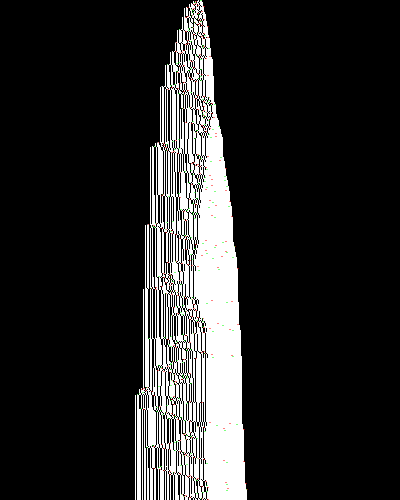
About this picture
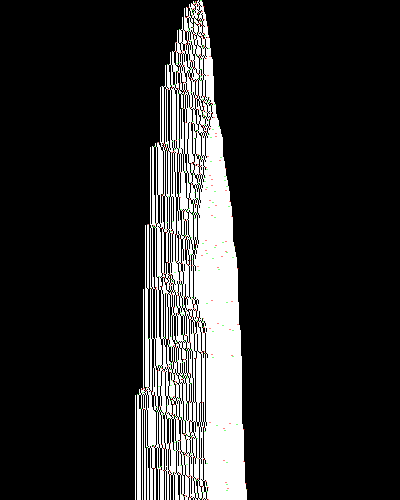
The standard picture (bbchallenge.org's Default view): each row is the whole tape at one step, time runs downward, and the head's path draws the pattern.
Overview
In one sentence
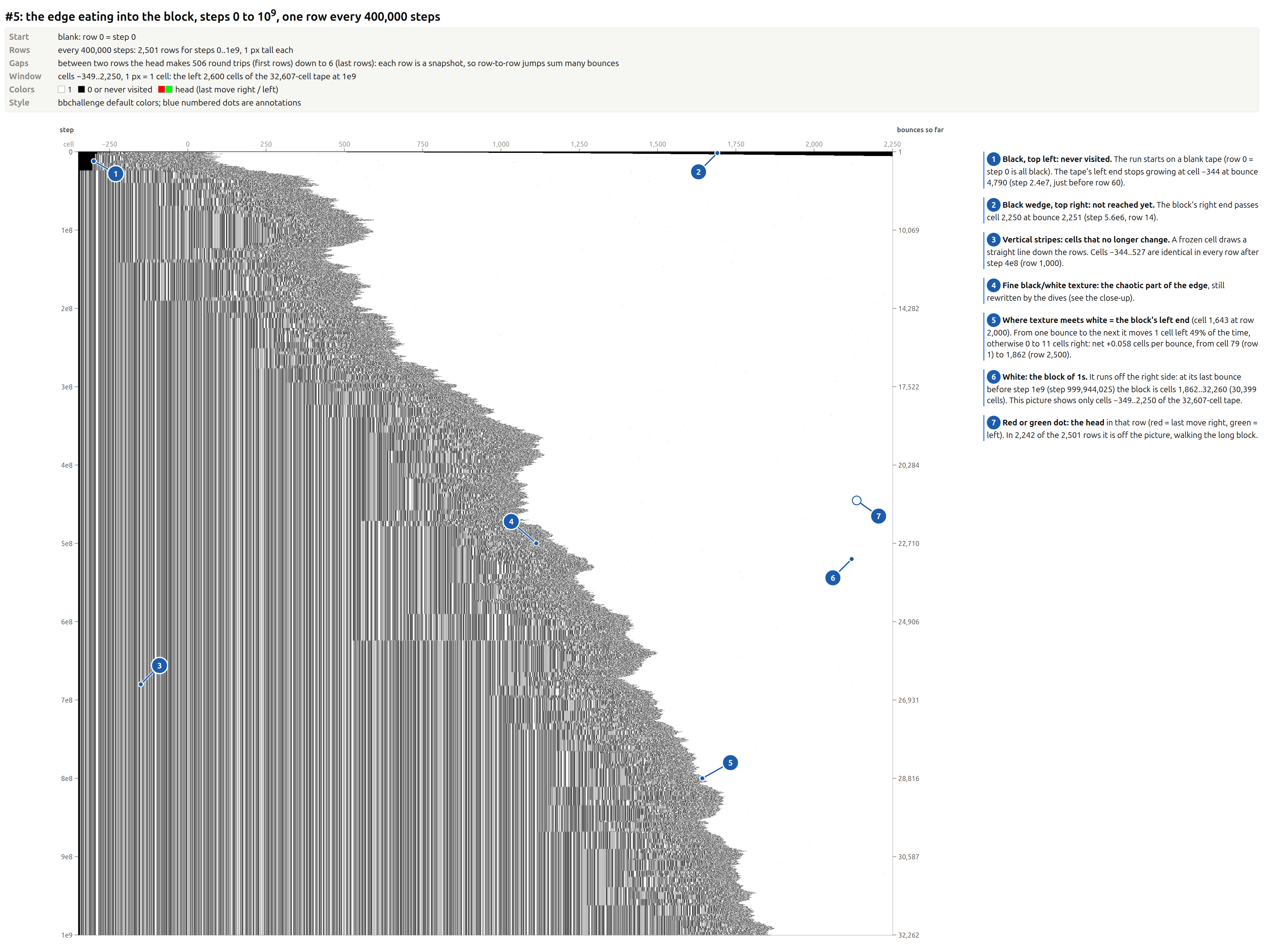
Bouncer; chaotic left edge slowly eats the 1-block. No-00 invariant: it can only halt if the edge eats the whole block
- Status
- Cryptid candidateresearch · updated 2026-10-12Parked · Dennis 2026-10-10: flag as cryptid candidate, deprioritize. The 3 open questions are optional.idle since Oct 12 10:06 · status.json 2026-10-12
- Class
- Bouncer + Chaotic Edgeours: Bouncer + Chaotic Edge (sheet) · ours adds: edge erodes the bouncer block; golden-mean invariant · high confidence
- On the list
- line 331 of
BB6_holdouts_663.txt· historical 740 line 365
Mechanism
How it works: 3 notes
- Bouncer: a solid 1-block gains one 1 per bounce; left of it sits a chaotic, aperiodic edge (~0.6 bits/cell).
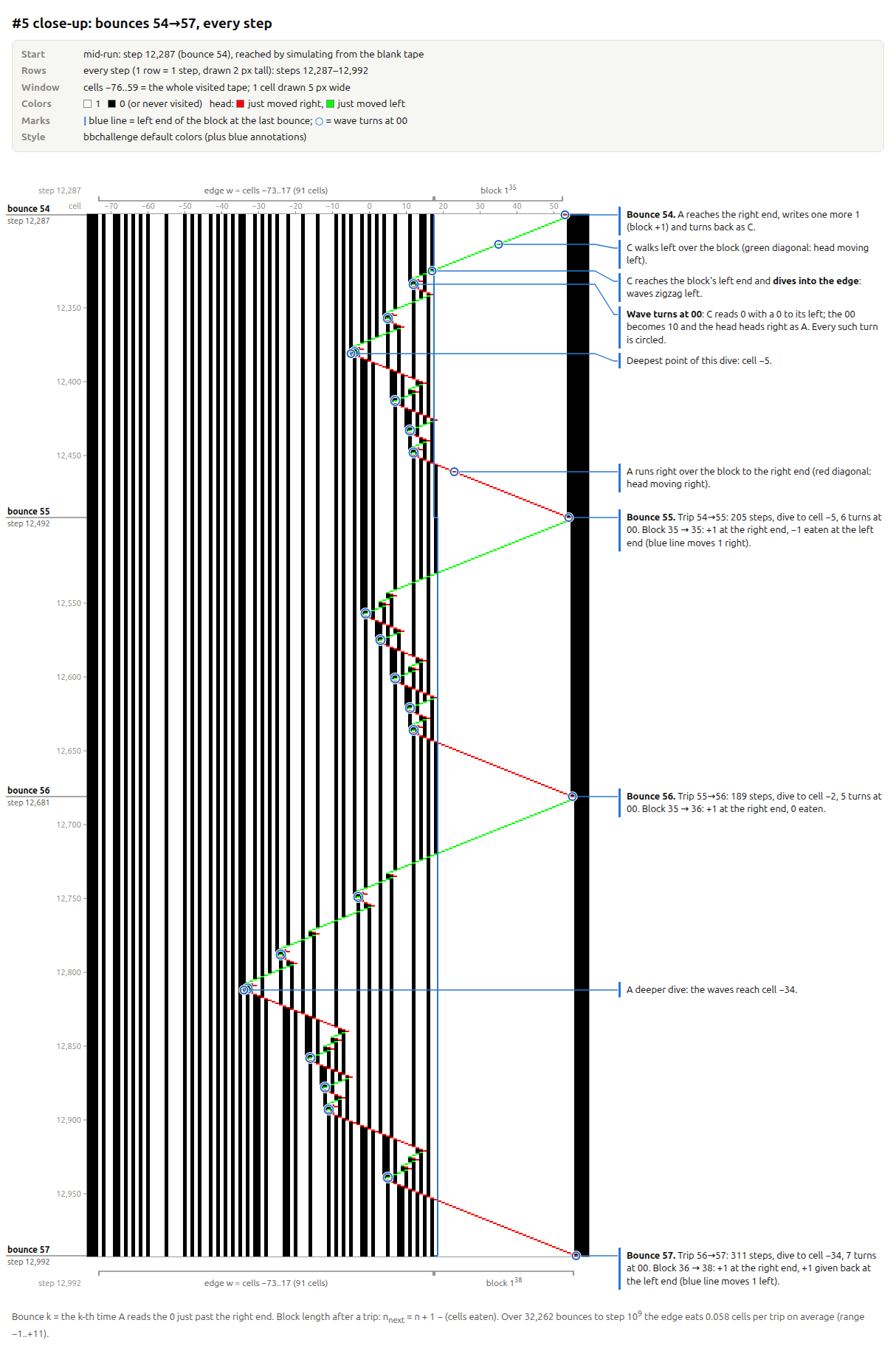
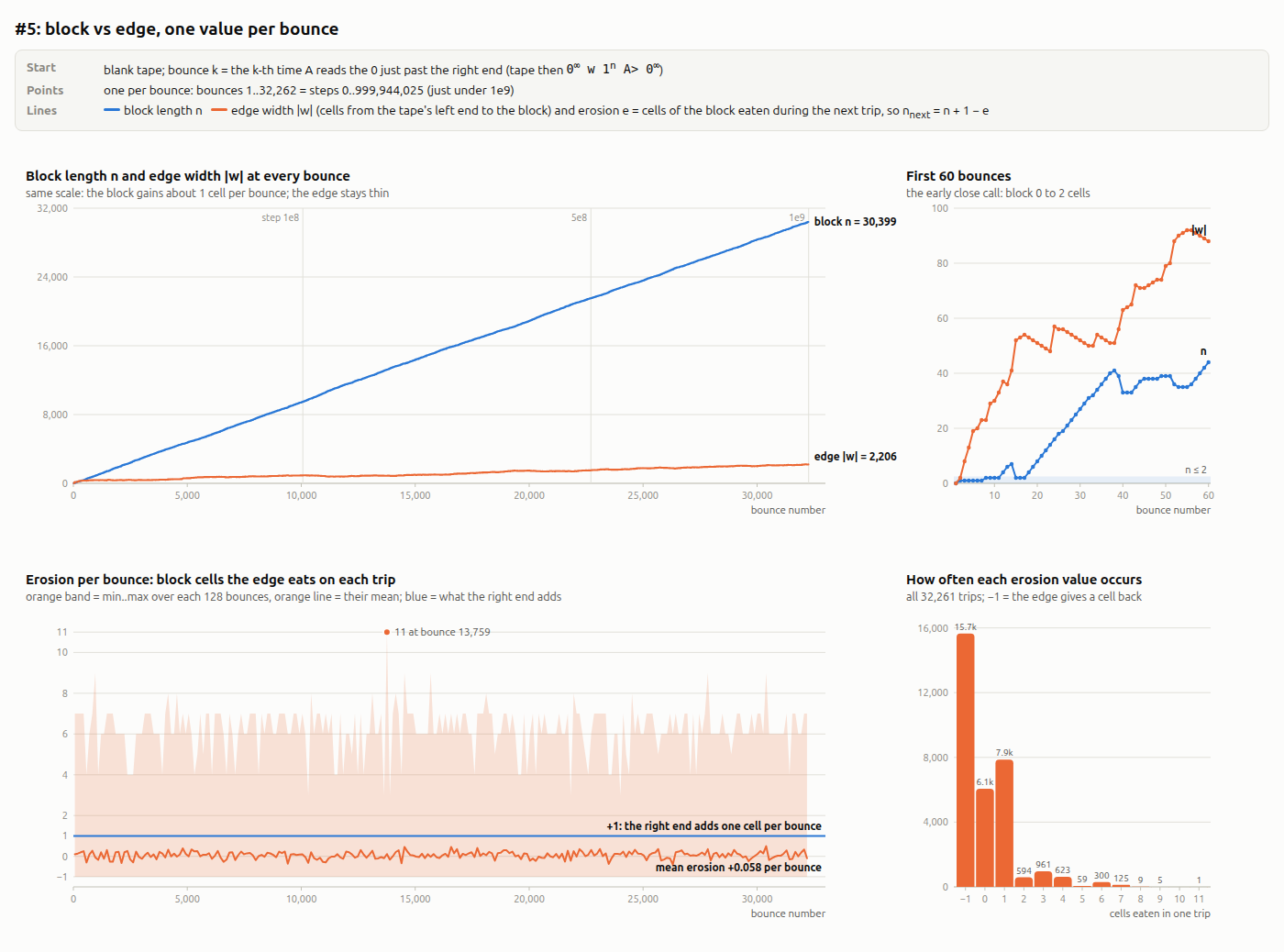
- Each bounce C dives into the edge in zigzag waves; the edge eats ~0.06 block cells per bounce on average, up to 11.
- No 00 ever lies between head and rightmost 1 (checked to 1e9, local proof): it halts only if the block falls to 2 cells.
Figures for Checkpoint A
One row per 400,000 steps to 1e9. Compare the left stripes with the textured fringe at the white block.
Bounces 54 to 57, every step. Look between the head and the white block for adjacent black cells.
Four panels, one value per bounce. Bottom left: cells eaten per trip (orange band = min..max per 128 bounces).
More figures (1)Fig 4: bbchallenge default view, first 10,000 steps
The site's view: the textured edge on the left, the growing white block on the right.
Rules (9/9 validated)exact tape rewrites the proof will formalize, each re-checked by simulation
| rule | from ⟶ to | cases | steps | checked |
|---|---|---|---|---|
| Bounce off the right end | x A> 1n 0∞ ⟶ x <C 1n+1 0∞ | any left side x, n >= 0 | 2n+3 | ✓48/48 |
| C walks left over 1s | x 0 1k <C y ⟶ x 0 <C 1k y | any x, y; k >= 1 | k | ✓48/48 |
| Wave turns at 00 | x 0 0 <C y ⟶ x 1 0 A> y | C on 0 with a 0 to its left | 3 | ✓40/40 |
| Wave carry 010 | x 0 1 0 <C y ⟶ x <C 0 1 1 y | C on 0, left cells 0 1; wave continues | 3 | ✓40/40 |
| Wave fold 110 | x 1 1 0 <C y ⟶ x <D 1 0 1 y | C on 0, left cells 1 1 (with the two rules above: complete split of C on 0) | 7 | ✓40/40 |
| Bounce map (block = wall) | 0∞ w <C 1n 0∞ ⟶ 0∞ f(w) <C 1n+1-e(w) 0∞ | n >= e(w)+3; f, e, s from the wall model (does not depend on n); also exact on 32,061 consecutive real bounces | s(w)+2(n-e(w))+3 | ✓120/120 |
| Halting door (only way to halt) | x A> 0 1 0j 1 0 0 y ⟶ halt | j >= 0; the only path into E0 is A0, B1, F0^j, F1, D0 (traced back from the transition table) | j+5 | ✓48/48 |
| No 00 right of head (invariant) | any configuration reached from blank ⟶ cells head+1 .. rightmost 1 contain no 00 | Only B0 moves left writing 0, and its right neighbour is always 1. Validated at every step; arbitrary-left search: 182,877 states, 0 violations | — | ✓1000000000/1000000000 |
| End doors (door + invariant) | x A> 0 1 1 0∞ | x A> 0 1 0 1 0∞ ⟶ halt | with the invariant these are the only halting configurations: the block has been eaten down to 2 cells | 5 | 6 | ✓40/40 |
Compressed historythe tape as 0∞ w 1n A> 0∞ at 32 moments: where the rules are read off
| step | bounce | |w| (edge width) | n (block) | lo | dive depth of next bounce | last 16 cells of w |
|---|---|---|---|---|---|---|
| 7 | 2 | 2 | 1 | -2 | 6 | 10 |
| 36 | 3 | 8 | 1 | -7 | 11 | 10,110,010 |
| 232 | 5 | 19 | 1 | -16 | 10 | 1.01·1015 |
| 751 | 10 | 30 | 2 | -23 | 31 | 1.1·1015 |
| 1,515 | 14 | 41 | 7 | -35 | 45 | 1.01·1013 |
| 2,087 | 16 | 53 | 2 | -40 | 32 | 1.01·1014 |
| 2,527 | 20 | 51 | 8 | -40 | 9 | 1.11·1015 |
| 3,813 | 30 | 52 | 27 | -50 | 47 | 1.11·1014 |
| 10,819 | 50 | 79 | 39 | -69 | 10 | 1.1·1014 |
| 36,133 | 100 | 160 | 76 | -137 | 149 | 1.11·1015 |
| 99,583 | 200 | 195 | 196 | -192 | 9 | 1.11·1015 |
| 391,927 | 500 | 325 | 418 | -244 | 10 | 1.1·1014 |
| 1,279,887 | 1,000 | 364 | 923 | -288 | 23 | 1.01·1015 |
| 4,517,187 | 2,000 | 371 | 1,924 | -296 | 26 | 1.01·1015 |
| 9,733,649 | 3,000 | 389 | 2,906 | -296 | 147 | 1.11·1015 |
| 23,935,909 | 4,790 | 555 | 4,578 | -344 | 16 | 1.1·1015 |
| 36,764,163 | 6,000 | 739 | 5,604 | -344 | 46 | 1.11·1015 |
| 63,891,977 | 8,000 | 819 | 7,524 | -344 | 20 | 1.11·1015 |
| 98,657,737 | 10,000 | 929 | 9,414 | -344 | 125 | 1.11·1014 |
| 141,448,415 | 12,000 | 798 | 11,545 | -344 | 76 | 1.11·1014 |
| 192,212,801 | 14,000 | 866 | 13,477 | -344 | 135 | 1.1·1015 |
| 250,521,939 | 16,000 | 1,011 | 15,332 | -344 | 8 | 1.11·1014 |
| 316,323,169 | 18,000 | 1,268 | 17,075 | -344 | 20 | 1.1·1015 |
| 389,050,183 | 20,000 | 1,467 | 18,876 | -344 | 16 | 1.01·1014 |
| 469,510,483 | 22,000 | 1,410 | 20,933 | -344 | 177 | 1.01·1014 |
| 557,615,571 | 24,000 | 1,607 | 22,736 | -344 | 9 | 1.11·1015 |
| 623,953,000 | 25,407 | 1,761 | 23,989 | -344 | 888 | 1.11·1014 |
| 653,003,235 | 26,000 | 1,792 | 24,551 | -344 | 69 | 1.01·1014 |
| 755,917,539 | 28,000 | 1,915 | 26,428 | -344 | 10 | 1.1·1014 |
| 866,138,561 | 30,000 | 2,009 | 28,334 | -344 | 10 | 1.01·1015 |
| 983,977,631 | 32,000 | 2,171 | 30,172 | -344 | 20 | 1.11·1015 |
| 999,882,966 | 32,261 | 2,205 | 30,399 | -344 | 47 | 1.1·1015 |
bouncelast 32,261|w| (edge width)last 2,205n (block)last 30,399lolast -344dive depth of next bouncelast 47last 16 cells of wlast 1.1·1015Template comparisonBouncer_v3.v TM1: does not apply · the nearest solved proof, what carries over, and the transitions that differ
| 0 | 1 | |
|---|---|---|
| A | 1RB | 1RA |
| B | 0LC | 0RF |
| C | 1LD | 1LC |
| D | 1RE | 1LB |
| E | --- | 0RA |
| F | 1RF | 0RD |
- file
Bouncer_v3.v:44- module
TM1- machine
1LB1RA_0RA0RC_---1RD_1RE1RB_1LF0LE_0RD0LE(10 transitions apart)- diff
8 of 11 transitions differ (best mirror+relabel); InfiniteRect_v1 TM4: 8; LongNv1 TM1/TM2: 9- note
- Bouncer_v3 needs a periodic side (RC i -> RC (i+1) every 128 bounces). Here 300/300 snapshots have distinct skeletons, and the mirrored RC 0 does not reach RC 1 after 128 bounces. LongN and InfiniteRect also need periodic interaction streams.
Proof strategy & riskshow the formal proof will go · 3 risks to watch
1) Prove the no-00 invariant as a closed predicate on the right side (progress_nonhalt_cond; checks the 11 transitions). Then halting needs A> 0 11 0^inf or A> 0 101 0^inf. 2) Show the edge never eats the block below 3 cells. This needs a potential that bounds the edge's growth per bounce (open). 3) Get from the blank tape to bounce ~30 (n=29) with es/execute, then apply 1) and 2) with an arbitrary left side l.
- ▲The crux is a bound on erosion, and the edge's growth looks statistical: 0.057/bounce on average, up to 11 in one bounce, 60 in 50 bounces. If there is no deterministic bound, the machine is cryptid-like.
- ▲There was an early close call: the block was 2 cells long at bounces 10 and 14-16. The init phase must simulate past it.
- ▲Twin #26
1RB1RA_1LC1RE_---0LD_1LE1LD_0RA0LF_1LF0LBdiffers in 6 transitions, so we must re-derive the invariant before claiming 2 kills.
Stats & provenance109 steps simulated · 32,607 cells · the status in full · files
- simulated
- 109 steps
- tape
- 32,607 cells · 31,695 nonzeros
- growth
- span ~ t^0.5 (block +1 per bounce); edge +0.057 cells/bounce; 32,262 bounces by 1e9
- status now
- Dennis 2026-10-10: flag as cryptid candidate, deprioritize. research/erosion.md: no deterministic erosion bound found (potentials miss by 5-12x; edge ~0.63 bits/cell); no halt in 1e8 bounces (~9.6e15 steps). Cryptid protocol still owes a formal rule reduction in Rocq (bounce = 7 local rules) before the label is final. (status.json, 2026-10-12)
- files
- observe.json · notes.md · status.json
- other viewers
- closeup_bounces54-57 · closeup_waves · edge_every4e5_1e9_labeled
Proof & checks
- rocq/reduction.v · Rocq, not a kill yet
- rocq/rule_reduction.v · Rocq, not a kill yet
○ Checkpoint B: no note from Dennis found
- notes.md L68: - Checkpoint questions are now yes/no questions about the figures. Moved off the card (strategy calls, not figure reading; settle them in proof.md / Checkpoint B):
Files
machines/<tm>/: 7 entries · raw notes, status, scripts, images
| name | size | changed |
|---|---|---|
| notes.md ↓ | 12 KB | 2026-10-12 10:05 |
| status.json ↓ | 1.1 KB | 2026-10-12 10:06 |
| observe.json ↓ | 13 KB | 2026-10-10 04:41 |
| img/ | 15 items | 2026-10-10 02:00 |
| research/ | 3 items | 2026-10-10 02:26 |
| rocq/ | 3 items | 2026-10-12 10:04 |
| work/ | 28 items | 2026-10-10 00:38 |
status.json in full
{
 "tm": "1RB1RA_0LC0RF_1LD1LC_1RE1LB_---0RA_1RF0RD",
 "status": "CRYPTID_CANDIDATE",
 "stage": "observe+research",
 "updated": "2026-10-12",
 "reason": "Dennis 2026-10-10: flag as cryptid candidate, deprioritize. research/erosion.md: no deterministic erosion bound found (potentials miss by 5-12x; edge ~0.63 bits/cell); no halt in 1e8 bounces (~9.6e15 steps). Cryptid protocol still owes a formal rule reduction in Rocq (bounce = 7 local rules) before the label is final.",
 "rule_reduction": "2026-10-12: Rocq rule reduction compiles (machines/1RB1RA_0LC0RF_1LD1LC_1RE1LB_---0RA_1RF0RD/rocq/rule_reduction.v; no Admitted/Axiom): local rules + no-00 invariant proved; erosion_open stated as open Definition; ~halts <-> erosion_open proved (#5 and twin #26 via flip/perm). NOT a kill.",
 "reduction": "machines/1RB1RA_0LC0RF_1LD1LC_1RE1LB_---0RA_1RF0RD/rocq/reduction.v (2026-10-12): rule-system reduction, compiles 2.8 s, closed under the global context. reduction : EdgeNeverEats a0 -> ~ halts tm c0; reduction_iff; reduction_twin for #26. Open condition EdgeNeverEats is a premise, not proved. NOT a kill."
}1 contract warning
- diagrams[2].window: not "cells A..B, 1 px = k cells"