tools/rebuild_pages.sh rebuilds the site within 5 minutes of a change; by hand: python3 -B tools/site.py.1RB1LC_1LA1RF_0RD1RD_0RA0LE_1LA0LE_0RC---
Where it stands
Cryptid candidate, parked at the observation
Observe done (about 1 h 50 min). The mechanism is a 0011 defect walking through 110 fields: the head shuttles between the defect and a unary counter at the right end, one block per round trip.
Read the full status
Three exact visit rules R1-R3 (main walk, walk that eats the second field, the same walk inside the second field) are validated 25/25 each from random instances. When the active defect reaches the junk before the counter, the head sweeps to the left edge and a new epoch starts. The epoch law, fitted on 22 resets to 1.63e10, is N' ~ N + 1.22M, M' ~ 0.30N - 0.58M (eigenvalues 1.20, -0.78); each phase ends on a remainder (mod 6, 8, 2) that picks the junk and the next branch. That is the pre-registered W6-3 stop rule (a field divided, branches on residues), so the cryptid protocol applies: rules formalized in observe.json, flagged, stopped. Unlike H-4, no branch is known to halt: halting needs D to read 0011 from its left, which no observed branch does, and ~5e5 epochs (Alistaire's 10^73975 steps) passed without a halt. A proof would need a closed census of branch shapes plus a 2-D band invariant on M/N (0.06..0.25 seen).
About this picture
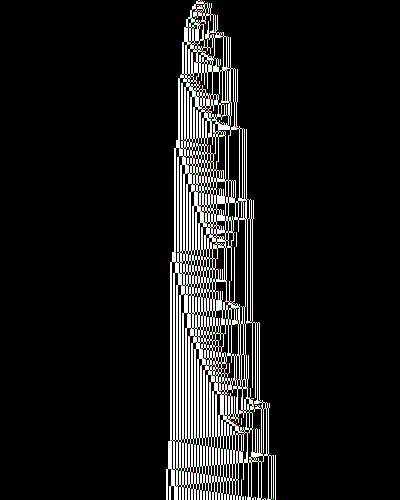
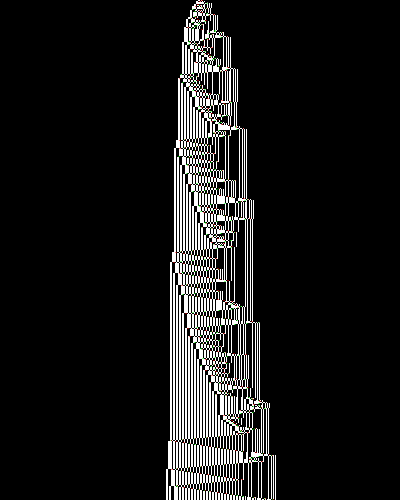
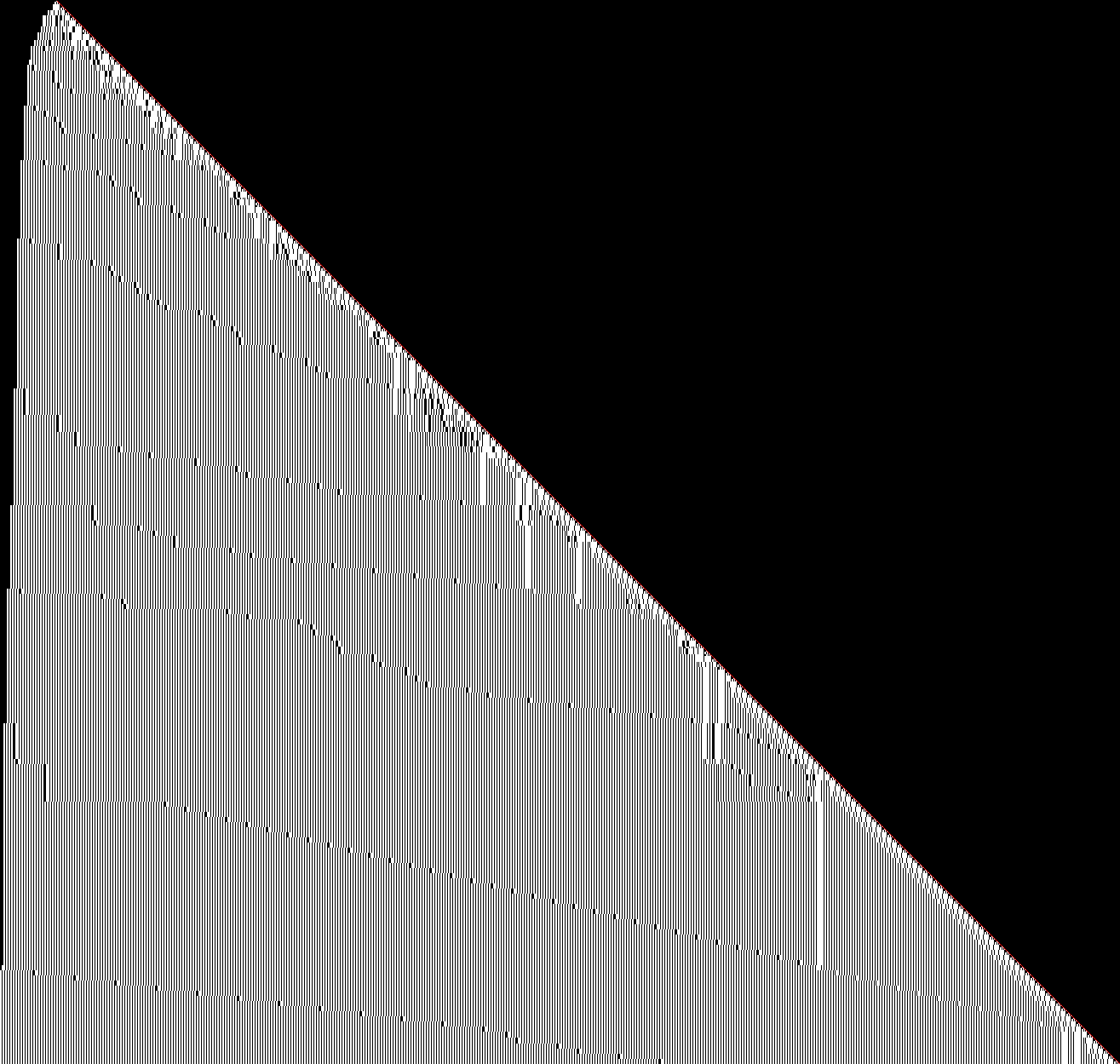
The standard picture (bbchallenge.org's Default view): each row is the whole tape at one step, time runs downward, and the head's path draws the pattern.
Overview
In one sentence
A 0011 defect walks through 110 fields off a right counter; epochs reset via a 2-D map that branches on remainders
- Status
- Cryptid candidateobserving · updated 2026-10-14Parked · Observe done (about 1 h 50 min). The 3 open questions are optional.idle since Oct 14 16:43 (44 h ago) · status.json 2026-10-14
- Class
- Unknownours: sheet Unknown ≠ ours Nested defect-walk counter (budget + round counter at two levels); 2-D residue-branching epoch map: cryptid-like · med confidence
- On the list
- line 262 of
BB6_holdouts_663.txt· historical 740 line 291 · observe.json rank #291
Your calls on file 3
- priority call (answered)
- Cryptid-like (pre-registered stop): the epoch law branches on remainders, but no halting branch is known. Park it, or fund one 2 h stage to build an exact epoch accelerator and census the branch shapes for closure?
- parked
- Dennis 2026-10-14: park
- 2026-10-14 · park
- W6-3's epoch law branches on remainders (the pre-registered stop): park it, or fund one 2 h stage?
Mechanism
How it works: 3 notes
- Trips: the head shuttles between a 0011 defect (left wall) and a unary counter at the right end; each round trip moves the defect one 110 block right, and every 8 trips add 2 blocks to the counter (rule R1).
- Two levels: the same walk also eats the second field (R2: x+16, y-8, z-6) and runs inside it (R3: a+4, b-2). When the active defect reaches the junk before the counter, the head sweeps to the left edge and a new epoch starts.
- Epoch law (fitted, 22 resets to 1.6e10): N' ~ N + 1.22M, M' ~ 0.30N - 0.58M (eigenvalues 1.20, -0.78); phases end on remainders (mod 6, 8, 2) that pick the junk and the next branch. Halting needs D to read 0011 from its left; never seen.
Figures for Checkpoint A
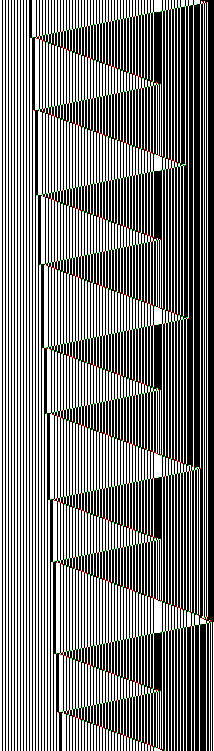
The site's view. The striped area is the 110 field; the ragged right edge is the counter.
Each black wedge is one round trip. Follow the left tip of the wedges from row to row.
Thin diagonals are defects crossing the field; each new diagonal from the left edge is a reset.
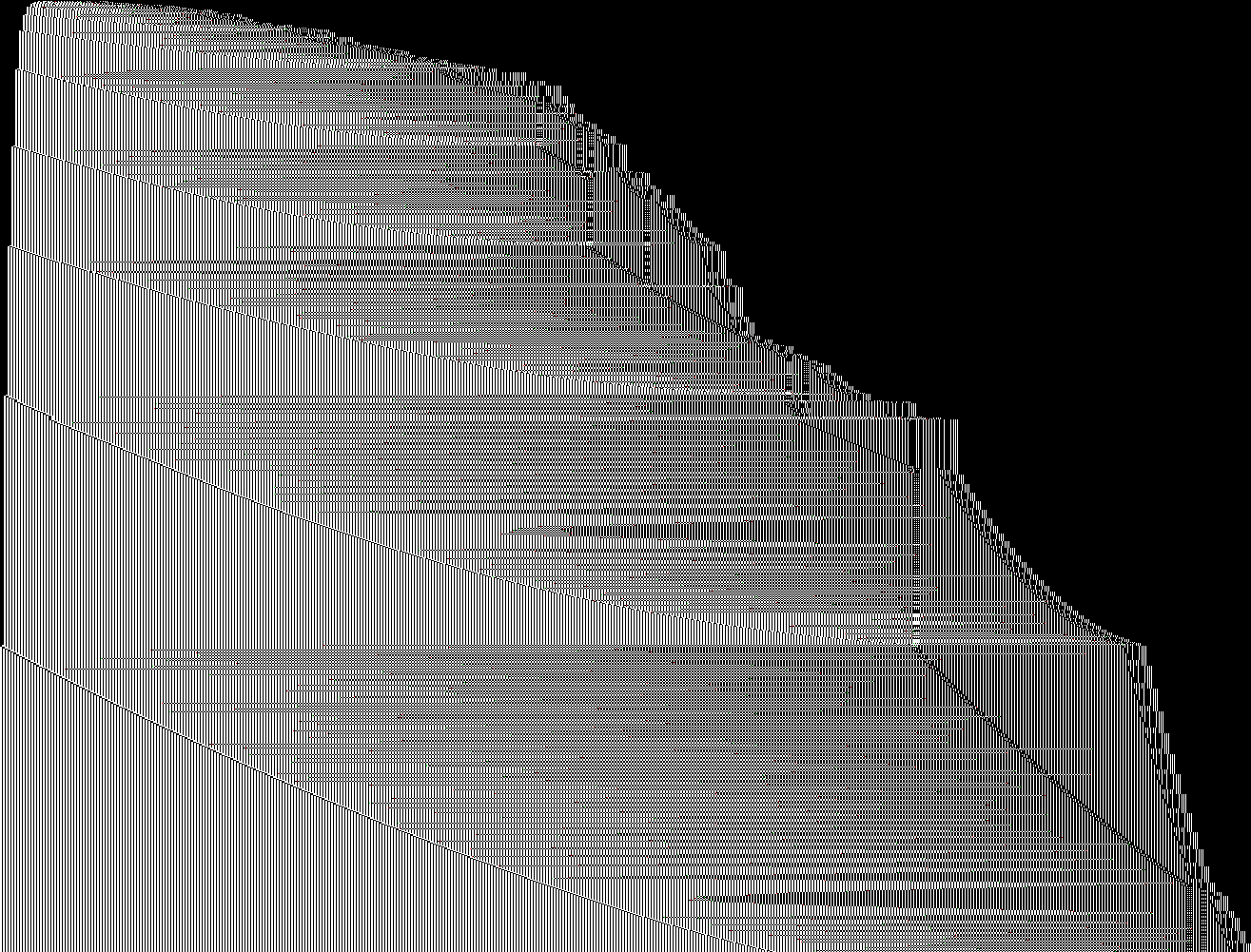
More figures (1)Fig 4: Right records, 3 million steps
One row per new rightmost cell. The vertical streaks are the defect paths seen at record times.
Rules (4/5 validated)exact tape rewrites the proof will formalize, each re-checked by simulation
| rule | from ⟶ to | cases | steps | checked |
|---|---|---|---|---|
| R1 main walk (P1) | 0∞ (110)a 0011 (110)b 16 (110)c (11011110)2 16 02 D> 0∞ ⟶ 0∞ (110)a+8 0011 (110)b-8 16 (110)c+2 (11011110)2 16 02 D> 0∞ | b >= 8; 8 trips of one block each | measured per instance (e.g. 5,966 at (41,27,50)); not fitted | ✓25/25 |
| R2 walk eating the second field (Q1) | 0∞ (110)x 0011 (110)y 1011 (110)z (11011110)2 16 02 D> 0∞ ⟶ 0∞ (110)x+16 0011 (110)y-8 1011 (110)z-6 (11011110)2 16 02 D> 0∞ | y >= 8, z >= 6 | measured per instance (e.g. 17,086 at (118,66,52)); not fitted | ✓25/25 |
| R3 walk inside the second field (Q3) | 0∞ (110)p 0011 (110)q 16 (011)2 03 16 (110)a 0011 (110)b (11011110)2 16 02 D> 0∞ ⟶ 0∞ (110)p 0011 (110)q 16 (011)2 03 16 (110)a+4 0011 (110)b-2 (11011110)2 16 02 D> 0∞ | b >= 2; a + 2b conserved | measured per instance; not fitted | ✓25/25 |
| halting pattern | 0∞ (110)5 D> 0011 (110)4 0∞ ⟶ halt | the only way to halt: D moving right reads the first 0 of 0011 (A0, B1, F1) | 4 | ✓1/1 |
| epoch law (reset to reset), fitted | 0∞ <E (001)N J word^M R 0∞ ⟶ 0∞ <E (001)N' J' word^M' R' 0∞, N' ~ N + 1.22M + 92, M' ~ 0.30N - 0.58M - 38 | residues of the phase ends (mod 6, 8, 2) pick J', R' and the next branch (Q1 then P1, or Q3 first); residuals up to +-550 / +-330 | — | –untested |
Compressed historythe tape as 0∞ <E (001)N J word^M R 0∞ at 23 moments: where the rules are read off
| step | N | M |
|---|---|---|
| 2,032,991 | 319 | 72 |
| 3,168,091 | 416 | 28 |
| 4,681,947 | 458 | 43 |
| 7,679,013 | 682 | 70 |
| 12,185,873 | 783 | 147 |
| 18,852,531 | 985 | 149 |
| 28,624,657 | 1,202 | 93 |
| 44,343,831 | 1,408 | 341 |
| 66,995,761 | 1,894 | 113 |
| 97,482,007 | 2,072 | 213 |
| 147,640,349 | 2,506 | 623 |
| 218,584,065 | 3,241 | 473 |
| 323,194,717 | 3,801 | 695 |
| 472,935,407 | 4,751 | 355 |
| 710,419,407 | 5,471 | 1,366 |
| 1,057,265,263 | 7,298 | 909 |
| 1,570,250,057 | 8,353 | 1,615 |
| 2,324,688,333 | 10,511 | 1,551 |
| 3,447,311,415 | 12,585 | 2,113 |
| 5,102,449,077 | 15,405 | 2,440 |
| 7,551,201,897 | 18,671 | 3,037 |
| 11,167,615,143 | 22,725 | 3,655 |
| 16,295,935,265 | 26,702 | 4,690 |
Nlast 26,702Mlast 4,690Template comparisonBECv5.v TM1: partly applies · the nearest solved proof, what carries over, and the transitions that differ
| 0 | 1 | |
|---|---|---|
| A | 1RB | 1LC |
| B | 1LA | 1RF |
| C | 0RD | 1RD |
| D | 0RA | 0LE |
| E | 1LA | 0LE |
| F | 0RC | --- |
- file
BECv5.v:30- module
TM1- machine
1RB1RA_1LC1LE_1RF1LD_1RE0LD_0LB0RA_---0RC(11 transitions apart)- diff
architecture only (no shared transitions)- note
- W5-3 (our kill, BECv5 TM1 architecture): a defect walks through a periodic word while a right counter counts trips, plus a left-edge eat; one level, a binary counter, 5 residue cases, 1-D invariant 1 <= N <= 2p. Here the counter is unary, the same walk runs at two levels (R1, R3), and the epoch map is 2-D with eigenvalues 1.20 and -0.78, so a proof needs a 2-D band (e.g. 0.05N <= M <= 0.3N) plus a closed census of branch shapes. No upstream proof of this table; 291 is only in Eqv lemmas (Eqv.v TM44, Eqv_v3.v TM437).
Proof strategy & riskshow the formal proof will go · 3 risks to watch
Pre-registered stop: the epoch law divides fields and branches on remainders, so park as a cryptid candidate. If funded: build an exact epoch accelerator from R1-R3 and the reset branches, check it against direct runs to 2e10, then census the branch shapes far out to see whether they close.
- ▲The branch set (J x R x phase, plus interleaved two-defect visits) may be large or not closed; 185 raw visit shapes by 1e8 (uncanonicalized).
- ▲The 2-D invariant band must survive residue perturbations; the -0.78 eigenvalue makes M/N oscillate (0.06..0.25 seen).
- ▲152 is only Eqv-linked (not the same table): a 291 proof transfers only through upstream Eqv lemmas resting on BBinf (two .v files).
Stats & provenance2·1010 steps simulated · 94,226 cells · the status in full · files
- simulated
- 2·1010 steps
- tape
- 94,226 cells
- growth
- epochs grow ~1.20x (fitted eigenvalue); span 94,226 at 1.63e10; 23 resets to 1.63e10, no halt
- status now
- Observe done (about 1 h 50 min). The mechanism is a 0011 defect walking through 110 fields: the head shuttles between the defect and a unary counter at the right end, one block per round trip. Three exact visit rules R1-R3 (main walk, walk that eats the second field, the same walk inside the second field) are validated 25/25 each from random instances. When the active defect reaches the junk before the counter, the head sweeps to the left edge and a new epoch starts. The epoch law, fitted on 22 resets to 1.63e10, is N' ~ N + 1.22M, M' ~ 0.30N - 0.58M (eigenvalues 1.20, -0.78); each phase ends on a remainder (mod 6, 8, 2) that picks the junk and the next branch. That is the pre-registered W6-3 stop rule (a field divided, branches on residues), so the cryptid protocol applies: rules formalized in observe.json, flagged, stopped. Unlike H-4, no branch is known to halt: halting needs D to read 0011 from its left, which no observed branch does, and ~5e5 epochs (Alistaire's 10^73975 steps) passed without a halt. A proof would need a closed census of branch shapes plus a 2-D band invariant on M/N (0.06..0.25 seen). (status.json, 2026-10-14)
- observer's note
- Visit rules R1-R3 exact and validated (25/25 each). The epoch law is a 2-D piecewise-affine map (eigenvalues 1.20, -0.78) whose branches are picked by remainders mod 6/8/2: the pre-registered W6-3 stop rule. No halting branch is known; closure of the branch set is unproved.
- files
- observe.json · notes.md · status.json
Proof & checks
No proof work yet.
Files
machines/<tm>/: 7 entries · raw notes, status, scripts, images
| name | size | changed |
|---|---|---|
| notes.md ↓ | 6.2 KB | 2026-10-14 14:07 |
| status.json ↓ | 2.2 KB | 2026-10-14 16:43 |
| observe.json ↓ | 10 KB | 2026-10-14 14:07 |
| decisions/ | 1 item | 2026-10-14 16:43 |
| img/ | 5 items | 2026-10-14 14:07 |
| scripts/ | 7 items | 2026-10-14 14:05 |
| work/ | 7 items | 2026-10-14 14:02 |
status.json in full
{
 "tm": "1RB1LC_1LA1RF_0RD1RD_0RA0LE_1LA0LE_0RC---",
 "label": "W6-3",
 "status": "CRYPTID_CANDIDATE",
 "stage": "observe",
 "updated": "2026-10-14",
 "confidence": "med",
 "reason": "Observe done (about 1 h 50 min). The mechanism is a 0011 defect walking through 110 fields: the head shuttles between the defect and a unary counter at the right end, one block per round trip. Three exact visit rules R1-R3 (main walk, walk that eats the second field, the same walk inside the second field) are validated 25/25 each from random instances. When the active defect reaches the junk before the counter, the head sweeps to the left edge and a new epoch starts. The epoch law, fitted on 22 resets to 1.63e10, is N' ~ N + 1.22M, M' ~ 0.30N - 0.58M (eigenvalues 1.20, -0.78); each phase ends on a remainder (mod 6, 8, 2) that picks the junk and the next branch. That is the pre-registered W6-3 stop rule (a field divided, branches on residues), so the cryptid protocol applies: rules formalized in observe.json, flagged, stopped. Unlike H-4, no branch is known to halt: halting needs D to read 0011 from its left, which no observed branch does, and ~5e5 epochs (Alistaire's 10^73975 steps) passed without a halt. A proof would need a closed census of branch shapes plus a 2-D band invariant on M/N (0.06..0.25 seen).",
 "siblings": [],
 "sibling_note": "No other start or mirror of this table is on the 740 or 778 lists (canon from all 6 starts). Starts B and E are in the 1590 equivalence file (Eqv_v3.v TM10, Eqv_v2.v TM1055). 152 (1RB1LF_0LC0RE_1LA1RD_0LB1LB_1RC1RD_0LD---) is not the same table; it is linked only through upstream Eqv lemmas.",
 "holdout_line_740": 291,
 "upstream": "No upstream proof of this table. 291 appears only in Eqv lemmas (Eqv.v TM44, Eqv_v3.v TM437), which are equivalences, not verdicts. No claim in data/discord or data/sheet (Results row 28: Unknown, no status, Alistaire's simulation note).",
 "priority_call_answered": "Cryptid-like (pre-registered stop): the epoch law branches on remainders, but no halting branch is known. Park it, or fund one 2 h stage to build an exact epoch accelerator and census the branch shapes for closure?",
 "parked": "Dennis 2026-10-14: park"
}