tools/rebuild_pages.sh rebuilds the site within 5 minutes of a change; by hand: python3 -B tools/site.py.1RB1LA_1LC0RA_0LD1RC_---0LE_0LF1LE_1RF1LB
How we proved it never halts
#12's proof with a smaller budget and zero slack
#12 works like a recursive call stack written in runs of 1s. Each round starts at the left end with a bottom call that can pay for three calls, the machine halts only if a round needs a fourth, and an exact law shows that every round costs exactly 2. #12b, once its states are renamed, is #12's table with one transition changed, started in the state that is #12's B instead of A; no renaming or mirror makes it exactly #12.
The changed transition is used only at the start of a round, when the bottom call is created at the left end. There it takes a 6-step detour to the same tape that #12 reaches in 2 steps. So the call-stack picture, the replay of rounds one level down and the cost law all carry over unchanged.
What is new is the budget. After a 48-step opening, every round starts with the left end reading 11 00 instead of 111 00, so the bottom call is three 1s long and can pay for only two calls. A single round needing three would halt the machine. But #12's law counts the calls exactly, not just as a bound: every round needs exactly 2, the budget is always just enough, and the missing transition never fires.
The Rocq proof is #12's file with the start-of-round move re-proved by running it, detour included, plus the new 48-step opening and one added lemma for a round that starts with the smaller bottom call.
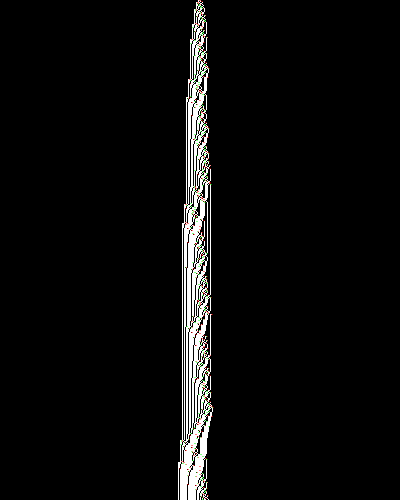
About this picture
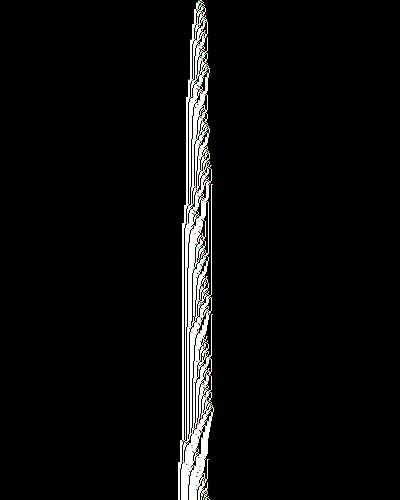
The standard picture (bbchallenge.org's Default view): each row is the whole tape at one step, time runs downward, and the head's path draws the pattern.
Claimed by someone else
We proved this machine locally, but our proof was still unsubmitted when we found it already covered upstream.
Submit completed proofs early. A local proof does not secure an upstream claim.
Upstream proof ↗ · Recorded timeline
What the timing evidence establishes
This describes upstream credit, not who first discovered the mathematics. The records do not establish adoption of our proof, first public push time, or whether an earlier submission would have secured credit.
Overview
In one sentence
Rename the twin's states A..F to B,C,D,E,F,A. The result is #12 with one transition changed (A0 = 1RA instead of 1RB; in twin names F0 = 1RF), started in #12's state B. It is not #12 up to renaming or mirroring (all 1,440 relabelings checked). F0 is read only at the first step of the left-edge push R3, where it takes a 6-step detour (F0 F0 F1 B1 A1 A0) to the configuration #12 reaches in 2 steps. The tape effect is the same; it costs 4 more steps. (submission/README.md, Mechanism)
- Upstream
- The blank-start machine never halts: CounterClass4.v.TM1 ↗. We also have a local proof. This upstream addition is separate from our merged submissions; adoption credit is not established. Recorded commit time: 2026-10-14T06:19:56Z. First public push time is not established.
- Rocq proof
- check_kill PASS · first Oct 10 09:52896 lines · 40 KB .v · compile 4.2 s · coqchk pass · 0 axioms · PASS Oct 10 09:52 (re-run Oct 10 11:54)· the .v file
- Automatic review
- 6 of 6 checks passtemplate: #12's kill file (kill 5) (twin: parent kill's .v) · details in Proof →
- Class
- Counter Class 4
- On the list
- not on
BB6_holdouts_663.txt(line 640 of the previous list) · historical 740 line 640 - Derived from
1RB1LC_#12 Claimed by someone else1RC1LB_ 1LD0RB_ 0LE1RD_ ---0LF_ 0LA1LF
Mechanism
What to check here: the pictures show the mechanism that the rule table describes.
Figures
Blaze view, time runs down. Find each row where the left edge steps out, and compare the gaps between them.
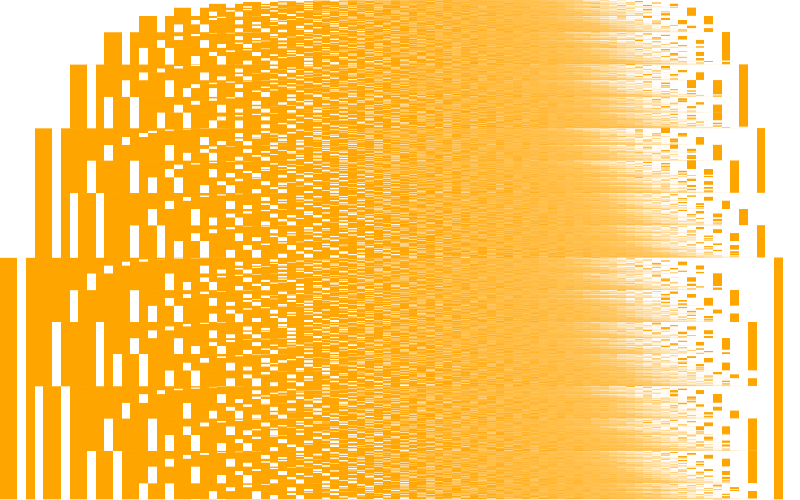
One long epoch (k = 8), time runs down. Find each step where the long left block (run 1) shrinks.
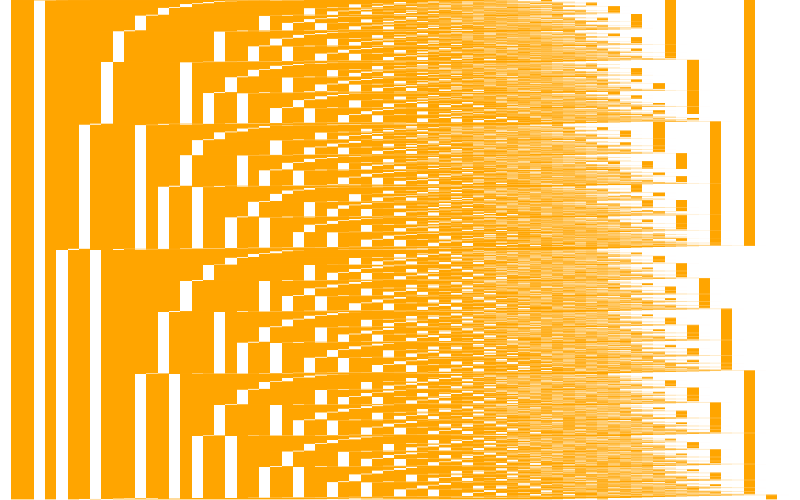
Edge records to 1e9 (only 134 rows). Look at the two thin white lines in the black right half.
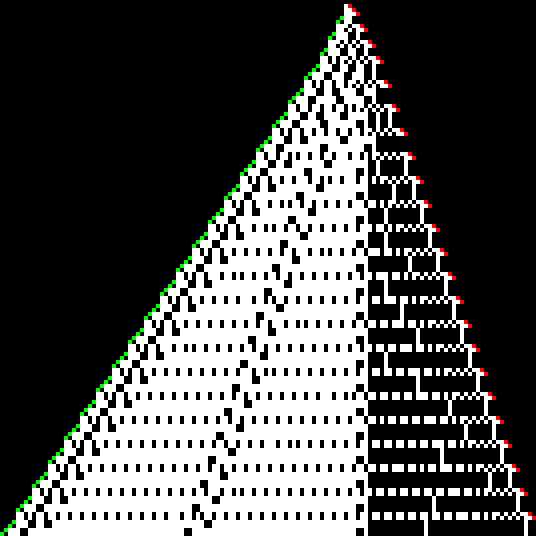
More figures (1)Fig 4: bbchallenge Default view, first 10,000 steps
For orientation: zig-zag sweeps over runs of 1s, as bbchallenge.org shows them.
Rules (9/9 validated)exact tape rewrites the proof will formalize, each re-checked by simulation
| rule | from ⟶ to | cases | steps | checked |
|---|---|---|---|---|
| R1 pointer right | 1n+2 <A 0 1m+1 02 1x 0 ⟶ 1n+1 0 1m+1 <A 0 1x+1 02 | n,m,x>=0; x=0 covers 0^3 and 0^inf after the 00 | 3m+2x+15 | ✓60/60 |
| R2 lone 1 merges, jump back | 1j+1 0 1k+1 0 1 <A 0 ⟶ 1j+1 <A 0 1k+2 02 | j,k>=0 | k+10 | ✓60/60 |
| R2e jump to edge | 0∞ 1k+1 0 1 <A 0 ⟶ 0∞ <A 0 1k+2 02 | k>=0 | k+10 | ✓60/60 |
| R3 edge refill | 0∞ <A 0 1k+1 02 1m 0 ⟶ 0∞ 1k+2 <A 0 1m+1 02 | k,m>=0 | 3k+2m+11 | ✓60/60 |
| HALT | 03 1 <A 0 ⟶ halt | only halting route; needs a lone 1 at the far left | 4 (incl. halting transition) | ✓40/40 |
| short epoch | Fs(k,P) = 0∞ <A 0 13 02 12 02 12k 02 12k+1 0P 1 0Q 1 0∞, P+Q=2k ⟶ Fl(k,P) = 0∞ <A 0 13 02 12k+1 02 12k+3 02 1 0P 1 0Q 1 0∞ | P,Q even >=2 (k up to 200 tested) | 40k+288 | ✓24/24 |
| long epoch | Fl(k,P) ⟶ Fs(k+1,P') with P' even, 2<=P'<=2k; or D(k+1) | P' irregular in (k,P), e.g. k=11: P 2,4,6,8,10,12 -> 6,8,10,16,D,4. Macro model: every even P for k<=13 closes with no halt | ~1260*2k (+-200, depends on P) | ✓22/22 |
| degenerate D | D(k) = 0∞ <A 0 13 02 12 02 12k+2 02 12k+1 0∞ ⟶ E(k) = 0∞ <A 0 13 02 12k+3 02 12k+3 02 1 0∞ | k>=3 | 40k+312 | ✓8/8 |
| E back to family | E(k) ⟶ Fs(k+1,2) | k=3..10; the real orbit takes D at k=25 (step 4.2e10), then E, then Fs(26,2) | ~1260*2k | ✓8/8 |
Compressed historythe tape as 0∞ <A 0 13 02 12 02 12k 02 12k+1 0P 1 0Q 1 0∞ at 26 moments: where the rules are read off
| step | k | P | Q |
|---|---|---|---|
| 1,590 | 1 | D | D |
| 4,090 | 2 | 2 | 2 |
| 8,806 | 3 | D | D |
| 18,826 | 4 | 2 | 6 |
| 38,730 | 5 | 6 | 4 |
| 78,838 | 6 | 4 | 8 |
| 159,230 | 7 | 4 | 10 |
| 320,186 | 8 | 10 | 6 |
| 642,526 | 9 | 4 | 14 |
| 1,287,310 | 10 | 8 | 12 |
| 2,577,198 | 11 | 12 | 10 |
| 5,157,430 | 12 | 4 | 20 |
| 10,317,966 | 13 | 12 | 14 |
| 20,639,446 | 14 | 20 | 8 |
| 41,282,870 | 15 | 24 | 6 |
| 82,570,218 | 16 | 18 | 14 |
| 165,145,050 | 17 | 30 | 4 |
| 330,295,486 | 18 | 16 | 20 |
| 660,596,506 | 19 | 14 | 24 |
| 1,321,198,810 | 20 | 26 | 14 |
| 2,642,404,258 | 21 | 10 | 32 |
| 5,284,815,110 | 22 | 28 | 16 |
| 10,569,637,546 | 23 | 38 | 8 |
| 21,139,283,246 | 24 | 24 | 24 |
| 42,278,575,038 | 25 | D | D |
| 84,557,158,858 | 26 | 2 | 50 |
klast 26Plast 2Qlast 50Template comparisonCounterClass2v1.v: does not apply · the nearest solved proof, what carries over, and the transitions that differ
| 0 | 1 | |
|---|---|---|
| A | 1RB | 1LC |
| B | 1RC | 1LB |
| C | 1LD | 0RB |
| D | 0LE | 1RD |
| E | --- | 0LF |
| F | 0LA | 1LF |
- file
CounterClass2v1.v- module
- —
- machine
1RB1RD_1LC---_1LE0LD_0RE1LC_1RA1RF_1RE0LF(11 transitions apart)- diff
10/12 transitions differ (best renaming+mirror); CounterClass3v2 8/12, closest CounterClass1 machine 8/12- note
- No rules or shapes carry over: 7 of 16 CC2v1 starting shapes (SkelE/Be) halt on this machine. What does carry over is the proof skeleton: an Inductive Side type, a Good invariant and progress_nonhalt_cond.
Proof & checks
Kill 6 · Counter Class 4 · the kill file 1RB1LA_1LC0RA_0LD1RC_---0LE_0LF1LE_1RF1LB.v: 896 lines, 106 items · the package submission/
1What is provedCheck: the string, the theorem and every check_kill line are green, and the .v on disk is the one that was checked (same sha256).
1RB1LA_1LC0RA_0LD1RC_---0LE_0LF1LE_1RF1LBsha256 81348b14976e863f…
| ✓ | 1RB1LA_1LC0RA_0LD1RC_---0LE_0LF1LE_1RF1LB.v | 81348b14976e863f… = checked |
| ✓ | submission/1RB1LA_1LC0RA_0LD1RC_---0LE_0LF1LE_1RF1LB.v | 81348b14976e863f… = checked |
All 17 check_kill checks with their one-line results
| ✓ | args | 6x2 machine, framework module Individual62, mode nonhalt |
| ✓ | input | 41142 bytes, 896 lines, 980 sentences |
| ✓ | framework | HEAD 0940bb9cf434ba68f0c025dabfde45a219999973 == pin; no tracked changes under verify/ |
| ✓ | framework_build | 13 needed framework .vo files present and fresh, with native code no older than the .vo |
| ✓ | forbidden | none of 30 forbidden patterns occur (ground rule 1's words: anywhere; command words: outside comments and strings; comments never split a token) |
| ✓ | structure | 5 Require name(s) allowed; no top-level Variable/Context; no shadowing; Module/Section balanced |
| ✓ | tm_text | line 26: TM_from_str "1RB1LA_1LC0RA_0LD1RC_---0LE_0LF1LE_1RF1LB" == <tm> (41 bytes) |
| ✓ | theorem_text | line 847: nonhalt : ~halts tm c0 |
| ✓ | coq | coqc 8.20.1 ([local working file] |
| ✓ | names | halts, c0, TM_from_str resolved inside Individual62 |
| ✓ | compile | compiled in 4.2s with all appended checks |
| ✓ | tm_rocq | BB6Kill.Candidate.tm = BusyCoq.Individual62.TM_from_str "1RB1LA_1LC0RA_0LD1RC_---0LE_0LF1LE_1RF1LB" by eq_refl (in-file and isolated) |
| ✓ | theorem_rocq | nonhalt : ~ halts (TM_from_str "1RB1LA_1LC0RA_0LD1RC_---0LE_0LF1LE_1RF1LB") c0 with absolute names (in-file and isolated) |
| ✓ | isolation | only stock proof plugins loaded; guard/positivity/universe checking on, definitional UIP off |
| ✓ | assumptions | 0 assumption(s), all in the baseline |
| ✓ | coqchk | coqchk -norec BB6Kill.Candidate ok (1.3s); its context summary lists nothing of the file's own |
| ✓ | integrity | input sha256 and framework HEAD/cleanliness identical before and after |
2Same machine as #12?Check: every row of the table is ✓ under the computed renaming (or the listed differences are what status.json's relation says), the two pictures show the same bands, and the trajectory numbers agree with the claimed relation (a twin keeps a fixed small offset; a sibling's gap grows).
status.json names #12 as the parent (1RB1LC_1RC1LB_1LD0RB_0LE1RD_---0LF_0LA1LF); label: “#12b”; relation: “neighbour of #12: one transition away from #12's table (after renaming); its run is nearly identical (134 vs 133 cells at 1e9), so a look-alike, not a sibling”. Everything below is computed from the two machine strings, not read from notes.
✗ Not the same table. No renaming of #12's states, with or without mirroring, gives this machine's table. Closest: A→F, B→A, C→B, D→C, E→D, F→E (#12's state → this machine's), no mirror, where 1 of 12 transitions differ:
- #12's A0 =
1RBpredicts this machine's F0 =1RA; it is1RF.
Under that map: This machine starts in #12's state B (#12 itself starts in A).
| #12 | #12's row (read 0, read 1) | σ | predicted row: renamed by σ | this machine's actual row | ||
|---|---|---|---|---|---|---|
| A | 1RB 1LC | → F | 1RA 1LB | 1RF 1LB | ✗ | start of #12 |
| B | 1RC 1LB | → A | 1RB 1LA | 1RB 1LA | ✓ | start of this machine |
| C | 1LD 0RB | → B | 1LC 0RA | 1LC 0RA | ✓ | |
| D | 0LE 1RD | → C | 0LD 1RC | 0LD 1RC | ✓ | |
| E | --- 0LF | → D | --- 0LE | --- 0LE | ✓ | |
| F | 0LA 1LF | → E | 0LF 1LE | 0LF 1LE | ✓ |
Rows aligned by σ: each of #12's states X sits next to this machine's state σ(X). ✓ = the actual row equals #12's row with every target state renamed by σ; --- (halt) must stay ---. Searched: all 720 renamings × with/without mirror.
Same view, same settings on both sides. Look for the same band structure: the tables differ in 1 transition(s) (listed above); it starts in #12's state B, not A, so the first steps differ; the numbers below read: trajectory twin, so after the start the bands should match line for line.
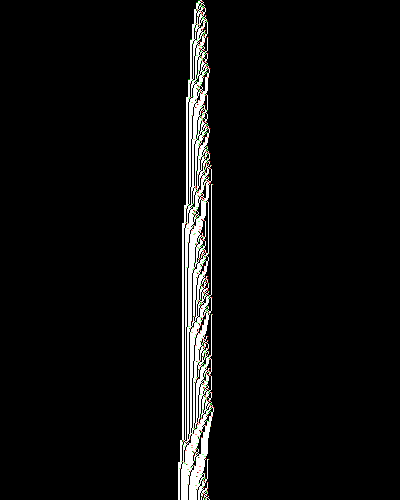
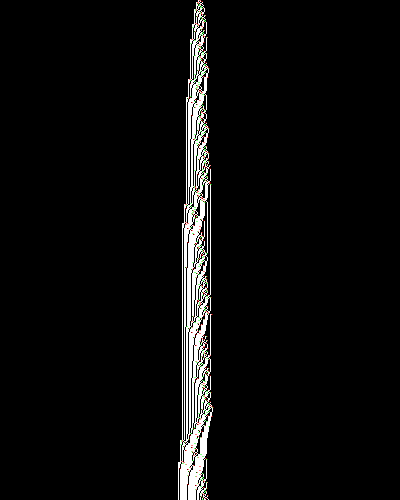
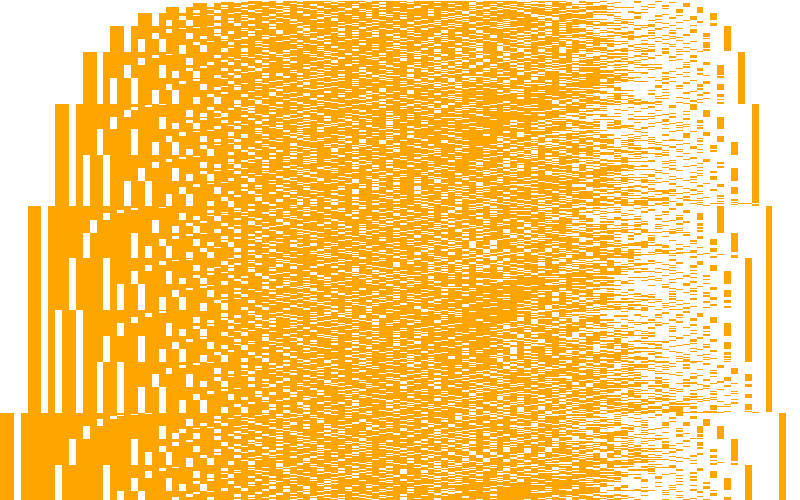
The macro behaviour, identical settings on both sides: each picture is its machine's own visited span stretched to 800 px, so compare the shape and order of the bands, not their absolute width. Speed mode samples one cell per column, so a one-cell shift can swap orange and white inside a band; compare band edges, not colours.
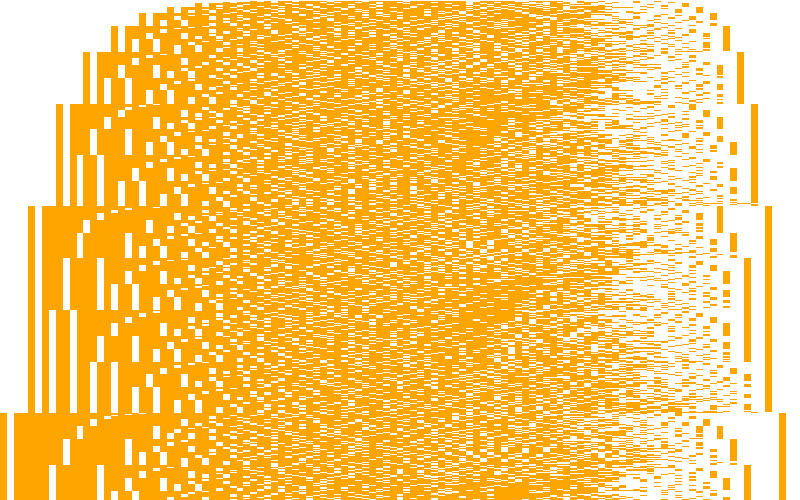
Trajectory numbers, from blank (C core)
✓ trajectory twin: within 2.2% at 1e9 (cells -1, nonzeros -2); the offset stays within 2 at every checkpoint instead of growing
| steps | cells visited (hi − lo + 1) | nonzeros | ||||
|---|---|---|---|---|---|---|
| #12 | this | ratio (Δ) | #12 | this | ratio (Δ) | |
| 1e5 | 56 | 55 | 0.9821 (-1) | 35 | 35 | 1.0000 (+0) |
| 1e6 | 74 | 73 | 0.9865 (-1) | 48 | 46 | 0.9583 (-2) |
| 1e7 | 92 | 91 | 0.9891 (-1) | 61 | 59 | 0.9672 (-2) |
| 1e8 | 116 | 115 | 0.9914 (-1) | 76 | 75 | 0.9868 (-1) |
| 1e9 | 134 | 133 | 0.9925 (-1) | 89 | 87 | 0.9775 (-2) |
Each machine from blank in its own start state, sim.py C core. Trajectory twin = cells and nonzeros stay within 16 of the parent's at every checkpoint (a fixed offset from a different start, not a growing gap). Cached in img/vs-parent.json (2026-10-16 10:29 PDT); --force recomputes.
3Where it came fromCheck: the template is the one you expect, and the measured reuse (tiles, the reuse figure, diff) agrees with what the README says was kept and changed (quoted).
This extends kill #12's .v (876 lines; in #12's own package). The changes:
- the
tmstring; - the head state
<{{A}}becomes<{{F}}(9 places: tR1, tR3, tR2, tR3c andconf); - the new
Ep_tm2; init's target, andnonhalt'sCand top step;- the comments.
The proof text differs in 4 lines plus the one new lemma, and the file compiled on the first try. It is a direct proof on the holdout string and does not use TM113.eqv. The file is 896 lines and imports only Individual62 from busycoq.
Top two bars: non-blank lines after the TM string is replaced by <TM> and whitespace is collapsed. Bottom bar: our Definitions/Lemmas/… by name.
Side-by-side diff: template (751 lines) vs ours (766 lines), 41 lines differ; runs of identical lines and long template-only runs folded
| template | ours | ||
|---|---|---|---|
| 16 | From BusyCoq Require Import Individual62. | 20 | From BusyCoq Require Import Individual62. |
| 17 | Require Import Lia. | 21 | Require Import Lia. |
| ⋯ 6 identical lines (template 18–25, ours 22–29) | |||
| 26 | Notation "c -->+ c'" := (c -[ tm ]->+ c') (at level 40). | 30 | Notation "c -->+ c'" := (c -[ tm ]->+ c') (at level 40). |
| 28 | Open Scope list. | 32 | Open Scope list. |
| 30 | (* R1: l 1^(n+2) <A 0 1^(m+1) 0 0 1^x 0 r --> l 1^(n+1) 0 1^(m+1) <A 0 1^(x+1) 0 0 r *) | 34 | (* R1: l 1^(n+2) <F 0 1^(m+1) 0 0 1^x 0 r --> l 1^(n+1) 0 1^(m+1) <F 0 1^(x+1) 0 0 r *) |
| 31 | Lemma tR1 n m x l r : | 35 | Lemma tR1 n m x l r : |
| 32 | l <* [1]^^(S (S n)) <{{A}} [0] *> [1]^^(S m) *> [0;0] *> [1]^^x *> [0] *> r -->+ | 36 | l <* [1]^^(S (S n)) <{{F}} [0] *> [1]^^(S m) *> [0;0] *> [1]^^x *> [0] *> r -->+ |
| 33 | l <* [1]^^(S n) <* [0] <* [1]^^(S m) <{{A}} [0] *> [1]^^(S x) *> [0;0] *> r. | 37 | l <* [1]^^(S n) <* [0] <* [1]^^(S m) <{{F}} [0] *> [1]^^(S x) *> [0;0] *> r. |
| 34 | Proof. es. Qed. | 38 | Proof. es. Qed. |
| 36 | (* R3: l 0 <A 0 1^(k+1) 0 0 1^m 0 r --> l 1^(k+2) <A 0 1^(m+1) 0 0 r *) | 40 | (* R3': l 0 <F 0 1^(k+1) 0 0 1^m 0 r --> l 1^(k+2) <F 0 1^(m+1) 0 0 r |
| 41 | (detour F0 F0 F1 B1 A1 A0, then #12's R3 tail; 4 more steps than #12) *) | ||
| 37 | Lemma tR3 k m l r : | 42 | Lemma tR3 k m l r : |
| 38 | l <* [0] <{{A}} [0] *> [1]^^(S k) *> [0;0] *> [1]^^m *> [0] *> r -->+ | 43 | l <* [0] <{{F}} [0] *> [1]^^(S k) *> [0;0] *> [1]^^m *> [0] *> r -->+ |
| 39 | l <* [1]^^(S (S k)) <{{A}} [0] *> [1]^^(S m) *> [0;0] *> r. | 44 | l <* [1]^^(S (S k)) <{{F}} [0] *> [1]^^(S m) *> [0;0] *> r. |
| 40 | Proof. es. Qed. | 45 | Proof. es. Qed. |
| 42 | (* R2: l 0 1^(k+1) 0 1 <A 0 r --> l <A 0 1^(k+2) 0 0 r *) | 47 | (* R2: l 0 1^(k+1) 0 1 <F 0 r --> l <F 0 1^(k+2) 0 0 r *) |
| 43 | Lemma tR2 k l r : | 48 | Lemma tR2 k l r : |
| 44 | l <* [0] <* [1]^^(S k) <* [0] <* [1] <{{A}} [0] *> r -->+ | 49 | l <* [0] <* [1]^^(S k) <* [0] <* [1] <{{F}} [0] *> r -->+ |
| 45 | l <{{A}} [0] *> [1]^^(S (S k)) *> [0;0] *> r. | 50 | l <{{F}} [0] *> [1]^^(S (S k)) *> [0;0] *> r. |
| 46 | Proof. es. Qed. | 51 | Proof. es. Qed. |
| 48 | Lemma tR3c k m r : | 53 | Lemma tR3c k m r : |
| 49 | const 0 <{{A}} [0] *> [1]^^(S k) *> [0;0] *> [1]^^m *> [0] *> r -->+ | 54 | const 0 <{{F}} [0] *> [1]^^(S k) *> [0;0] *> [1]^^m *> [0] *> r -->+ |
| 50 | const 0 <* [1]^^(S (S k)) <{{A}} [0] *> [1]^^(S m) *> [0;0] *> r. | 55 | const 0 <* [1]^^(S (S k)) <{{F}} [0] *> [1]^^(S m) *> [0;0] *> r. |
| 51 | Proof. rewrite (const_unfold _ S0) at 1. es. Qed. | 56 | Proof. rewrite (const_unfold _ S0) at 1. es. Qed. |
| 53 | (* ---------- tape encoding of the run model ---------- *) | 58 | (* ---------- tape encoding of the run model ---------- *) |
| ⋯ 14 identical lines (template 54–69, ours 59–74) | |||
| 70 | | c :: g :: R' => [1]^^c *> [0]^^g *> rside R' | 75 | | c :: g :: R' => [1]^^c *> [0]^^g *> rside R' |
| 71 | end. | 76 | end. |
| 73 | Definition conf (L R : list nat) : Q * tape := lside L <{{A}} [0] *> rside R. | 78 | Definition conf (L R : list nat) : Q * tape := lside L <{{F}} [0] *> rside R. |
| 75 | Lemma c0_1 : 0 >> const 0 = const 0. | 80 | Lemma c0_1 : 0 >> const 0 = const 0. |
| 76 | Proof. symmetry. apply const_unfold. Qed. | 81 | Proof. symmetry. apply const_unfold. Qed. |
| ⋯ 119 identical lines (template 78–209, ours 83–214) | |||
| 210 | intros z Hz. destruct z as [|z]; [lia|]. | 215 | intros z Hz. destruct z as [|z]; [lia|]. |
| 211 | replace (S z - S c + 1) with (z - c + 1) by lia. eapply L_cpp; eauto; [lia | apply Hm; lia]. | 216 | replace (S z - S c + 1) with (z - c + 1) by lia. eapply L_cpp; eauto; [lia | apply Hm; lia]. |
| 217 | Qed. | ||
| 219 | (* the twin's edge frame has value 3 (budget 2): an epoch of cost 2 runs at z = 3 | ||
| 220 | (proof.md section 5, budget-2 edge lemma) *) | ||
| 221 | Lemma Ep_tm2 W W' : Ep W 2 W' -> conf [] (2 :: 2 :: W) -->+ conf [] (2 :: 2 :: W'). | ||
| 222 | Proof. | ||
| 223 | intros (R0 & Hu & HL). | ||
| 224 | destruct (Life_shape _ _ _ HL 2 _ eq_refl) as (W'' & E & Hc & Hm). | ||
| 225 | inversion E; subst. | ||
| 226 | eapply progress_trans. { apply push0_ok; [exact Hu | lia]. } | ||
| 227 | exact (Life_tm _ _ _ (Hm 3 ltac:(lia)) []). | ||
| 212 | Qed. | 228 | Qed. |
| 214 | Definition bump (o : outcome) : outcome := | 230 | Definition bump (o : outcome) : outcome := |
| ⋯ 533 identical lines (template 215–824, ours 231–840) | |||
| 825 | Qed. | 841 | Qed. |
| 827 | (* ---------- top level ---------- *) | 843 | (* ---------- top level ---------- *) |
| 828 | Lemma init : c0 -->* conf [] [3; 2; 1]. | 844 | Lemma init : c0 -->* conf [] [2; 2; 1]. |
| 829 | Proof. unfold conf, lside, rside. cbn [lpow app]. solve_init. Qed. | 845 | Proof. unfold conf, lside, rside. cbn [lpow app]. solve_init. Qed. |
| 831 | Lemma nonhalt: ~halts tm c0. | 847 | Lemma nonhalt: ~halts tm c0. |
| 832 | Proof. | 848 | Proof. |
| 833 | eapply multistep_nonhalt; [apply init |]. | 849 | eapply multistep_nonhalt; [apply init |]. |
| 834 | apply (progress_nonhalt_cond tm (nat * list nat) (0, [1]) (fun i => conf [] (3 :: 2 :: snd i)) | 850 | apply (progress_nonhalt_cond tm (nat * list nat) (0, [1]) (fun i => conf [] (2 :: 2 :: snd i)) |
| 835 | (fun i => Orb [] (fst i) (snd i) /\ (1 <= fst i -> Inv [] (fst i) (snd i)))). | 851 | (fun i => Orb [] (fst i) (snd i) /\ (1 <= fst i -> Inv [] (fst i) (snd i)))). |
| 836 | - intros [n W] [HO HI]. cbn [fst snd] in *. | 852 | - intros [n W] [HO HI]. cbn [fst snd] in *. |
| 837 | destruct (step_lemma n (main n) [] n W ltac:(cbn; lia) I HO HI) as (W' & HE & HI'). | 853 | destruct (step_lemma n (main n) [] n W ltac:(cbn; lia) I HO HI) as (W' & HE & HI'). |
| 838 | exists (S n, W'). cbn [fst snd]. split. | 854 | exists (S n, W'). cbn [fst snd]. split. |
| 839 | + apply Ep_tm in HE. replace (cost [] n) with 2 in HE by reflexivity. exact HE. | 855 | + replace (cost [] n) with 2 in HE by reflexivity. exact (Ep_tm2 _ _ HE). |
| 840 | + split; [econstructor; eauto | intros; exact HI']. | 856 | + split; [econstructor; eauto | intros; exact HI']. |
| 841 | - cbn [fst snd]. split; [exact (O0 []) | lia]. | 857 | - cbn [fst snd]. split; [exact (O0 []) | lia]. |
| ⋯ 2 identical lines (template 842–845, ours 858–861) | |||
| 846 | ``` | 862 | ``` |
| 847 | 1RB1LC_1RC1LB_1LD0RB_0LE1RD_---0LF_0LA1LF | 863 | 1RB1LA_1LC0RA_0LD1RC_---0LE_0LF1LE_1RF1LB |
| 849 | conf L R := 0^inf 1^a_1 0 1^a_2 0 .. 0 1^a_p <A 0 1^c_1 0^g_1 1^c_2 .. 1^c_r 0^inf | 865 | conf L R := 0^inf 1^a_1 0 1^a_2 0 .. 0 1^a_p <F 0 1^c_1 0^g_1 1^c_2 .. 1^c_r 0^inf |
| 850 | (L = [a_p; ..; a_1] top first, R = [c_1; g_1; c_2; ..; c_r]) | 866 | (L = [a_p; ..; a_1] top first, R = [c_1; g_1; c_2; ..; c_r]) |
| 851 | tR1 l 1^(n+2) <A 0 1^(m+1) 0 0 1^x 0 r -->+ l 1^(n+1) 0 1^(m+1) <A 0 1^(x+1) 0 0 r | 867 | tR1 l 1^(n+2) <F 0 1^(m+1) 0 0 1^x 0 r -->+ l 1^(n+1) 0 1^(m+1) <F 0 1^(x+1) 0 0 r |
| 852 | tR3 l 0 <A 0 1^(k+1) 0 0 1^m 0 r -->+ l 1^(k+2) <A 0 1^(m+1) 0 0 r | 868 | tR3 l 0 <F 0 1^(k+1) 0 0 1^m 0 r -->+ l 1^(k+2) <F 0 1^(m+1) 0 0 r (3k+2m+15 steps: |
| 853 | tR2 l 0 1^(k+1) 0 1 <A 0 r -->+ l <A 0 1^(k+2) 0 0 r | ||
| 869 | detour F0 F0 F1 B1 A1 A0, then #12's R3 tail) | ||
| 870 | tR2 l 0 1^(k+1) 0 1 <F 0 r -->+ l <F 0 1^(k+2) 0 0 r | ||
| 854 | push conf (x::L) (h::R') -->+ conf (h::x-1::L) (updt R') x >= 2 (tR1) | 871 | push conf (x::L) (h::R') -->+ conf (h::x-1::L) (updt R') x >= 2 (tR1) |
| 855 | push0 conf [] (h::R') -->+ conf [h+1] (updt R') (tR3) | 872 | push0 conf [] (h::R') -->+ conf [h+1] (updt R') (tR3) |
| 856 | pop conf (1::y::L) R -->+ conf L (y+1::2::R) y >= 1 (tR2) | 873 | pop conf (1::y::L) R -->+ conf L (y+1::2::R) y >= 1 (tR2) |
| 857 | updt [] = [1], updt [2;c] = [c+1], updt (2::c::g::R) = c+1::g+1::R, updt (g::R) = 1::g-1::R (g >= 3) | 874 | updt [] = [1], updt [2;c] = [c+1], updt (2::c::g::R) = c+1::g+1::R, updt (g::R) = 1::g-1::R (g >= 3) |
| 859 | Edge W := conf [] (3::2::W); Ep W c W' : Edge W -->+ conf [] (5-c::2::W') | ||
| 876 | Ep W c W' : conf [] (3::2::W) -->+ conf [] (5-c::2::W') (edge frame of value 4, as in #12) | ||
| 877 | Ep_tm2 : Ep W 2 W' -> conf [] (2::2::W) -->+ conf [] (2::2::W') | ||
| 878 | (edge frame of value 3: Life_shape at z = 3, push0 at h = 2, Life_tm at L = []) | ||
| 860 | U0 Ep [1] = (2, [2;2;1]) | 879 | U0 Ep [1] = (2, [2;2;1]) |
| 861 | U1 Ep (1::g::rest) = (2, 2::2::1::g-2::rest) g >= 4 | 880 | U1 Ep (1::g::rest) = (2, 2::2::1::g-2::rest) g >= 4 |
| ⋯ 9 identical lines (template 862–870, ours 881–889) | |||
| 871 | Q = Qi ++ Qe, |Qi| = b+1-a+[k in P], every q in Qi <= a-2-[k in P], | 890 | Q = Qi ++ Qe, |Qi| = b+1-a+[k in P], every q in Qi <= a-2-[k in P], |
| 872 | Qe = the indices of P above k, each shifted by a-k-3 | 891 | Qe = the indices of P above k, each shifted by a-k-3 |
| 873 | start: c0 -->* Edge [1] = Edge (O_0([])) (50 steps) | ||
| 892 | start: c0 -->* conf [] [2;2;1] = conf [] (2::2::O_0([])) (48 steps) | ||
| 874 | top: O_n([]) has no markers, so Edge (O_n([])) -->+ Edge (O_(n+1)([])) for every n | ||
| 893 | top: O_n([]) has no markers, so every epoch costs exactly 2 and | ||
| 894 | conf [] (2::2::O_n([])) -->+ conf [] (2::2::O_(n+1)([])) for every n | ||
| 875 | ``` | 895 | ``` |
| 876 | *) | 896 | *) |
4Proof outlineCheck: the new items (green) carry the argument; the names read like the proof.md rules.
106 items in 1RB1LA_1LC0RA_0LD1RC_---0LE_0LF1LE_1RF1LB.v (896 lines): 81 Lemma, 16 Definition, 5 Fixpoint, 3 Inductive, 1 Theorem. Tags against the template: identical = same name and same text once each file's own TM string is <TM> (marked "except the TM string" when that is the only difference); adapted = same name, different text; new = no item of that name in the template part.
| # | kind | name | statement (no proof body) | line | vs template |
|---|---|---|---|---|---|
| 1 | Definition | tm | Definition tm := Eval compute in (TM_from_str "1RB1LA_1LC0RA_0LD1RC_---0LE_0LF1LE_1RF1LB"). | L26 | identicalexcept the TM string |
| 2 | Lemma | tR1 | Lemma tR1 n m x l r :
l <* [1]^^(S (S n)) <{{F}} [0] *> [1]^^(S m) *> [0;0] *> [1]^^x *> [0] *> r -->+
l <* [1]^^(S n) <* [0] <* [1]^^(S m) <{{F}} [0] *> [1]^^(S x) *> [0;0] *> r. | L35 | adapted |
| 3 | Lemma | tR3 | Lemma tR3 k m l r :
l <* [0] <{{F}} [0] *> [1]^^(S k) *> [0;0] *> [1]^^m *> [0] *> r -->+
l <* [1]^^(S (S k)) <{{F}} [0] *> [1]^^(S m) *> [0;0] *> r. | L42 | adapted |
| 4 | Lemma | tR2 | Lemma tR2 k l r :
l <* [0] <* [1]^^(S k) <* [0] <* [1] <{{F}} [0] *> r -->+
l <{{F}} [0] *> [1]^^(S (S k)) *> [0;0] *> r. | L48 | adapted |
| 5 | Lemma | tR3c | Lemma tR3c k m r :
const 0 <{{F}} [0] *> [1]^^(S k) *> [0;0] *> [1]^^m *> [0] *> r -->+
const 0 <* [1]^^(S (S k)) <{{F}} [0] *> [1]^^(S m) *> [0;0] *> r. | L53 | adapted |
| 6 | Fixpoint | lsep | Fixpoint lsep (L : list nat) : side := match L with | [] => const 0 | y :: L' => lsep L' <* [1]^^y <* [0] end. | L59 | identical |
| 7 | Definition | lside | Definition lside (L : list nat) : side := match L with | [] => const 0 | x :: L' => lsep L' <* [1]^^x end. | L65 | identical |
| 8 | Fixpoint | rside | Fixpoint rside (R : list nat) : side := match R with | [] => const 0 | [c] => [1]^^c *> const 0 | c :: g :: R' => [1]^^c *> [0]^^g *> rside R' end. | L71 | identical |
| 9 | Definition | conf | Definition conf (L R : list nat) : Q * tape := lside L <{{F}} [0] *> rside R. | L78 | adapted |
| 10 | Lemma | c0_1 | Lemma c0_1 : 0 >> const 0 = const 0. | L80 | identical |
| 11 | Lemma | lsep_eq | Lemma lsep_eq L : lsep L = lside L <* [0]. | L83 | identical |
| 12 | Definition | updt | Definition updt (R' : list nat) : option (list nat) := match R' with | [] => Some [1] | g :: R'' => match g with | 0 | 1 => None … +11 lines | L91 | identical |
| 13 | Lemma | updt_shape | Lemma updt_shape m R' R1 : updt R' = Some R1 ->
exists x r, rside (S m :: R') = [S1]^^(S m) *> [S0;S0] *> [S1]^^x *> [S0] *> r /\
rside R1 = [S1]^^(S x) *> [S0;S0] *> r. | L109 | identical |
| 14 | Lemma | push_ok | Lemma push_ok y h R' R1 L : updt R' = Some R1 -> 1 <= y -> 1 <= h -> conf (S y :: L) (h :: R') -->+ conf (h :: y :: L) R1. | L123 | identical |
| 15 | Lemma | push0_ok | Lemma push0_ok h R' R1 : updt R' = Some R1 -> 1 <= h -> conf [] (h :: R') -->+ conf [S h] R1. | L133 | identical |
| 16 | Lemma | pop_ok | Lemma pop_ok y L R : 1 <= y -> conf (1 :: y :: L) R -->+ conf L (S y :: 2 :: R). | L143 | identical |
| 17 | Inductive | outcome | Inductive outcome := Fin (R : list nat) | Pop (c : nat) (R : list nat). | L153 | identical |
| 18 | Inductive | Life | Inductive Life : nat -> list nat -> outcome -> Prop :=
| L_fin R : Life 1 R (Fin R)
| L_cf y h R' R1 Rc : 1 <= y -> updt R' = Some R1 -> Life h R1 (Fin Rc) ->
Life (S y) (h :: R') (Pop 1 (S y :: 2 :: Rc))
| L_cpf y h R' R1 c' R2 Rf : 1 <= y -> updt R' = Some R1 -> Life h R1 (Pop c' R2) ->
Life y R2 (Fin Rf) -> Life (S y) (h :: R') (Fin Rf)
… +2 lines | L159 | identical |
| 19 | Lemma | Life_pos | Lemma Life_pos x R o : Life x R o -> 1 <= x. | L168 | identical |
| 20 | Lemma | Life_tm | Lemma Life_tm x R o : Life x R o -> forall L, match o with | Fin Rf => conf (x :: L) R -->* conf (1 :: L) Rf | Pop _ Rf => conf (x :: L) R -->+ conf L Rf end. | L171 | identical |
| 21 | Definition | Ep | Definition Ep (W : list nat) (c : nat) (W' : list nat) : Prop := exists R0, updt (2 :: W) = Some R0 /\ Life 4 R0 (Pop c ((5 - c) :: 2 :: W')). | L194 | identical |
| 22 | Lemma | Ep_tm | Lemma Ep_tm W c W' : Ep W c W' -> conf [] (3 :: 2 :: W) -->+ conf [] ((5 - c) :: 2 :: W'). | L197 | identical |
| 23 | Lemma | Life_shape | Lemma Life_shape x R o : Life x R o -> forall c Rf, o = Pop c Rf -> exists W', Rf = (x - c + 1) :: 2 :: W' /\ c + 1 <= x /\ forall z, c + 1 <= z -> Life z R (Pop c ((z - c + 1) :: 2 :: W')). | L204 | identical |
| 24 | Lemma | Ep_tm2 | Lemma Ep_tm2 W W' : Ep W 2 W' -> conf [] (2 :: 2 :: W) -->+ conf [] (2 :: 2 :: W'). | L221 | new |
| 25 | Definition | bump | Definition bump (o : outcome) : outcome := match o with Fin W => Fin W | Pop c W => Pop (S c) W end. | L230 | identical |
| 26 | Lemma | L_cp | Lemma L_cp y h R' R1 c' R2 o : 1 <= y -> updt R' = Some R1 -> Life h R1 (Pop c' R2) -> Life y R2 o -> Life (S y) (h :: R') (bump o). | L233 | identical |
| 27 | Lemma | updt_cons2 | Lemma updt_cons2 W R0 : updt (2 :: W) = Some R0 -> exists c2 W1, W = c2 :: W1. | L237 | identical |
| 28 | Lemma | frame_step | Lemma frame_step y z W c W' o y' z' : Ep W c W' -> 2 <= y -> c + 1 <= z -> y' = y - 1 -> z' = z - c + 1 -> Life y' (z' :: 2 :: W') o -> Life y (z :: 2 :: W) (bump o). | L241 | identical |
| 29 | Definition | tail_ok | Definition tail_ok (N : list nat) : Prop := N = [] \/ exists g rest, N = S (S g) :: rest. | L264 | identical |
| 30 | Lemma | U0 | Lemma U0 : Ep [1] 2 [2;2;1]. | L266 | identical |
| 31 | Lemma | U1 | Lemma U1 g rest : Ep (1 :: S (S (S (S g))) :: rest) 2 (2 :: 2 :: 1 :: S (S g) :: rest). | L269 | identical |
| 32 | Lemma | U2 | Lemma U2 b N : tail_ok N -> Ep (1 :: 2 :: S b :: N) 2 (S (S (S b)) :: 2 :: 1 :: N). | L272 | identical |
| 33 | Lemma | ruleS | Lemma ruleS a b N : tail_ok N -> Ep (2 :: 2 :: S a :: 2 :: S b :: N) 2 (S (S a) :: 2 :: S (S (S b)) :: 2 :: 1 :: N). | L275 | identical |
| 34 | Lemma | TRF | Lemma TRF a b N Rc : tail_ok N -> 2 <= a -> Life a (S (S (S b)) :: 2 :: 1 :: N) (Fin Rc) -> Ep (a :: 2 :: S b :: N) 2 Rc. | L279 | identical |
| 35 | Lemma | Xin0 | Lemma Xin0 a'' b'' : 1 <= a'' -> Life 2 [2; 2; a''; 2; b''] (Pop 1 [2; 2; S a''; 2; S b'']). | L283 | identical |
| 36 | Lemma | Xin1 | Lemma Xin1 a'' b'' g rest : 1 <= a'' -> Life 2 (2 :: 2 :: a'' :: 2 :: b'' :: S g :: rest) (Pop 1 (2 :: 2 :: S a'' :: 2 :: S b'' :: S (S g) :: rest)). | L287 | identical |
| 37 | Lemma | TRX0 | Lemma TRX0 a b N c a'' b'' : tail_ok N -> 2 <= a -> Life a (S (S (S b)) :: 2 :: 1 :: N) (Pop c [2; 2; S a''; 2; S b'']) -> Ep (a :: 2 :: S b :: N) 3 [S (S a''); 2; S (S b'')]. | L291 | identical |
| 38 | Lemma | TRX1 | Lemma TRX1 a b N c a'' b'' g rest : tail_ok N -> 2 <= a -> Life a (S (S (S b)) :: 2 :: 1 :: N) (Pop c (2 :: 2 :: S a'' :: 2 :: S b'' :: S g :: rest)) -> Ep (a :: 2 :: S b :: N) 3 (S (S a'') :: 2 :: S (S b'') :: S (S g) :: rest). | L296 | identical |
| 39 | Fixpoint | mwf | Fixpoint mwf (s : nat) (P : list nat) : list nat := match P with | [] => [] | p :: P' => (p - s + 1) :: 1 :: mwf p P' end. | L304 | identical |
| 40 | Definition | mw | Definition mw (P : list nat) : list nat := mwf 0 P. | L309 | identical |
| 41 | Fixpoint | valid_from | Fixpoint valid_from (s : nat) (P : list nat) : Prop := match P with | [] => True | p :: P' => (exists t, p = s + 2 * t + 1) /\ valid_from p P' end. | L312 | identical |
| 42 | Definition | valid | Definition valid (P : list nat) : Prop := valid_from 0 P. | L317 | identical |
| 43 | Definition | cnt | Definition cnt (Q : list nat) (n : nat) : nat := length (filter (fun q => q <? n) Q). | L319 | identical |
| 44 | Definition | ind | Definition ind (Q : list nat) (n : nat) : nat := cnt Q (S n) - cnt Q n. | L320 | identical |
| 45 | Definition | cost | Definition cost (Q : list nat) (n : nat) : nat := 2 + ind Q n. | L321 | identical |
| 46 | Inductive | Orb | Inductive Orb (Q : list nat) : nat -> list nat -> Prop := | O0 : Orb Q 0 (1 :: mw Q) | OS n W W' : Orb Q n W -> Ep W (cost Q n) W' -> Orb Q (S n) W'. | L323 | identical |
| 47 | Fixpoint | bumpn | Fixpoint bumpn (k : nat) (o : outcome) : outcome := match k with 0 => o | S k => bumpn k (bump o) end. | L327 | identical |
| 48 | Lemma | bumpn_fin | Lemma bumpn_fin k W : bumpn k (Fin W) = Fin W. | L330 | identical |
| 49 | Lemma | bumpn_pop | Lemma bumpn_pop k c W : bumpn k (Pop c W) = Pop (k + c) W. | L333 | identical |
| 50 | Lemma | cnt_0 | Lemma cnt_0 Q : cnt Q 0 = 0. | L336 | identical |
| 51 | Lemma | cnt_mono | Lemma cnt_mono Q n : cnt Q n <= cnt Q (S n). | L339 | identical |
| 52 | Lemma | cnt_mono' | Lemma cnt_mono' Q n m : n <= m -> cnt Q n <= cnt Q m. | L345 | identical |
| 53 | Lemma | replay | Lemma replay Q k Wk : Orb Q k Wk -> forall y z o, k + 1 <= y -> (k = 0 \/ k + 2 + cnt Q k <= z) -> Life (y - k) ((z - k - cnt Q k) :: 2 :: Wk) o -> Life y (z :: 2 :: 1 :: mw Q) (bumpn k o). | L348 | identical |
| 54 | Lemma | mw_tail_ok | Lemma mw_tail_ok Q : valid Q -> tail_ok (mw Q). | L358 | identical |
| 55 | Lemma | ruleT | Lemma ruleT a b Q W' : Orb Q (a - 1) W' -> 2 <= a -> 1 <= b -> valid Q -> a - 1 + cnt Q (a - 1) <= b -> Ep (a :: 2 :: b :: mw Q) 2 ((b + 3 - a - cnt Q (a - 1)) :: 2 :: W'). | L364 | identical |
| 56 | Lemma | mwf_shift | Lemma mwf_shift s k P : mwf (s + k) (map (fun p => p + k) P) = mwf s P. | L377 | identical |
| 57 | Lemma | ruleX | Lemma ruleX a b Q a'' Q'' : Orb Q (a - 2) (a'' :: 2 :: b :: mw Q'') -> 3 <= a -> 1 <= b -> 1 <= a'' -> valid Q -> valid Q'' -> b = a - 2 + cnt Q (a - 2) -> Ep (a :: 2 :: b :: mw Q) 3 (S (S a'') :: 2 :: S (S b) :: mw (map (fun q => q + 2) Q'')). | L383 | identical |
| 58 | Lemma | valid_gt | Lemma valid_gt s P : valid_from s P -> Forall (fun p => s < p) P. | L406 | identical |
| 59 | Lemma | cnt_cons_lt | Lemma cnt_cons_lt q Q n : q < n -> cnt (q :: Q) n = S (cnt Q n). | L413 | identical |
| 60 | Lemma | cnt_cons_ge | Lemma cnt_cons_ge q Q n : n <= q -> cnt (q :: Q) n = cnt Q n. | L416 | identical |
| 61 | Lemma | cnt_app | Lemma cnt_app X Y n : cnt (X ++ Y) n = cnt X n + cnt Y n. | L419 | identical |
| 62 | Lemma | cnt_all_lt | Lemma cnt_all_lt X n : Forall (fun q => q < n) X -> cnt X n = length X. | L422 | identical |
| 63 | Lemma | cnt_all_ge | Lemma cnt_all_ge X n : Forall (fun q => n <= q) X -> cnt X n = 0. | L428 | identical |
| 64 | Lemma | cnt_S_nin | Lemma cnt_S_nin Q n : ~ In n Q -> cnt Q (S n) = cnt Q n. | L434 | identical |
| 65 | Lemma | cnt_S_in | Lemma cnt_S_in s Q n : valid_from s Q -> In n Q -> cnt Q (S n) = S (cnt Q n). | L444 | identical |
| 66 | Lemma | ind_in | Lemma ind_in Q n : valid Q -> In n Q -> ind Q n = 1. | L454 | identical |
| 67 | Lemma | ind_nin | Lemma ind_nin Q n : ~ In n Q -> ind Q n = 0. | L457 | identical |
| 68 | Lemma | ind_iff | Lemma ind_iff P Q k k' : valid P -> valid Q -> (In k P <-> In k' Q) -> ind P k = ind Q k'. | L460 | identical |
| 69 | Lemma | parity_in | Lemma parity_in s P n : valid_from s P -> In n P -> exists u, n + cnt P n + s = 2 * u + 1. | L467 | identical |
| 70 | Lemma | filter_lt_app | Lemma filter_lt_app X Y k : Forall (fun q => q <= k) X -> filter (fun q => k <? q) (X ++ Y) = filter (fun q => k <? q) Y. | L479 | identical |
| 71 | Lemma | filter_filter_lt | Lemma filter_filter_lt P k k' : k <= k' -> filter (fun p => k' <? p) (filter (fun p => k <? p) P) = filter (fun p => k' <? p) P. | L487 | identical |
| 72 | Lemma | filter_all | Lemma filter_all P k : Forall (fun p => k < p) P -> filter (fun p => k <? p) P = P. | L494 | identical |
| 73 | Lemma | filter_gt | Lemma filter_gt P k p : In p (filter (fun p => k <? p) P) -> k < p. | L500 | identical |
| 74 | Lemma | filter_in | Lemma filter_in P k p : k < p -> (In p (filter (fun p => k <? p) P) <-> In p P). | L503 | identical |
| 75 | Lemma | filter_cnt_len | Lemma filter_cnt_len P n : length (filter (fun p => n <? p) P) + cnt P (S n) = length P. | L508 | identical |
| 76 | Definition | Sh | Definition Sh (u v : nat) (Q P : list nat) : Prop := Forall2 (fun q p => q + u = p + v) Q P. | L517 | identical |
| 77 | Lemma | Sh_len | Lemma Sh_len u v Q P : Sh u v Q P -> length Q = length P. | L519 | identical |
| 78 | Lemma | Sh_eq | Lemma Sh_eq u v u' v' Q P : Sh u v Q P -> u = u' -> v = v' -> Sh u' v' Q P. | L522 | identical |
| 79 | Lemma | Sh_filter | Lemma Sh_filter u v Q P k k' : Sh u v Q P -> k + u = k' + v -> Sh u v (filter (fun q => k <? q) Q) (filter (fun p => k' <? p) P). | L525 | identical |
| 80 | Lemma | Sh_in | Lemma Sh_in u v Q P k k' : Sh u v Q P -> k + u = k' + v -> (In k Q <-> In k' P). | L534 | identical |
| 81 | Lemma | Sh_trans | Lemma Sh_trans u1 v1 u2 v2 u v w X Y Z : Sh u1 v1 X Y -> Sh u2 v2 Y Z -> u1 + u2 = u + w -> v1 + v2 = v + w -> Sh u v X Z. | L540 | identical |
| 82 | Lemma | Sh_map | Lemma Sh_map u v d Q P : Sh u v Q P -> Sh u (v + d) (map (fun q => q + d) Q) P. | L547 | identical |
| 83 | Lemma | Sh_unmap | Lemma Sh_unmap v k P : Forall (fun p => k <= p) P -> Sh (v + k) v (map (fun p => p - k) P) P. | L550 | identical |
| 84 | Lemma | Sh_ge | Lemma Sh_ge u v Q P k k' : Sh u v Q P -> (forall p, In p P -> k' <= p) -> k + u <= k' + v -> Forall (fun q => k <= q) Q. | L553 | identical |
| 85 | Lemma | valid_shift | Lemma valid_shift s k P : valid_from s P -> valid_from (s + k) (map (fun p => p + k) P). | L561 | identical |
| 86 | Lemma | valid_map2 | Lemma valid_map2 s P : valid_from s P -> valid_from s (map (fun p => p + 2) P). | L567 | identical |
| 87 | Lemma | valid_cons1 | Lemma valid_cons1 Q : valid Q -> valid (1 :: map (fun q => q + 1) Q). | L573 | identical |
| 88 | Lemma | valid_unshift | Lemma valid_unshift s k P : valid_from (s + k) P -> valid_from s (map (fun p => p - k) P). | L576 | identical |
| 89 | Lemma | valid_app_l | Lemma valid_app_l X Y : valid (X ++ Y) -> Forall (fun q => 1 <= q) X. | L583 | identical |
| 90 | Lemma | mwf_unshift | Lemma mwf_unshift s k P : k <= s -> Forall (fun p => k <= p) P -> mwf (s - k) (map (fun p => p - k) P) = mwf s P. | L589 | identical |
| 91 | Lemma | mw_cons1 | Lemma mw_cons1 Q : 2 :: 1 :: mw Q = mw (1 :: map (fun q => q + 1) Q). | L596 | identical |
| 92 | Lemma | valid_tail_ok | Lemma valid_tail_ok s P : valid_from s P -> tail_ok (mwf s P). | L599 | identical |
| 93 | Lemma | cnt1_valid | Lemma cnt1_valid P : valid P -> cnt P 1 = 0. | L605 | identical |
| 94 | Lemma | in_transfer | Lemma in_transfer Qi Qe P k k' u v kf : Forall (fun q => q < k) Qi -> Sh u v Qe (filter (fun p => kf <? p) P) -> k + u = k' + v -> kf < k' -> (In k (Qi ++ Qe) <-> In k' P). | L610 | identical |
| 95 | Lemma | sh_compose | Lemma sh_compose Qi Qe Qe' P n a a' k k' : Forall (fun q => q <= k) Qi -> n <= k' -> k + (n + 3) = k' + a -> Sh (k + 3) a' Qe' (filter (fun q => k <? q) (Qi ++ Qe)) -> Sh (n + 3) a Qe (filter (fun p => n <? p) P) -> Sh (k' + 3) a' Qe' (filter (fun p => k' <? p) P). | L619 | identical |
| 96 | Definition | Core | Definition Core (P : list nat) (k a b : nat) (Q : list nat) : Prop := valid Q /\ 2 <= a /\ exists Qi Qe, Q = Qi ++ Qe /\ length Qi + a = b + 1 + ind P k /\ Forall (fun q => q + 2 + ind P k <= a) Qi /\ Sh (k + 3) a Qe (filter (fun p => k <? p) P). | L634 | identical |
| 97 | Definition | Inv | Definition Inv (P : list nat) (n : nat) (W : list nat) : Prop := (Nat.Odd (n + cnt P n) /\ exists a Q, W = a :: 2 :: (n + cnt P n) :: mw Q /\ Core P n a (n + cnt P n) Q) \/ (Nat.Even (n + cnt P n) /\ exists a Q, W = 2 :: 2 :: a :: 2 :: (n + cnt P n - 1) :: mw Q /\ Core P (S n) a (n + cnt P n - 1) Q). | L639 | identical |
| 98 | Definition | Claim | Definition Claim (Lm : nat) : Prop := forall Q k, k + length Q <= Lm -> valid Q -> exists W, Orb Q k W /\ (1 <= k -> Inv Q k W). | L645 | identical |
| 99 | Lemma | stepU | Lemma stepU P : valid P -> exists W', Ep (1 :: mw P) (cost P 0) W' /\ Inv P 1 W'. | L648 | identical |
| 100 | Lemma | stepS | Lemma stepS P n a Q : valid P -> 1 <= n -> Nat.Even (n + cnt P n) -> Core P (S n) a (n + cnt P n - 1) Q -> exists W', Ep (2 :: 2 :: a :: 2 :: (n + cnt P n - 1) :: mw Q) (cost P n) W' /\ Inv P (S n) W'. | L694 | identical |
| 101 | Lemma | stepT_nabs | Lemma stepT_nabs Lm P n a Q : Claim Lm -> valid P -> 1 <= n -> n + length P <= Lm -> Nat.Odd (n + cnt P n) -> ~ In n P -> Core P n a (n + cnt P n) Q -> exists W', Ep (a :: 2 :: (n + cnt P n) :: mw Q) (cost P n) W' /\ Inv P (S n) W'. | L725 | identical |
| 102 | Lemma | stepT_abs | Lemma stepT_abs Lm P n a Q : Claim Lm -> valid P -> 1 <= n -> n + length P <= Lm -> Nat.Odd (n + cnt P n) -> In n P -> Core P n a (n + cnt P n) Q -> exists W', Ep (a :: 2 :: (n + cnt P n) :: mw Q) (cost P n) W' /\ Inv P (S n) W'. | L770 | identical |
| 103 | Lemma | step_lemma | Lemma step_lemma Lm : Claim Lm -> forall P n W, n + length P <= Lm -> valid P -> Orb P n W -> (1 <= n -> Inv P n W) -> exists W', Ep W (cost P n) W' /\ Inv P (S n) W'. | L819 | identical |
| 104 | Theorem | main | Theorem main Lm : Claim Lm. | L832 | identical |
| 105 | Lemma | init | Lemma init : c0 -->* conf [] [2; 2; 1]. | L844 | adapted |
| 106 | Lemma | nonhalt | Lemma nonhalt: ~halts tm c0. | L847 | adapted |
5What a maintainer readsCheck: the rule table below is what the .v proves, and proof.md / README read cleanly for a maintainer.
- submission/proof.md · informal proof (submitted copy)
- submission/README.md · the package README
- submission/discord.md · Discord draft (not posted)
- submission/parent-proof.md · the parent's proof, as shipped
- proof.md (working copy) · differs from the submitted copy
Where A0 is read. By Lemma RM (P§1.1) and the initial segment (§4, whose first 8 steps use no A0), the whole run splits into the macro rules of P§1. Each of them is a fixed transition sequence, listed in P§1. A0 occurs in exactly one of these sequences: as the first transition of R3. R1, R2 and R2e start with A1, and so does HALT. CW, DW and FW use C1/B1/B0, D1 and F1. Every other transition is the same in both machines under σ. So changing A0 changes R3 and nothing else.
Why this is so: in the parent, A is entered only by F0 = 0LA [twin E0 = 0LF], the last transition of every macro rule. A then reads the last cell of lside L. That cell is a 1 when L ≠ [] (the top run), and the edge 0 when L = [], which is the p = 0 case of RM, R3. In the twin, A [twin F] is also entered by the changed transition itself (A0 = 1RA, twin F0 = 1RF), but only inside the R3' detour below.
R3   (parent)  0^inf <A 0 1^(k+1) 0 0 1^m 0 r  -->  0^inf 1^(k+2) <A 0 1^(m+1) 0 0 r     3k+2m+11
               = A0 B0 · CW(k) · C1 B0 C0 · DW(m+2) · D0 E1 · FW(m+1) · F0
R3'  (twin)    0^inf <A 0 1^(k+1) 0 0 1^m 0 r  -->  0^inf 1^(k+2) <A 0 1^(m+1) 0 0 r     3k+2m+15
               = A0 A0 A1 C1 B1 B0 · CW(k) · C1 B0 C0 · DW(m+2) · D0 E1 · FW(m+1) · F0
                 [twin names: F0 F0 F1 B1 A1 A0 · CW(k) · ...]
The detour. Call the head cell e, the next cell z (the 0), and the first cell of 1^(k+1) u.
| step | transition (parent name, twin name) | effect |
|---|---|---|
| 1 | A0 = 1RA (twin F0 = 1RF) |
e := 1, move right, stay in A |
| 2 | A0 |
z := 1, move right |
| 3 | A1 = 1LC (twin F1 = 1LB) |
reads u = 1, moves left to z, state C |
| 4 | C1 = 0RB |
z := 0, move right to u, state B |
| 5 | B1 = 1LB |
u stays 1, move left to z |
| 6 | B0 = 1RC |
z := 1, move right to u, state C |
The result is e = 1, z = 1, with C reading u. The parent reaches this same configuration after A0 = 1RB, B0 = 1RC. From here both machines run the identical sequence CW(k) · C1 B0 C0 · ..., which uses no A0. The detour touches only e, z and u. It needs u = 1, which holds because c_1 >= 1 in the domain, and the cells left of e play no part. So R3' also holds with an arbitrary left side l 0 <A 0 1^(k+1) ..., which is the form of tR3; tR3c is its instance at the left edge.
Unchanged rules. CW, DW, FW, R1, R2, R2e and HALT (P§1) are unchanged: they use the same transitions in the same order and take the same number of steps. HALT is 0^inf 1 <A 0 r, then A1 C0 D0, and E reads 0 [twin: F1 B0 C0, then D reads 0 at ---]. The twin's macro rules, in parent names, with l and r arbitrary and all parameters >= 0:
R1   l 1^(n+2) <A 0 1^(m+1) 0 0 1^x 0 r  -->  l 1^(n+1) 0 1^(m+1) <A 0 1^(x+1) 0 0 r      3m+2x+15   (tR1)
R3'  l 0 <A 0 1^(k+1) 0 0 1^m 0 r        -->  l 1^(k+2) <A 0 1^(m+1) 0 0 r                3k+2m+15   (tR3, tR3c)
R2   l 1^(j+1) 0 1^(k+1) 0 1 <A 0 r       -->  l 1^(j+1) <A 0 1^(k+2) 0 0 r               k+10       (tR2)
R2e  0^inf 1^(k+1) 0 1 <A 0 r             -->  0^inf <A 0 1^(k+2) 0 0 r                   k+10       (tR2, l = 0^inf)
HALT 0^inf 1 <A 0 r                       -->  A1 C0 D0, then E reads 0: halt             3
6FamilyCheck: related machines are killed together or have a reason to be left open.
2 machines, 2 killed, 0 not. Family links: status.json parent, same transition table with another start (tools/dashboard.py), targeting.md follow-on rows, ledger "= twin" notes. A machine string named in a .v header / proof.md / notes.md is listed but does not make a family.
| who | machine | status | relation to this kill |
|---|---|---|---|
| #12 kill 5 | 1RB1LC_1RC1LB_1LD0RB_0LE1RD_---0LF_0LA1LF | ✓Killed: never halts | parent link; named in #12's proof.md; named in #12's notes.md; named in #12b's .v header; named in #12b's proof.md; named in #12b's notes.md · review · compared side by side above · mechanism |
| #12b kill 6 | 1RB1LA_1LC0RA_0LD1RC_---0LE_0LF1LE_1RF1LB | ✓Killed: never halts | this kill |
7ChecklistCheck: every ✓ is computed; the two ○ are yours to decide; an amber ! is an optional check that did not finish.
- ✓Machine string exactthe .v literal == holdout list line 676 byte for byte
- ✓Statement is
~halts tm c0parsed from the .v and confirmed by check_kill (theorem_text, theorem_rocq) - ✓No axioms beyond baseline0 assumption(s); tools/assumptions_baseline.txt allows only functional_extensionality_dep
- ✓coqchk finished (optional)coqchk pass in 1.3 s
- ✓.v hash matches the checked hash.v = checked sha256 81348b14976e…; submission/ copy = checked sha256 81348b14976e…
- ✓No repo-local paths in the .vcomments name no path of ours (vendor/, machines/, tools/, rocq/, scripts/, reports/, atlas/, data/, journal/, /home/); busycoq's own
verify/X.vis fine: none in the .v or the submission/ copy - ✓Public write-up is cleantools/writeup_lint.py on
submission/proof.md: 0 error(s) - ○proof.md reviewed by Dennis (Checkpoint B)no Checkpoint B note from Dennis found
- notes.md L61: - No Checkpoint A or B notes from Dennis were on file when this was packaged. If he adds any, fold them into proof.md and the submission copy first.
- proof.md L6: - Status: delta proof, written 2026-10-10 (overnight, unattended). Every claim is checked by simulation in `check_proof.py` (labels R, A, C, B, T, H, F, G). Not formalized yet. Checkpoint B (Dennis) is pending.
- ○Family posted together?1 other kill(s) in the family: #12; the Discord draft names 1 of them
Generated by tools/killreview.py at 2026-10-16 13:29 PDT in 0.0 s from the files linked above; nothing in this review is hand-written except the box “How we proved it never halts” (above), which quotes how_proved.md. Re-run: python3 -B tools/killreview.py 1RB1LA_1LC0RA_0LD1RC_---0LE_0LF1LE_1RF1LB
Files
machines/<tm>/: 11 entries · raw notes, status, scripts, images
| name | size | changed |
|---|---|---|
| notes.md ↓ | 6.4 KB | 2026-10-10 09:56 |
| proof.md ↓ | 17 KB | 2026-10-10 09:46 |
| how_proved.md ↓ | 1.4 KB | 2026-10-14 10:51 |
| status.json ↓ | 434 B | 2026-10-10 16:07 |
| 1RB1LA_1LC0RA_0LD1RC_---0LE_0LF1LE_1RF1LB.v ↓ | 40 KB | 2026-10-10 11:50 |
| img/ | 5 items | 2026-10-16 10:29 |
| rocq/ | 5 items | 2026-10-10 09:54 |
| scripts/ | 2 items | 2026-10-10 09:46 |
| submission/ | 6 items | 2026-10-14 09:18 |
| work/ | 1 item | 2026-10-10 15:58 |
| check_proof.py ↓ | 23 KB | 2026-10-10 09:41 |
status.json in full
{
 "tm": "1RB1LA_1LC0RA_0LD1RC_---0LE_0LF1LE_1RF1LB",
 "status": "KILLED_NONHALT",
 "stage": "done",
 "updated": "2026-10-10",
 "reason": "check_kill PASS, independently re-verified",
 "parent": "1RB1LC_1RC1LB_1LD0RB_0LE1RD_---0LF_0LA1LF",
 "label": "#12b",
 "relation": "neighbour of #12: one transition away from #12's table (after renaming); its run is nearly identical (134 vs 133 cells at 1e9), so a look-alike, not a sibling"
}