tools/rebuild_pages.sh rebuilds the site within 5 minutes of a change; by hand: python3 -B tools/site.py.1RB0RF_1RC1LB_1LD1RE_1LB0LD_1RF0RC_1RA---
Where it stands
Cryptid candidate, parked at the observation
Observe done. The mechanism is understood: these are SOC_2_5_v1.v TM10's macro rules, every TM10 lemma except ROv3_0/ROv3_1 compiles for this string, and the rules were re-validated on the TM.
Read the full status
From blank every cycle is LOv, RC1_Ov_0, an R4 chain, RC4_Ov_0, giving an explicit map (L,x) -> (L',x') on the left-overflow configurations cfgL(L,0,2x+1). The run leaves this cycle only if every 1-bit of x is at an odd position. Then the chain empties and TM10's ROv3 (A reads 1) comes up, and with A1 = 0RF that can halt: the TM10-invariant configuration cfgL(8,0,17) halts at step 10,189,718, so TM10's P is not an invariant here. All 20,000 cycles computed (L to 172,193) stay normal, and the even-position 1-bits grow about 0.36 per cycle, so heuristically it never halts. But the condition is about the binary digits of an exponentially growing orbit, and no invariant is known: ground rule 6. The scout's near-port premise is wrong, because ROv3_0/ROv3_1 are false here, not just unproved.
About this picture
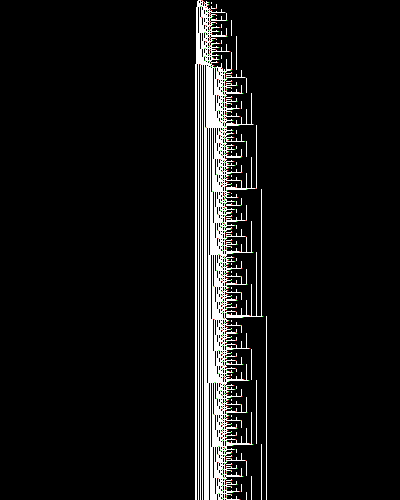
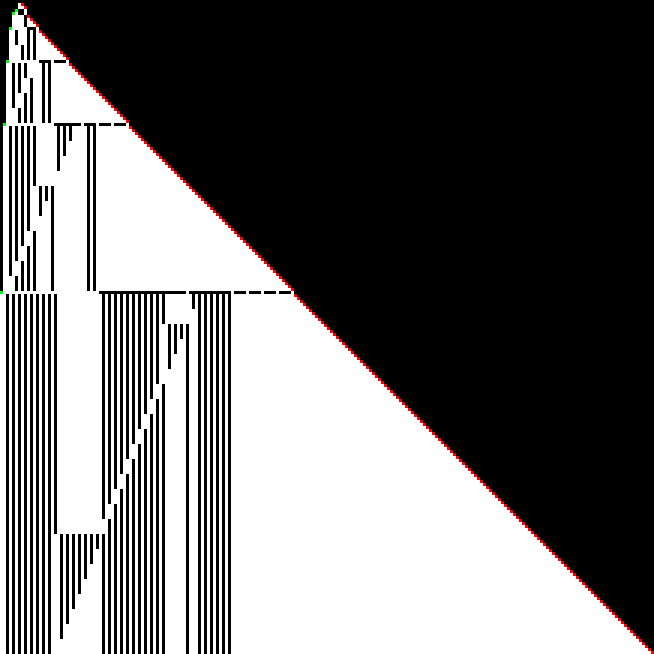
The standard picture (bbchallenge.org's Default view): each row is the whole tape at one step, time runs downward, and the head's path draws the pattern.
Overview
In one sentence
TM10's two binary counters; it can halt only if a counter value x ever has every 1-bit at an odd position
- Status
- Cryptid candidateobserving · updated 2026-10-14Parked · Observe done. The 3 open questions are optional.idle since Oct 14 16:43 (44 h ago) · status.json 2026-10-14
- Class
- Shift-overflow counterours: Shift-overflow counter (sheet) · ours adds: (SOC_2_5_v1 TM10 with A1 = 0RF); halting hinges on the bits of a counter value: cryptid-like · med confidence
- On the list
- line 371 of
BB6_holdouts_663.txt· historical 740 line 409 · observe.json rank #409
Your calls on file 3
- priority call (answered)
- Cryptid-like: halting needs some cycle's x to have all 1-bits at odd positions. Park it, or fund one 2 h stage to formalize the reduction in Rocq ('no cycle empties the chain -> ~halts tm c0') and search for a digit invariant?
- parked
- Dennis 2026-10-14: park
- 2026-10-14 · park
- W5-2 halts only if some cycle's x has all its 1-bits at odd positions: park it, or fund one 2 h stage?
Mechanism
How it works: 3 notes
- SOC_2_5_v1.v TM10's macro rules (A1 = 0LB there, 0RF here): a left counter LC (digits 11/10) counts down, a right counter RC (digits 10000/00000) counts up, and overflows shift digits between them. Every TM10 lemma except ROv3_0/ROv3_1 compiles for this string.
- From blank (cfgL(3,6,1) at step 35) every cycle is LOv at cfgL(L,0,2x+1), RC1_Ov_0, c >= 0 RC4_Ov_1, RC4_Ov_0. The chain eats x's 1-bits from the bottom and stops at the first one at an even position, which gives an explicit map (L,x) -> (L',x'). All 20,000 cycles computed (L to 172,193) are like this. The history table has one row per cycle (step column = cycle t).
- If every 1-bit of x is at an odd position, the chain empties and the run leaves TM10's cycle into ROv3, where A reads 1. With 0RF that can halt (cfgL(8,0,17) halts at step 10,189,718). Even-position 1-bits grow ~0.36 per cycle (min 7 at cycle 13); chain lengths look random. No invariant is known, so ground rule 6 applies.
Figures for Checkpoint A
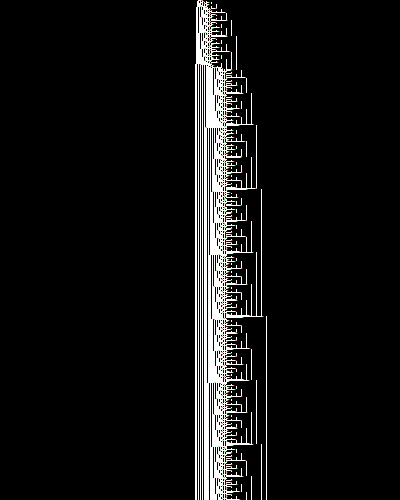
The site's view. Left: the slowly growing left counter. Right: the right counter's carry sweeps.
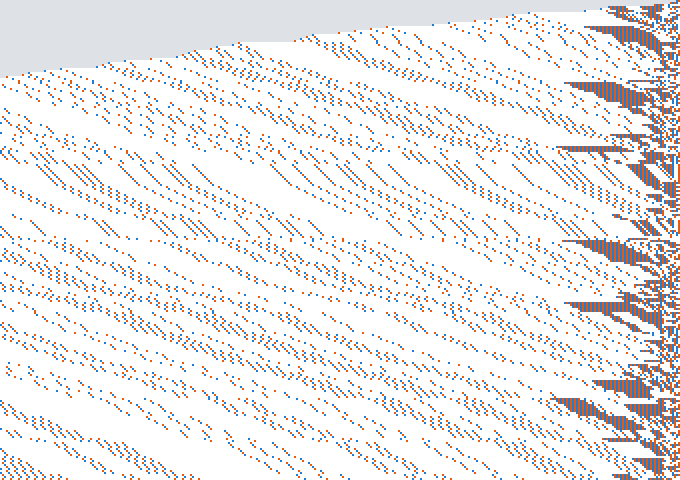
Each row is x in binary, lowest bit at the right. Look for any row without orange.
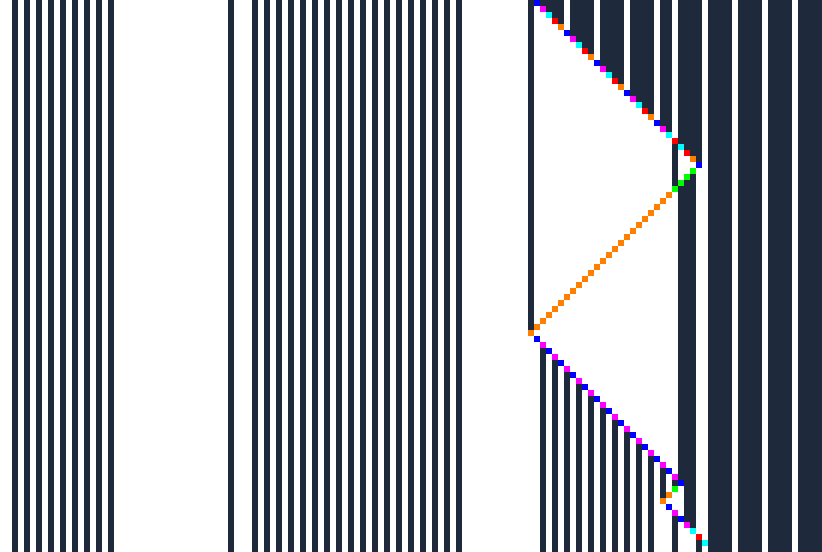
Row 0 is TM10's ROv3 situation. Watch the red A on a 1 head right; F (cyan) later reads 1.
More figures (2)Fig 4–5: Records to 10^10 steps · From blank: the only A1 step
Rows are records only. The staircase of right records is the right counter's carry sweep writing 1s.
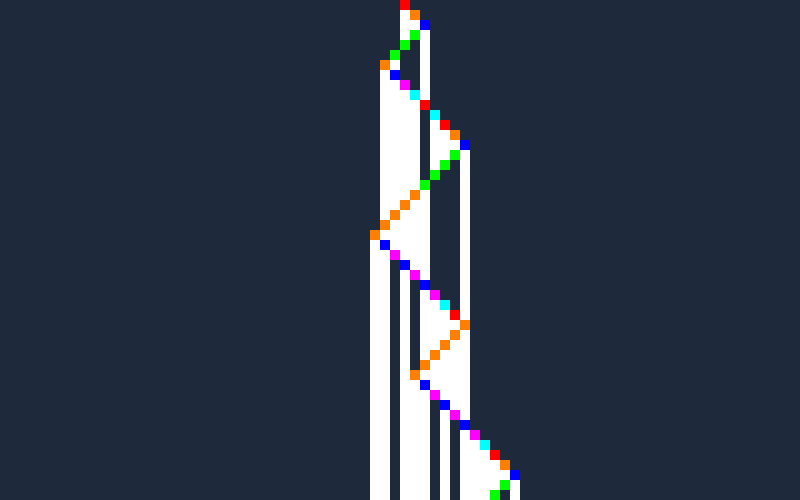
Row 10: the red A on a white 1. Through 3e10 steps A never reads 1 again.
Rules (10/10 validated)exact tape rewrites the proof will formalize, each re-checked by simulation
| rule | from ⟶ to | cases | steps | checked |
|---|---|---|---|---|
| init | 0∞ A> 0∞ ⟶ cfgL(3,6,1) = LC(3,6) <B 11 RC(1) | — | 35 | ✓1/1 |
| LC_Inc | LC(L,k+1) <B 11 RC(n) ⟶ LC(L,k) 10 C> RC(n) | k+1 < 2^L; LC(L,k) = 0^inf 1 + L digits of 2^L-1-k (11 = 1, 10 = 0), RC(n) = n LSB first (10000 = 1, 00000 = 0) | — | ✓54/54 |
| RC_Inc | LC(L,k) 10 C> RC(n) ⟶ LC(L,k) <B 11 RC(n+1) | — | — | ✓60/60 |
| LC_Ov | LC(L,0) <B 11 RC((2x+1)2i) ⟶ LC(L,2L-1) 10 C> RC1(i,2i+1-2,x) | n != 2^L (n = 2^L: corner case, 10/10, never reached from blank since n is odd) | — | ✓83/83 |
| RCj_Inc + LC_Inc | LC(L,k+1) 10 C> RCj(r,n+1,m) ⟶ LC(L,k) 10 C> RCj(r,n,m) | j = 1, 3, 4 (RCj = TM10's BinDec2 words with tails 10000, 0010000, 00010000) | — | ✓181/181 |
| RC1_Ov_0 | LC(L,k) 10 C> RC1(2r,0,m) ⟶ LC(L+1+5r,(2k+1)25r-1) 10 C> RC4(i,2i+1-2,m') if m = (2m'+1)2i, else C> RC(1) | m > 0 (47/47) and m = 0 (29/29); odd lenR: RC1_Ov_1/_1_0 77/77 (only after an exhaustion) | — | ✓76/76 |
| RC4_Ov_0 | LC(L,k) 10 C> RC4(2r,0,m) ⟶ LC(L+2+5r,(2k+1)25r+1-1) 10 C> RC(2m+1) | ends every cycle | — | ✓70/70 |
| RC4_Ov_1 | LC(L,k) 10 C> RC4(2r+1,0,m) ⟶ LC(L+5+5r,(2k+1)25r+4-1) 10 C> RC4(i,2i+1-1,m') if m = (2m'+1)2i; m = 0: C> RC(0) (RC4_Ov_1_0 = exhaustion) | m > 0 (46/46), m = 0 (33/33) | — | ✓79/79 |
| cycle map F | cfgL(L,0,2x+1) ⟶ cfgL(L',0,2x'+1), x' = (2k_c+1)25q + (x >> s) | x has a 1-bit at an even position; the chain stops there (q = half its gap, s = bits consumed, k_c from the chain). Checked on the real TM at the next left record: chain length 0 (28), 1 (19), 2 (3), L' <= 21; F = macro-rule simulator on 783 orbit cycles | — | ✓50/50 |
| RC3 overflow, A1 = 0RF | LC(L,k) 10 C> RC3(2r,0,2m+1) ⟶ halt | TM10's ROv3_0 needs A1 = 0LB. Here A reads the 1 of the 1 00 10000 tail and moves right; with m odd, F later reads a 1. Other RC3 cases: 13 halts, 56 no TM10 result in 2e5 steps | 30r+30 (r = 0: 30) | ✓16/16 |
Compressed historythe tape as 0∞ <B 12L+3 RC(2x+1) 0∞ at 35 moments: where the rules are read off
| step | L | 1-bits of x | E (1-bits at even positions) |
|---|---|---|---|
| 1 | 3 | 2 | 1 |
| 2 | 6 | 4 | 2 |
| 3 | 14 | 6 | 3 |
| 4 | 37 | 25 | 11 |
| 5 | 40 | 23 | 13 |
| 6 | 48 | 19 | 8 |
| 8 | 84 | 21 | 10 |
| 10 | 95 | 23 | 11 |
| 13 | 124 | 18 | 7 |
| 16 | 163 | 39 | 19 |
| 20 | 190 | 37 | 15 |
| 25 | 235 | 30 | 18 |
| 30 | 265 | 29 | 15 |
| 40 | 345 | 31 | 17 |
| 50 | 435 | 69 | 31 |
| 75 | 650 | 92 | 51 |
| 100 | 815 | 82 | 46 |
| 150 | 1,215 | 133 | 65 |
| 200 | 1,640 | 172 | 95 |
| 300 | 2,355 | 240 | 140 |
| 400 | 3,190 | 305 | 167 |
| 500 | 4,010 | 378 | 202 |
| 750 | 6,015 | 554 | 284 |
| 1,000 | 8,245 | 749 | 394 |
| 1,500 | 12,405 | 1,080 | 551 |
| 2,000 | 16,920 | 1,432 | 705 |
| 3,000 | 25,530 | 2,197 | 1,084 |
| 4,000 | 33,625 | 2,886 | 1,417 |
| 5,000 | 42,020 | 3,601 | 1,769 |
| 7,500 | 63,420 | 5,483 | 2,791 |
| 10,000 | 85,235 | 7,355 | 3,725 |
| 12,500 | 106,850 | 9,032 | 4,638 |
| 15,000 | 129,520 | 10,788 | 5,523 |
| 17,500 | 150,875 | 12,599 | 6,415 |
| 20,000 | 172,160 | 14,392 | 7,299 |
Llast 172,1601-bits of xlast 14,392E (1-bits at even positions)last 7,299Template comparisonSOC_2_5_v1.v TM10: partly applies · the nearest solved proof, what carries over, and the transitions that differ
| 0 | 1 | |
|---|---|---|
| A | 1RB | 0RFtpl 0LB |
| B | 1RC | 1LB |
| C | 1LD | 1RE |
| D | 1LB | 0LD |
| E | 1RF | 0RC |
| F | 1RA | --- |
differs from the template
- file
SOC_2_5_v1.v:5186- module
TM10- machine
1RB0LB_1RC1LB_1LD1RE_1LB0LD_1RF0RC_1RA---(1 transition apart)- diff
A1: 0LB -> 0RF- note
- Every TM10 lemma except ROv3_0/ROv3_1 compiles with this string (the scout's Iter.v, which admits those two). They are false here, not just unproved: TM10's invariant P contains halting configurations of this machine (cfgL(8,0,17) halts at step 10,189,718). A proof needs P plus an orbit-specific digit condition (the chain never empties), and that condition is the open part. No other upstream file proves this table from any start.
Proof strategy & riskshow the formal proof will go · 3 risks to watch
No non-halting proof is known. Rule 6: formalize the reduction (Rocq: 'no cycle empties the chain -> ~halts tm c0', from TM10's lemmas and F), then park unless a digit invariant turns up.
- ▲Non-halting depends on the binary digits of an exponentially growing orbit (all 1-bits at odd positions must never happen): cryptid-like.
- ▲The scout's Iter.v 'nonhalt' admits ROv3_0/ROv3_1, which are false for this machine; it is not evidence.
- ▲After an exhaustion the dynamics are unmodelled; halting is shown only from constructed starts, not from blank.
Stats & provenance3·1010 steps simulated · 228 cells · the status in full · files
- simulated
- 3·1010 steps
- tape
- 228 cells · 70 nonzeros
- growth
- exponential (two binary counters); A reads 1 only at step 10 through 3e10 steps; abstract orbit checked for 20,000 cycles (L to 172,193)
- status now
- Observe done. The mechanism is understood: these are SOC_2_5_v1.v TM10's macro rules, every TM10 lemma except ROv3_0/ROv3_1 compiles for this string, and the rules were re-validated on the TM. From blank every cycle is LOv, RC1_Ov_0, an R4 chain, RC4_Ov_0, giving an explicit map (L,x) -> (L',x') on the left-overflow configurations cfgL(L,0,2x+1). The run leaves this cycle only if every 1-bit of x is at an odd position. Then the chain empties and TM10's ROv3 (A reads 1) comes up, and with A1 = 0RF that can halt: the TM10-invariant configuration cfgL(8,0,17) halts at step 10,189,718, so TM10's P is not an invariant here. All 20,000 cycles computed (L to 172,193) stay normal, and the even-position 1-bits grow about 0.36 per cycle, so heuristically it never halts. But the condition is about the binary digits of an exponentially growing orbit, and no invariant is known: ground rule 6. The scout's near-port premise is wrong, because ROv3_0/ROv3_1 are false here, not just unproved. (status.json, 2026-10-14)
- observer's note
- Mechanism understood (TM10's macro rules, validated); non-halting needs the orbit of an explicit digit map never to put every 1-bit of x at an odd position. Heuristically never; no invariant known.
- files
- observe.json · notes.md · status.json
Proof & checks
No proof work yet.
Files
machines/<tm>/: 7 entries · raw notes, status, scripts, images
| name | size | changed |
|---|---|---|
| notes.md ↓ | 8.7 KB | 2026-10-13 01:45 |
| status.json ↓ | 2.2 KB | 2026-10-14 16:43 |
| observe.json ↓ | 13 KB | 2026-10-13 01:45 |
| data/ | 5 items | 2026-10-13 01:45 |
| decisions/ | 1 item | 2026-10-14 16:43 |
| img/ | 5 items | 2026-10-13 01:39 |
| scripts/ | 10 items | 2026-10-13 01:44 |
status.json in full
{
 "tm": "1RB0RF_1RC1LB_1LD1RE_1LB0LD_1RF0RC_1RA---",
 "label": "W5-2",
 "status": "CRYPTID_CANDIDATE",
 "stage": "observe",
 "updated": "2026-10-14",
 "confidence": "med",
 "reason": "Observe done. The mechanism is understood: these are SOC_2_5_v1.v TM10's macro rules, every TM10 lemma except ROv3_0/ROv3_1 compiles for this string, and the rules were re-validated on the TM. From blank every cycle is LOv, RC1_Ov_0, an R4 chain, RC4_Ov_0, giving an explicit map (L,x) -> (L',x') on the left-overflow configurations cfgL(L,0,2x+1). The run leaves this cycle only if every 1-bit of x is at an odd position. Then the chain empties and TM10's ROv3 (A reads 1) comes up, and with A1 = 0RF that can halt: the TM10-invariant configuration cfgL(8,0,17) halts at step 10,189,718, so TM10's P is not an invariant here. All 20,000 cycles computed (L to 172,193) stay normal, and the even-position 1-bits grow about 0.36 per cycle, so heuristically it never halts. But the condition is about the binary digits of an exponentially growing orbit, and no invariant is known: ground rule 6. The scout's near-port premise is wrong, because ROv3_0/ROv3_1 are false here, not just unproved.",
 "siblings": [],
 "sibling_note": "No other start or mirror of this table is on the 740 or 778 lists (starts B..F checked by canon), and it is a singleton in the 1590 equivalence file. Upstream proves A1-variants of the table (SOC_2_5_v1.v TM8/9/10/11/12/14/15/18/19, A1 in {1RD,1LB,0LB,1LE,0RE,1LA,0LE,1LC,0RC}), but none with A1 = 0RF.",
 "holdout_line_740": 409,
 "holdout_line_778": 436,
 "upstream": "Nearest proof: SOC_2_5_v1.v Module TM10 (1RB0LB_..., A1 = 0LB), a hand proof with cfgL/cfgR/cfgR1/cfgR3/cfgR4 and invariant P. Both orbits avoid R3 in 20,000 macro events, but TM10's proof covers R3 because TM10's ROv3 lemmas hold there. No claim in data/discord or data/sheet (sheet: Shift-overflow counter, no status).",
 "priority_call_answered": "Cryptid-like: halting needs some cycle's x to have all 1-bits at odd positions. Park it, or fund one 2 h stage to formalize the reduction in Rocq ('no cycle empties the chain -> ~halts tm c0') and search for a digit invariant?",
 "parked": "Dennis 2026-10-14: park"
}