tools/rebuild_pages.sh rebuilds the site within 5 minutes of a change; by hand: python3 -B tools/site.py.1RB0RF_1RC0LD_1RD0RA_1LE0LC_1LB0LE_0RC---
Upstream result
Claimed elsewhere
The blank-start machine never halts: BECv10.v.TM10 ↗. Recorded commit time: 2026-10-13T13:42:06Z. First public push time is not established.
Absent from the current 663 holdout list. Earlier local observations remain below.
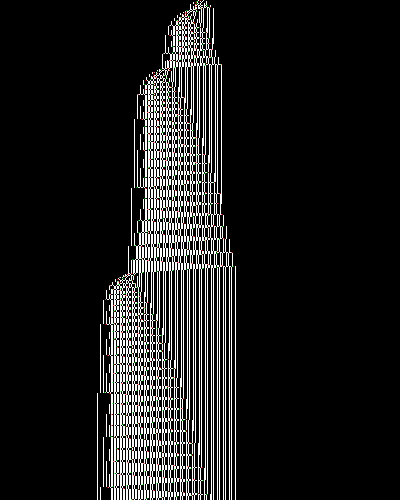
About this picture
The standard picture (bbchallenge.org's Default view): each row is the whole tape at one step, time runs downward, and the head's path draws the pattern.
Overview
In one sentence
Left-wall binary counter eats a 010001 reservoir; overflow leaves a binary-residue junk word; spurts are residue-timed
- Upstream
- The blank-start machine never halts: BECv10.v.TM10 ↗. Recorded commit time: 2026-10-13T13:42:06Z. First public push time is not established.
- Status
- Externally Solvedobserving · updated 2026-10-13Not blocking · Stuck at the observing stage. Answer Q1–Q2 whenever; a “no” redirects the work.idle since Oct 13 16:19 · status.json 2026-10-13
- Class
- Bell eats counterours: sheet Bell eats counter ≠ ours Binary counter at the left wall eats a 6-cell reservoir; each overflow fossilizes the counter's binary residue as junk that the next cycle re-reads · low confidence
- On the list
- not on
BB6_holdouts_663.txt(line 239 of the previous list) · historical 740 line 239
Mechanism
How it works: 3 notes
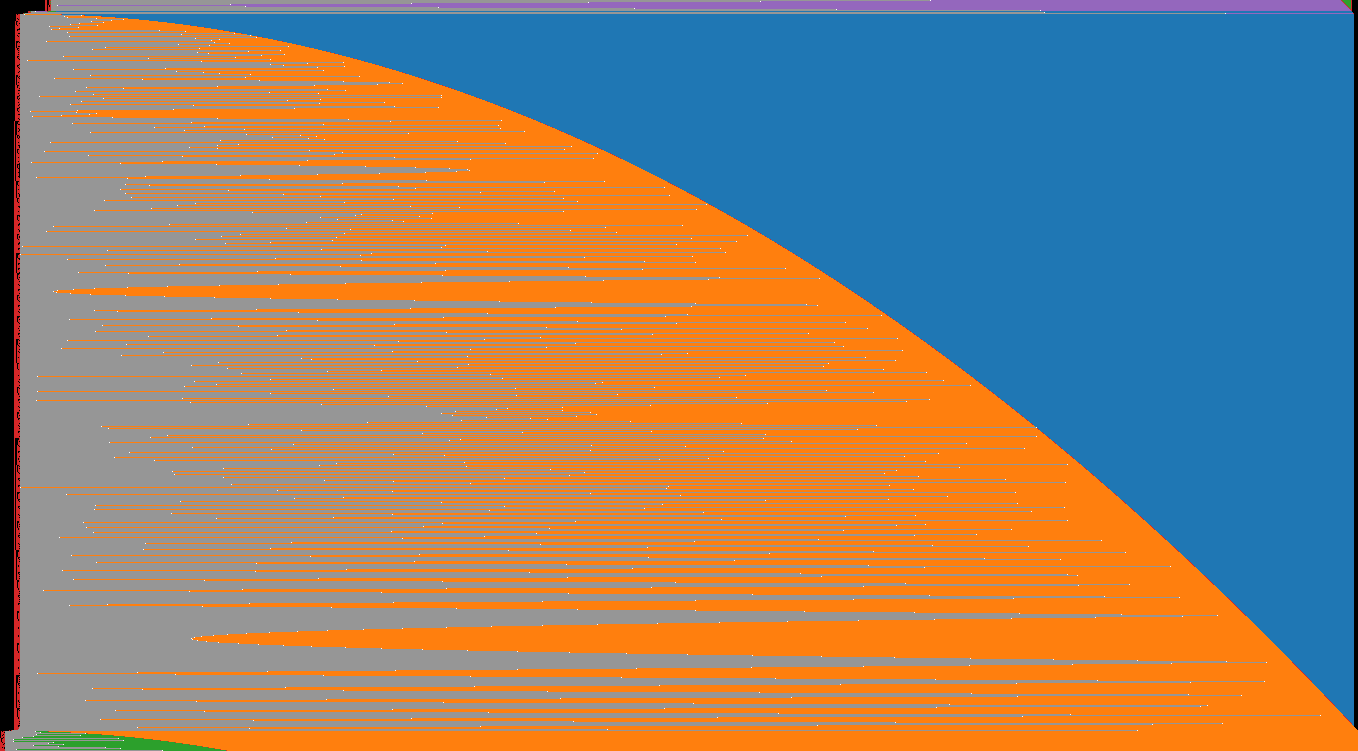
- Counter pass (rules P0/P1, 80/80): 0^inf <D (011)^a (010001)^b x (010001)^c, x = one-cell phase defect. One pass moves the defect 2^a words right and adds a digit: (a,b,c) -> (a+1, b+2^a, c-2^a) while c >= 2^a.
- Overflow (rule O, 24/24): when c < 2^a the whole sea is re-laid as a 3-cell field, 0^inf J (011)^(2b+2c) C>, where J is a junk word of exactly 3a+4 cells (the counter's partial state, i.e. a binary residue). Halting needs A to read 1 with a 1 on its right (A1 -> 0RF, F1 undefined). No halt to 2e10 (span 75,979, 36,061 ones).
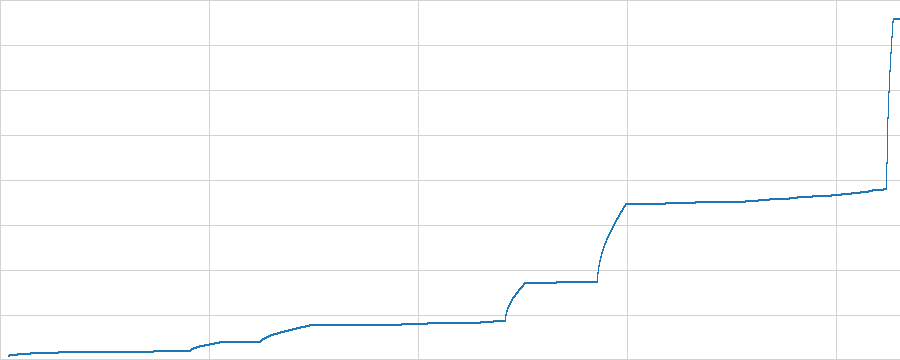
- Cycle: J (101)^n B> -> J' (101)^n' B> (n' - n = +28..+72 at the 34k level) or a spurt that doubles the field, 1 0^3 (011)^(2n+12..24) C>. J is the previous counter's residue (c0 + 2^a0) mod 2^A, and it decides which: plateaus of 1, 1, 9, 3 and 31 cycles, spurts at 1.1e7, 3.0e7, 3.3e8, 9.9e8, 1.88e10.
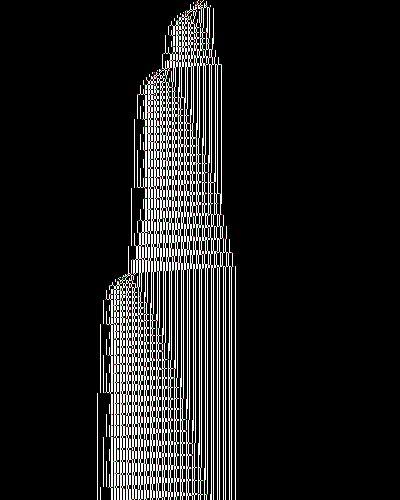
Figures for Checkpoint A
The site's view. The tape grows left in steps; the fine stripes are the 3- and 6-cell fields being rewritten.
Each flat stretch is many cycles; each steep rise is one spurt cycle. Compare the plateau lengths.
Rows go down in time. Watch the orange/blue boundary (the phase defect) move right until blue is gone.
More figures (1)Fig 4: The spurt cycle: the field doubles leftward
Same colours as the cycle map. Here the left edge advances on every sweep instead of the defect.

Rules (3/4 validated)exact tape rewrites the proof will formalize, each re-checked by simulation
| rule | from ⟶ to | cases | steps | checked |
|---|---|---|---|---|
| P1 counter pass, 1-defect | 0∞ <D (011)a (010001)b 1 (010001)c 0∞ ⟶ 0∞ <D (011)a+1 (010001)b+2^a 1 (010001)c-2^a 0∞ | c >= 2^a; a = 0..9, b = 1..2^a+60, c = 2^a..2^a+300 | — | ✓40/40 |
| P0 counter pass, 0-defect | 0∞ <D (011)a (010001)b 0 (010001)c 0∞ ⟶ 0∞ <D (011)a+1 (010001)b+2^a 0 (010001)c-2^a 0∞ | c >= 2^a; a = 0..9, b = 1..2^a+60, c = 2^a..2^a+300 | — | ✓40/40 |
| O overflow (shape only) | 0∞ <D (011)a (010001)b x (010001)c 0∞, x in {0,1} ⟶ 0∞ J (011)2b+2c C> 0∞ (at the next right record), |J| = 3a+4 cells, J not yet characterised | c < 2^a; a = 0..7 | — | ✓24/24 |
| Cycle map (observed only) | 0∞ J (101)n B> 0∞ ⟶ 0∞ J' (101)n' B> 0∞, n' - n in +9..+75; or spurt 0∞ 1 03 (011)2n+k C> 1 0∞, k in 12..24 | which branch: decided by J (a binary residue); not characterised | — | –untested |
Compressed historythe tape as 0∞ <D (011)a (010001)b 0 (010001)c 0∞ at 8 moments: where the rules are read off
| step | a | b | c |
|---|---|---|---|
| 56,559,588 | 3 | 13 | 1,277 |
| 56,564,129 | 4 | 21 | 1,269 |
| 56,579,358 | 5 | 37 | 1,253 |
| 56,634,395 | 6 | 69 | 1,221 |
| 56,842,776 | 7 | 133 | 1,157 |
| 57,652,757 | 8 | 261 | 1,029 |
| 60,845,586 | 9 | 517 | 773 |
| 73,522,703 | 10 | 1,029 | 261 |
alast 10blast 1,029clast 261Template comparison1RB0RF_1RC0RB_1LD0RA_1LE0LD_1RB0LC_1LA---.v: does not apply · the nearest solved proof, what carries over, and the transitions that differ
| 0 | 1 | |
|---|---|---|
| A | 1RB | 0RF |
| B | 1RC | 0LD |
| C | 1RD | 0RA |
| D | 1LE | 0LC |
| E | 1LB | 0LE |
| F | 0RC | --- |
- file
machines/1RB0RF_1RC0RB_1LD0RA_1LE0LD_1RB0LC_1LA---/1RB0RF_1RC0RB_1LD0RA_1LE0LD_1RB0LC_1LA---.v⚠ not at pin- module
- —
- machine
1RB0RF_1RC0RB_1LD0RA_1LE0LD_1RB0LC_1LA---(6 transitions apart)- diff
d = 4 (start A); SOMDC_Class1.v nonhalt (1LB---_1RC0RF_1LD1RB_1LE0LD_1RB0LB_1RB0RA, start F) also d = 4- note
- W4-3 (ours, killed) is a multi-level counter on 00/11 defects whose fossils are inert (block lengths only matter mod 4). Here the counter's leftover is fossilized as junk J and is re-read: J decides the next cycle's start and whether it spurts. W4-3's RIncs-style scan does not cover a junk word that carries a binary residue. SOMDC_Class1 shares the d = 4 distance only; its rule set (one structural counter) has no overflow-to-junk step.
Proof strategy & riskshow the formal proof will go · 3 risks to watch
A proof needs a closed description of the junk words J and the cycle map (J, n) -> (J', n') or spurt, for every reachable J. That is an arithmetic map on n and a binary residue (c0 + 2^a0) mod 2^A, with the spurt as one residue class. Parked unless that map turns out to be a clean binary rule.
- ▲Residue-driven: the cycle outcome depends on a ~12-bit residue of a slowly growing n; plateau lengths 1, 1, 9, 3, 31 look irregular (possible Collatz-like map).
- ▲The junk J and the junk-processing phase (several sweeps with right records before each counter starts) are not characterised.
- ▲Waves 4 and 5 rejected it; the only fixed-constant rule rulefit found (E1(2n,632-n)) is one finite pass of rule P.
Stats & provenance2·1010 steps simulated · 75,979 cells · the status in full · files
- simulated
- 2·1010 steps
- tape
- 75,979 cells · 36,061 nonzeros
- growth
- span doubles in spurts: 1.7k -> 3.5k (1.1e7) -> 7.4k (3.0e7) -> 16.7k (3.3e8) -> 34.2k (9.9e8) -> 75.0k (1.88e10); in between, plateaus grow ~30-190 cells per cycle; no halt to 2e10
- status now
- Parked at observe (BEC sweep, cap 1 h). Micro rules are clean: counter pass P0/P1 (0^inf <D (011)^a (010001)^b x (010001)^c -> a+1, b+2^a, c-2^a while c >= 2^a; 80/80) and overflow O (c < 2^a -> 0^inf J (011)^(2b+2c) C>, |J| = 3a+4; 24/24). The macro level is residue-driven: each overflow leaves the counter's binary residue in a junk word J that the next cycle re-reads, and J decides whether the cycle is ordinary (n -> n+9..75) or a spurt (n -> 2n+12..24). Plateaus of 1, 1, 9, 3, 31 cycles; spurts at 1.1e7, 3.0e7, 3.3e8, 9.9e8, 1.88e10; no halt to 2e10. Not flagged as cryptid (residue map not formalized). (status.json, 2026-10-13)
- observer's note
- Parked at observe (cap 1 h): counter passes and overflow shape validated (104/104), but the cycle map runs on a binary residue fossilized as junk; spurts are residue-timed (plateaus of 1, 1, 9, 3, 31 cycles).
- files
- observe.json · notes.md · status.json
- other viewers
- viewer
Proof & checks
No proof work yet.
Files
machines/<tm>/: 5 entries · raw notes, status, scripts, images
| name | size | changed |
|---|---|---|
| notes.md ↓ | 5.3 KB | 2026-10-13 16:19 |
| status.json ↓ | 1.2 KB | 2026-10-13 16:19 |
| observe.json ↓ | 9.0 KB | 2026-10-13 16:19 |
| img/ | 7 items | 2026-10-13 16:17 |
| work/ | 0 items | 2026-10-13 16:02 |
status.json in full
{
 "tm": "1RB0RF_1RC0LD_1RD0RA_1LE0LC_1LB0LE_0RC---",
 "label": "B-4",
 "status": "STUCK",
 "stage": "observe",
 "confidence": "low",
 "updated": "2026-10-13",
 "reason": "Parked at observe (BEC sweep, cap 1 h). Micro rules are clean: counter pass P0/P1 (0^inf <D (011)^a (010001)^b x (010001)^c -> a+1, b+2^a, c-2^a while c >= 2^a; 80/80) and overflow O (c < 2^a -> 0^inf J (011)^(2b+2c) C>, |J| = 3a+4; 24/24). The macro level is residue-driven: each overflow leaves the counter's binary residue in a junk word J that the next cycle re-reads, and J decides whether the cycle is ordinary (n -> n+9..75) or a spurt (n -> 2n+12..24). Plateaus of 1, 1, 9, 3, 31 cycles; spurts at 1.1e7, 3.0e7, 3.3e8, 9.9e8, 1.88e10; no halt to 2e10. Not flagged as cryptid (residue map not formalized).",
 "family_note": "No 740-list siblings. eqv_1590 lines 650-652: same table from starts B and C (Eqv_v2.v tm definitions), not on the 740 list.",
 "next_goal": "Characterise J: decode the junk word as the binary digits of r = (c0 + 2^a0) mod 2^A and test whether the next cycle's (a0, k, n' - n) and the spurt are a closed function of (r, A) on all ~50 observed cycles; park for good if not."
}2 contract warnings
- rank: missing
- template file not in the pinned tree: machines/1RB0RF_1RC0RB_1LD0RA_1LE0LD_1RB0LC_1LA---/1RB0RF_1RC0RB_1LD0RA_1LE0LD_1RB0LC_1LA---.v