tools/rebuild_pages.sh rebuilds the site within 5 minutes of a change; by hand: python3 -B tools/site.py.1RB0LD_1RC0RF_0LD0LE_1RF1LC_0LB1LE_0RA---
Where it stands
In progress: observation
Observe at table level done. The machine is an exact base-4 counter: W = 100 sea, digits D(m,p) = X(10)^mY (m even, phase = 2 bits at the region's ends), one sweep = one increment with shifts at 1->2 and 3->0, +1 W at the right end per sweep (R1/R2 700/700, exact step formula R3).
Read the full status
A mod-3 field invariant J keeps every merge clean (1,456/1,456 real fields, 1,986/1,986 glued sweeps). Overflows alternate the wall [10100][] and give births at the right end (300/300); the wall then eats the top digit through a finite remnant family (80/80 small cases return clean, none halts). The three starts enter the same language by step 20,600 and differ only in the far-left field. Exact sweep simulator = C core at 1e11 on all three (configuration and step count); no halt to 1e14 on 82, 464, 722 (82 to 1e15). Not a cryptid. Stage-1 GO signal; open: complete wall case table + closure check.
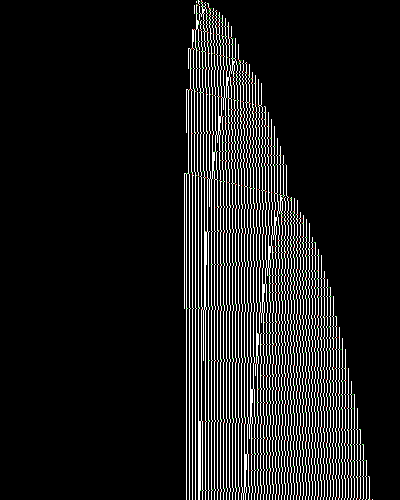
About this picture
The standard picture (bbchallenge.org's Default view): each row is the whole tape at one step, time runs downward, and the head's path draws the pattern.
Overview
In one sentence
Exact base-4 counter: digits are 10-regions in a 100 sea; a mod-3 field law keeps merges clean; no halt to 1e15.
- Status
- Checkpoint Aobserving · updated 2026-10-14Not blocking · Next: proof.md. Answer Q1–Q3 whenever; a “no” redirects the work.idle since Oct 14 20:36 (40 h ago) · status.json 2026-10-14
- Class
- Skelet 1-like Class 1ours: sheet Skelet 1-like Class 1 ≠ ours Base-4 counter on 10-regions in a 100 sea; overflow eats the left wall and spawns a digit at the right · high confidence
- On the list
- line 76 of
BB6_holdouts_663.txt· historical 740 line 82 · observe.json rank #82
Mechanism
How it works: 3 notes
- Tape at every C-record: 0^inf <wall> W^a D W^f ... D W^c 11 C> 0^inf, with W = 100 and digits D(m,p) = X (10)^m Y (m even, X in {10,11}, Y in {10,00}, phase p = 2x+y). One sweep adds 1 to this base-4 counter from the right; phases 1->2 and 3->0 shift the digit one W left; the right field gains 1 W.
- Every interior field keeps J = f + 2pL + floor(pR/2) - floor(pL/2) = 0 (mod 3), so a dying field always merges its two digits into one D(m+m'+2) and never goes negative. Digits are born at the right end on overflows and merge as they drift left: 10 digits at 1e14.
- Overflow: [10100] W^a -> [] W^a and [] W^a -> [10100] W^(a-2) (+ a birth). When the far-left field runs out, the wall eats the top digit through a finite remnant family. The three starts enter the same language by step 20,600, differing only in the far-left field; an exact sweep simulator matches the C core at 1e11 on all three and reaches 1e14 with no halt (82: 1e15).
Figures for Checkpoint A
Rows are steps. Count the trips from the right edge; compare how far left each one turns.

Each white line is one digit. Follow lines from the right edge leftward; watch where two lines meet.
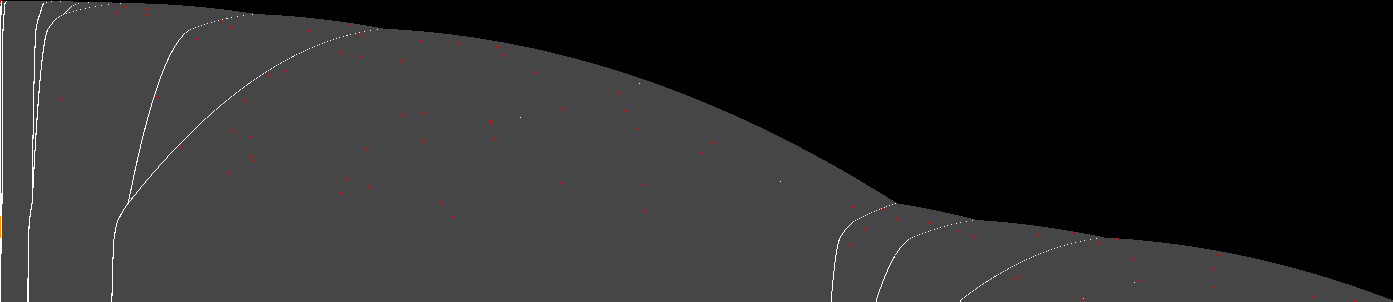
Watch the dense 1010 block at the far left shrink while the 8-cell digit to its right drifts left.

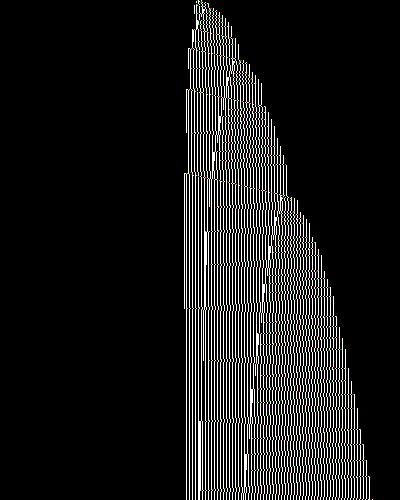
More figures (1)Fig 4: Default view, first 10,000 steps
The site's own picture: fine 3-cell stripes (the 100 sea) with a few thin defects, head bouncing at the right.
Rules (5/5 validated)exact tape rewrites the proof will formalize, each re-checked by simulation
| rule | from ⟶ to | cases | steps | checked |
|---|---|---|---|---|
| R1 increment (p = 0, 1, 2) | L W^a D(m,p) W^c 11 C> 0∞ ⟶ L W^(a-s) D(m,p+1) W^(c+1+s) 11 C> 0∞, s = 1 if p = 1 else 0 | m even; a >= s | 8c+11 (p = 0, 2); 8c+5m+23 (p = 1) | ✓700/700 |
| R2 carry (p = 3) | L W^a D(m',q) W^f D(m,3) W^c 11 C> 0∞ ⟶ R1 applied to D(m',q) with W^f as its right field, D(m,3) -> D(m,0) shifted 1 W left; right field c+2 | repeats leftward through every digit at phase 3 | 8(c+f) + (5m+12) + stop(q, m'), stop = 11 or 5m'+23 | ✓700/700 |
| J invariant and merges | interior field W^f between D(.,pL) and D(.,pR) with f + 2pL + floor(pR/2) - floor(pL/2) = 0 (mod 3) ⟶ J stays 0 under R1/R2; a field reaching 0 is followed by D(m,2x+0)D(m',0+y) = D(m+m'+2, 2x+y), never by a negative field | fields 0..18, glued digits, all phases | — | ✓1986/1986 |
| O1/O2 overflow | 0∞ [10100 | empty] W^a (all digits at phase 3) W^c 11 C> 0∞ ⟶ [10100] W^a -> [] W^a, right W^(c+2); [] W^a -> [10100] W^(a-2), right W^(c+1) D(0,0) (birth) or W^(c+3) | a >= 4; every digit shifts 1 W left; birth or no birth both stay in the language | — | ✓300/300 |
| Wall eats the top digit | [] W^1 D(m,0) ..., [] W^2 ..., [] W^3 ..., [10100] W^0..3 ... ⟶ remnant chain 11(10)k{10,00} -> 1(10)k{10,00} -> (10)k{10,00} -> ... -> 110100 -> [] W^f (next field) | 80 small-field families (wall x a in 0..4 x m in 0..6 x 2 field sizes): all return to a clean wall, none halts | — | ✓80/80 |
Compressed historythe tape as overflow outputs: 0∞ <wall> W^a D ... D W^c 11 C> 0∞ (82, exact sweep-level simulator) at 25 moments: where the rules are read off
| step | wall | a (far-left field) | digits | top digits | right end |
|---|---|---|---|---|---|
| 25,780 | [1110] | 3 | 1 | D0.0 | W^85 |
| 59,542 | [] | 85 | 2 | D0.0 D0.0 | W^73 |
| 155,923 | [] | 73 | 3 | D2.0 D0.0 D0.0 | W^96 |
| 375,678 | [] | 69 | 3 | D2.0 D0.0 D0.0 | W^289 |
| 927,748 | [] | 61 | 3 | D2.0 D2.0 D0.0 | W^289 |
| 3,105,598 | [10100] | 54 | 4 | D2.0 D2.0 D0.0 D0.0 | W^769 |
| 8,007,849 | [10100] | 50 | 3 | D6.0 D2.0 D0.0 | D0.0 |
| 18,063,033 | [] | 33 | 4 | D6.0 D2.0 D2.0 D0.0 | W^384 |
| 57,930,182 | [10100] | 22 | 5 | D6.0 D2.0 D2.0 D0.0 ... | W^3073 |
| 136,320,257 | [10100] | 18 | 5 | D6.0 D2.0 D2.0 D2.0 ... | D0.0 |
| 437,187,099 | [] | 9 | 6 | D6.0 D2.0 D2.0 D2.0 ... | W^6144 |
| 1,309,352,950 | [] | 5 | 6 | D6.0 D2.0 D2.0 D2.0 ... | W^18433 |
| 2,882,170,778 | [1101010] | 24 | 6 | D2.0 D6.0 D2.0 D0.0 ... | W^12289 |
| 6,675,937,712 | [] | 9 | 6 | D2.0 D6.0 D2.0 D4.0 ... | W^18433 |
| 15,392,730,394 | [10100] | 2 | 7 | D2.0 D6.0 D2.0 D4.0 ... | W^49153 |
| 35,297,299,805 | [1101010] | 780 | 6 | D6.0 D2.0 D4.0 D0.0 ... | D0.0 |
| 75,936,579,781 | [10100] | 758 | 7 | D6.0 D2.0 D4.0 D4.0 ... | D0.0 |
| 187,647,088,069 | [] | 741 | 8 | D6.0 D2.0 D4.0 D4.0 ... | W^98304 |
| 412,334,439,524 | [] | 737 | 8 | D6.0 D2.0 D4.0 D4.0 ... | W^294913 |
| 975,100,850,146 | [] | 729 | 8 | D6.0 D2.0 D4.0 D4.0 ... | W^294913 |
| 3.22·1012 | [10100] | 722 | 9 | D6.0 D2.0 D4.0 D4.0 ... | W^786433 |
| 8.34·1012 | [10100] | 718 | 8 | D6.0 D2.0 D4.0 D4.0 ... | D0.0 |
| 1.87·1013 | [] | 701 | 9 | D6.0 D2.0 D4.0 D4.0 ... | W^393216 |
| 6.03·1013 | [10100] | 690 | 10 | D6.0 D2.0 D4.0 D4.0 ... | W^3145729 |
| 9.52·1013 | [] | 689 | 10 | D6.0 D2.0 D4.0 D4.0 ... | W^4718593 |
walllast []a (far-left field)last 689digitslast 10top digitslast D6.0 D2.0 D4.0 D4.0 ...right endlast W^4718593Template comparisonSk1Machines.v Sk1Counter: partly applies · the nearest solved proof, what carries over, and the transitions that differ
| 0 | 1 | |
|---|---|---|
| A | 1RB | 0LD |
| B | 1RC | 0RF |
| C | 0LD | 0LE |
| D | 1RF | 1LC |
| E | 0LB | 1LE |
| F | 0RA | --- |
- file
Sk1Machines.v:8- module
Sk1Counter / Sk1CounterMixed + TM17- machine
1LB1LE_1RC1LB_1LA0RD_1LC0RB_0LF---_0RD1LA(11 transitions apart)- diff
different table; same architecture (digits with take/give/carry over a periodic word W, segRLs wall and one-digit lemmas)- note
- mxdys's Sk1Counter matches our sweep rules (one digit step = segRLs with take/give/carry; W traversal = wall lemma). Its endgame does not: TM17 runs an accelerated simulation until a glider (translated cycle); ours grows forever (fields 3*2^k, 10 digits at 1e14), so the endgame must be a closed invariant (as in our #30), not a glider check.
Proof strategy & riskshow the formal proof will go · 3 risks to watch
Finish stage 1: write the wall/remnant case table as affine rules and run an exhaustive closure check of the candidate language L (J-valid fields, even digits, wall grammar). Then proof.md: one closed-language argument for L plus three entry lemmas (82, 464, 722).
- ▲The wall grammar is only seen to 1e14: the remnant prefixes (11, 1, empty, 10100, 1011) and collision chains need a complete, proved table.
- ▲Formal size: the Sk1Counter-style lemmas exist upstream, but the closed-set argument over arbitrary digit lists is new work (#30 was 1,726 lines).
- ▲Owner risk: the class is mxdys's (Sk1Machines.v); ask in #bb6 before stage 2.
Stats & provenance1015 steps simulated · 896,775 cells · the status in full · files
- simulated
- 1015 steps
- tape
- 896,775 cells · 298,934 nonzeros
- growth
- direct C core: span 67k at 1e9, 897k at 1e11 (82); exact sweep-level simulator: no halt to 1e14 on 82, 464 and 722, and to 1e15 on 82 (11 digits, right field 1.5e7 W)
- status now
- Observe at table level done. The machine is an exact base-4 counter: W = 100 sea, digits D(m,p) = X(10)^mY (m even, phase = 2 bits at the region's ends), one sweep = one increment with shifts at 1->2 and 3->0, +1 W at the right end per sweep (R1/R2 700/700, exact step formula R3). A mod-3 field invariant J keeps every merge clean (1,456/1,456 real fields, 1,986/1,986 glued sweeps). Overflows alternate the wall [10100]<->[] and give births at the right end (300/300); the wall then eats the top digit through a finite remnant family (80/80 small cases return clean, none halts). The three starts enter the same language by step 20,600 and differ only in the far-left field. Exact sweep simulator = C core at 1e11 on all three (configuration and step count); no halt to 1e14 on 82, 464, 722 (82 to 1e15). Not a cryptid. Stage-1 GO signal; open: complete wall case table + closure check. (status.json, 2026-10-14)
- observer's note
- Stage-1 go signal: the interior counter is exact and closed (R1/R2, J mod 3, clean merges); overflow and wall rules are finite and affine as far as seen; no halt to 1e14 on any start. Remaining: complete the wall/remnant case table and check closure.
- files
- observe.json · notes.md · status.json
Proof & checks
No proof work yet.
Files
machines/<tm>/: 6 entries · raw notes, status, scripts, images
| name | size | changed |
|---|---|---|
| notes.md ↓ | 9.1 KB | 2026-10-14 20:36 |
| status.json ↓ | 1.9 KB | 2026-10-14 20:36 |
| observe.json ↓ | 12 KB | 2026-10-14 20:36 |
| img/ | 4 items | 2026-10-14 20:33 |
| scripts/ | 17 items | 2026-10-14 20:33 |
| work/ | 23 items | 2026-10-14 20:32 |
status.json in full
{
 "tm": "1RB0LD_1RC0RF_0LD0LE_1RF1LC_0LB1LE_0RA---",
 "label": "W7-4",
 "status": "CHECKPOINT_A",
 "stage": "observe",
 "updated": "2026-10-14",
 "confidence": "high",
 "holdout_line_740": 82,
 "reason": "Observe at table level done. The machine is an exact base-4 counter: W = 100 sea, digits D(m,p) = X(10)^mY (m even, phase = 2 bits at the region's ends), one sweep = one increment with shifts at 1->2 and 3->0, +1 W at the right end per sweep (R1/R2 700/700, exact step formula R3). A mod-3 field invariant J keeps every merge clean (1,456/1,456 real fields, 1,986/1,986 glued sweeps). Overflows alternate the wall [10100]<->[] and give births at the right end (300/300); the wall then eats the top digit through a finite remnant family (80/80 small cases return clean, none halts). The three starts enter the same language by step 20,600 and differ only in the far-left field. Exact sweep simulator = C core at 1e11 on all three (configuration and step count); no halt to 1e14 on 82, 464, 722 (82 to 1e15). Not a cryptid. Stage-1 GO signal; open: complete wall case table + closure check.",
 "siblings": [
  "1RB0RD_0LC0LF_1RD1LB_0RE---_1RA0LC_0LA1LF",
  "1RB1LE_0RC---_1RD0LA_1RE0RB_0LA0LF_0LD1LF"
 ],
 "sibling_note": "Same table from B (464) and D (722); starts C, E, F reduce to D, B, A after one step. Same counter and invariant; only the far-left field differs at entry (82: [] W^1, 464: [10100] W^9, 722: [10100] W^11), so one closed-language proof plus three entry lemmas covers all three lines.",
 "upstream": "No upstream proof of any start (solved_index: no; Astra equivalence sweeps negative). Nearest framework: verify/Sk1Machines.v (mxdys, Sk1 Class 1): same digit-counter shape, but its TM17 endgame is a glider check, which does not apply here.",
 "next_goal": "Stage 1 completion (2 h): write the wall/remnant case table as affine rules and run an exhaustive closure check of the candidate language L on small parameters."
}