tools/rebuild_pages.sh rebuilds the site within 5 minutes of a change; by hand: python3 -B tools/site.py.1RB0LC_1LC0RE_1LA1LD_1LA1LB_0RF1RA_---0RE
Upstream result
Claimed elsewhere
The blank-start machine never halts: BECv10.v.TM2 ↗. Recorded commit time: 2026-10-13T13:42:06Z. First public push time is not established.
Absent from the current 663 holdout list. Earlier local observations remain below.
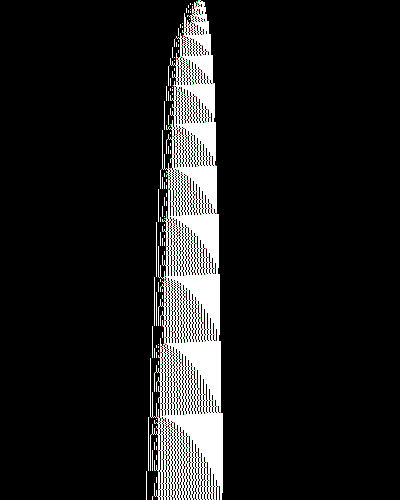
About this picture
The standard picture (bbchallenge.org's Default view): each row is the whole tape at one step, time runs downward, and the head's path draws the pattern.
Overview
In one sentence
Each bounce adds 1 to a binary counter and moves 3 bell cells to a middle field; each bell end eats a counter digit.
- Upstream
- The blank-start machine never halts: BECv10.v.TM2 ↗. Recorded commit time: 2026-10-13T13:42:06Z. First public push time is not established.
- Status
- Externally Solvedparked (funded stage3 ended at its stop rule) · updated 2026-10-13Not blocking · Stuck at the parked (funded stage3 ended at its stop rule) stage. Answer Q1–Q3 whenever; a “no” redirects the work.idle since Oct 13 09:21 · status.json 2026-10-13
- Class
- Bell eats counterours: Bell eats counter (sheet) · ours adds: binary counter on 2-cell digits (10 = 1, 00 = 0) with junk separators, bitten once per bell · med confidence
- On the list
- not on
BB6_holdouts_663.txt(line 88 of the previous list) · historical 740 line 88 · observe.json rank #88
Your calls on file 3
- funded
- option: stage3 · date: 2026-10-13
- next
- Parked; no new decision (stop rule). Reopen only with a history-carrying invariant: state (w, k0, n, m), where m is the n at the last odd eat, and window n >= max(Phi+1, 2^(D-1)), m >= 2^dS for the fresh S. Untested; see notes.md, Funded stage (stage3).
- 2026-10-13 · stage3
- Fund one more capped 2 h stage to turn the computed closed set into a closed-form invariant for W5-6 (which would also cover 280), or park both now? (Dennis 2026-10-13: 'go with recommendations')
Mechanism
How it works: 3 notes
- Turn config R(u,e) = 0^inf u <C 0 1^e 0^inf, u = w 1 (101)^k (w counter, 1 separator, (101)^k middle field). Bounce: R(w 1 (101)^k, e+3) -> R(inc(w) 1 (101)^(k+1), e) in 6k+4t+9 steps (t = trailing 1-digits); exact on all 60,001 turns to 5.1e7.
- Eat (e = r in {0,2}): z = inc(inc(w)); z = p 00 -> R(p 1, 3k+3+3[r=2]); z = q c 10 -> R(q 101, 3k+2+3[r=2]). Matches all 631 checked real eats (287 from A, 344 from the certified start B). So e mod 3 is always 0 or 2.
- Start B (IndBECv1 cert) stays on the clean orbit R(enc(s) 1, 3s) -> R(enc(s+1) 1, 3s+3). Start A keeps leaving it: odd eats make 010 tails and lone-1 separators inside w (90 of 289 cycle starts to 5e7 are not clean); inc passes through separators; w never contains 1111, which every halting inc input up to length 13 but one has. 88 and 280 run the same orbit (identical tape at 1e9): 280's table equals 88's with state B split by entry; they diverge only if 88's F reads 0 or 88's B (entered by D1) reads 1, which are exactly the two halting reads.
Figures for Checkpoint A
The site's view. Left edge: the counter. White triangles on the right: one bell each.
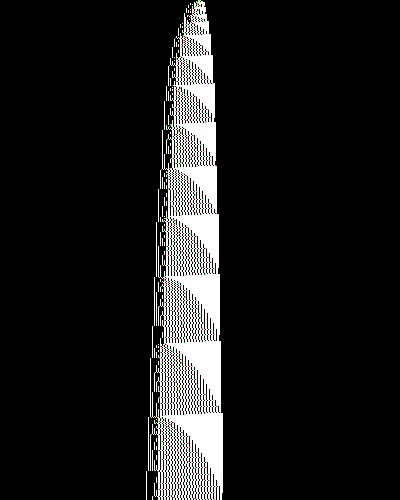
Each white triangle is one bell. Compare the triangle sizes going down, and watch the left edge.
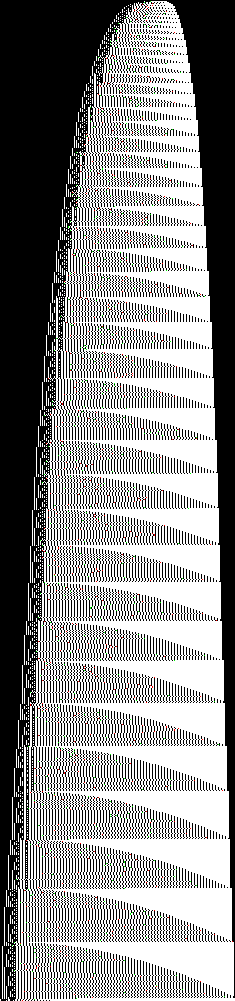
One row per cycle (first right turn after an eat). Compare colours near each counter's right end in both panels.
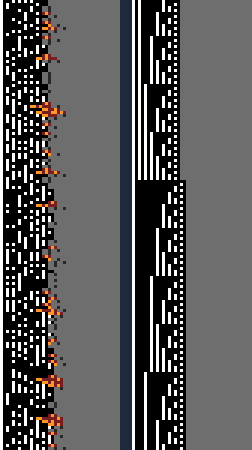
More figures (1)Fig 4: Left and right records to 1e8
One row per new leftmost or rightmost cell. The left edge grows about twice as fast as the right.

Rules (7/7 validated)exact tape rewrites the proof will formalize, each re-checked by simulation
| rule | from ⟶ to | cases | steps | checked |
|---|---|---|---|---|
| R1 bounce (clean counter) | 0∞ enc(v) 1 (101)k <C 0 1e+3 0∞ ⟶ 0∞ enc(v+1) 1 (101)k+1 <C 0 1e 0∞ | v>=1, k>=0, e>=0; enc(v) = v in binary, digit 1 = 10, digit 0 = 00; t = trailing 1-digits of v (overflow included); cross-checked with tools/sim.py on 20 more | 6k+4t+9 | ✓200/200 |
| R2 inc through a 110 separator | enc(a) 110 enc_d(b) 1 (101)k <C 0 1e+3 ⟶ enc(a) 110 enc_d(b+1) ... if b+1 < 2d, else enc(a+1) 110 (00)d ... | enc_d = d digits with leading 00s; the separator is transparent to the carry | — | ✓200/200 |
| R3 inc through a lone 1 then 00 | enc(a) 1 enc_d(b) 1 (101)k <C 0 1e+3 ⟶ enc(a) 1 enc_d(b+1) 1 (101)k+1 <C 0 1e | b < 2^(d-1) (top digit 00); when the top digit becomes 10 the word is R2's form | — | ✓200/200 |
| R4 eat, clean counter | 0∞ enc(v) 1 (101)k <C 0 1r 0∞ ⟶ 0∞ w' <C 0 1e' 0∞, w' by the parity of v (see cases) | r in {0,2}; v=2m -> 0^inf enc(m+1) 1 <C 0 1^(3k+3+3[r=2]); v=2m+1, m+1 odd -> enc((m+1)//2) 1 101 <C 0 1^(3k+2+3[r=2]); v=2m+1, m+1 even -> enc((m+1)/2) 010 1 <C 0 1^(3k+2+3[r=2]) (010 tail = junk) | — | ✓200/200 |
| R5 eat, any counter word | 0∞ w 1 (101)k <C 0 1r 0∞ ⟶ z = inc(inc(w)): z = p 00 -> 0∞ p 1 <C 0 13k+3+3[r=2]; z = q c 10 -> 0∞ q 101 <C 0 13k+2+3[r=2] | r in {0,2}, k>=1; random words from the run; also exact on all 631 real eats (A and B) | — | ✓200/200 |
| R6 inc does not depend on k, e | 0∞ w 1 (101)k <C 0 1e+3 ⟶ 0∞ inc(w) 1 (101)k+1 <C 0 1e | 2,000 distinct counter words from the run; random k, e pairs give the same inc(w) | — | ✓200/200 |
| R7 certified orbit (start B) | 0∞ enc(s) 1 <C 0 13s 0∞ ⟶ 0∞ enc(s+1) 1 <C 0 13s+3 0∞ | s>=2; s bounces (R1) then one even eat (R4) | — | ✓20/20 |
Compressed historythe tape as cycle start R(w 1 (101)k, e) after an eat (k = 0 or 1) at 40 moments: where the rules are read off
| step | e (bell length) | counter cells |w| | clean counter (1) or junk (0) | -lo (left edge) |
|---|---|---|---|---|
| 27 | 2 | 0 | 0 | 4 |
| 1,714 | 39 | 6 | 1 | 32 |
| 10,071 | 65 | 11 | 0 | 54 |
| 28,163 | 96 | 10 | 1 | 76 |
| 61,843 | 125 | 13 | 0 | 96 |
| 113,367 | 153 | 12 | 1 | 116 |
| 186,191 | 179 | 10 | 1 | 132 |
| 282,524 | 216 | 12 | 1 | 156 |
| 416,283 | 245 | 15 | 0 | 178 |
| 586,100 | 282 | 12 | 1 | 200 |
| 796,806 | 306 | 14 | 1 | 218 |
| 1,047,457 | 335 | 15 | 0 | 238 |
| 1,342,806 | 360 | 14 | 1 | 254 |
| 1,684,524 | 393 | 14 | 1 | 276 |
| 2,088,433 | 422 | 17 | 0 | 298 |
| 2,553,088 | 456 | 14 | 1 | 318 |
| 3,083,256 | 483 | 16 | 1 | 338 |
| 3,673,633 | 507 | 14 | 1 | 354 |
| 4,335,252 | 539 | 17 | 0 | 378 |
| 5,079,378 | 570 | 16 | 1 | 396 |
| 5,892,136 | 597 | 16 | 1 | 414 |
| 6,791,028 | 629 | 17 | 0 | 438 |
| 7,793,930 | 669 | 16 | 1 | 462 |
| 8,900,098 | 696 | 16 | 1 | 480 |
| 10,105,754 | 729 | 16 | 1 | 502 |
| 11,415,984 | 755 | 20 | 0 | 522 |
| 12,834,566 | 789 | 16 | 1 | 542 |
| 14,368,231 | 818 | 17 | 0 | 562 |
| 16,027,820 | 851 | 20 | 0 | 586 |
| 17,829,276 | 885 | 18 | 1 | 608 |
| 19,738,346 | 912 | 18 | 1 | 626 |
| 21,764,234 | 936 | 18 | 1 | 642 |
| 23,902,065 | 968 | 17 | 0 | 662 |
| 26,202,280 | 1,002 | 16 | 1 | 684 |
| 28,653,845 | 1,034 | 19 | 0 | 708 |
| 31,274,013 | 1,067 | 16 | 1 | 730 |
| 34,056,883 | 1,100 | 19 | 0 | 752 |
| 37,005,935 | 1,130 | 19 | 0 | 772 |
| 40,111,437 | 1,158 | 21 | 0 | 792 |
| 43,354,687 | 1,181 | 16 | 1 | 806 |
e (bell length)last 1,181counter cells |w|last 16clean counter (1) or junk (0)last 1-lo (left edge)last 806Template comparisonIndBECv1.v Others: partly applies · the nearest solved proof, what carries over, and the transitions that differ
| 0 | 1 | |
|---|---|---|
| A | 1RB | 0LC |
| B | 1LC | 0RE |
| C | 1LA | 1LD |
| D | 1LA | 1LB |
| E | 0RF | 1RA |
| F | --- | 0RE |
- file
IndBECv1.v:626- module
Others (nonhalt17)- machine
1LB0RD_1LC1LE_1RA0LB_0RF1RC_1LC1LA_---0RD(10 transitions apart)- diff
same table, start B (its A..F = our B,C,A,E,D,F; no mirror); our start A = its C- note
- Cert = hlin with side_binary_inc_rule d1=[0;1] (our names: l 00 (10)^n <C 0 r -> l 10 (00)^n 0 F> r), i.e. R1 on clean words; its orbit is R7 and uses only R4's even case. Ours also needs odd eats (e = 2 mod 3 cycles), separators (R2, R3) and the generic eat R5; 7 hlinx configs already fail on start A.
Proof strategy & riskshow the formal proof will go · 3 risks to watch
Find one regular language L of counter words w (clean digits, lone-1 separators, 010 tail) closed under inc (R1-R3, R6) and the eat (R5), with e = 0 or 2 mod 3; halting needs an inc on words with 1111-type runs, which L must exclude. Then a hand proof (Rocq: inc lemmas per word shape + progress_nonhalt_cond), with 280 covered by the shared orbit.
- ▲No closed language yet: separators are born at odd eats and die when eaten (29 junk-eat shapes in 83 junk eats); an 8-gram closure (words <= 20) reaches halting words after 3 rounds.
- ▲inc on general words is known only operationally (R1-R3 cover clean and single-separator words; multi-separator words rest on sampling, R6).
- ▲280 halts on different reads (B after D1 reading 1); a shared proof must exclude both 88's and 280's halting reads.
Stats & provenance1010 steps simulated · 7,346 cells · the status in full · files
- simulated
- 1010 steps
- tape
- 7,346 cells · 5,089 nonzeros
- growth
- span ~ t^(1/3) (3,420 cells at 1e9, 7,346 at 1e10; bell grows ~3 cells per cycle, cycle cost ~ bell^2)
- status now
- Parked 2026-10-13 (Dennis 2026-10-13: 'go with recommendations' -> stage3; its stop rule: no closed form after 2 h means park, with no further asking). Funded stage stage3 found no closed-form invariant. Greatest closed set n >= g(w) at 22 cells: 179,610 states, g = 1 for 178,926, max g = 16. Max g doubles every 2 cells (2/4/8/16 at 16-22 cells), and g is not a function of the 1-runs (at 20 cells, 130 states with runs <= 3 have g > 1). New exact object: the forward-least closed set (least n per cycle start from the real seeds) has 0 halts at 18/20/22 cells (5,071 / 14,547 / 40,998 states) and lies in a small grammar G* = (d|F)* (nothing | L with k0 = 1 | S 0^j 1 | L S 0^j 1). On it n >= Phi + 1 (30,242 / 30,242 parsable at 22 cells) and h >= 2^(D-1). The real orbit to step 1.78e7 lies in G* (204 / 204 cycle starts). But no window built from those bounds is closed: max(Phi+1, 2^(D-1)) gives 571 exits at 18 cells, the S-freeze bound still 472, and pure digit windows exit or halt. The coupling needs history (the n at the last odd eat / last L), which is not a function of the word. The bounded checks stay clean: 0 halts in every forward-least set and in every window closure that uses 2^(D-1) or the Phi bound. 280 (line 280) is parked with it. (status.json, 2026-10-13)
- observer's note
- Mechanism pinned: every turn to 5.1e7 is a bounce (R1/R6) or an eat (R5); the certified start B is the clean orbit R7. Ours leaves the clean words (junk separators from odd eats), and no closed invariant language is known yet.
- files
- observe.json · notes.md · status.json
Proof & checks
No proof work yet.
Files
machines/<tm>/: 8 entries · raw notes, status, scripts, images
| name | size | changed |
|---|---|---|
| notes.md ↓ | 27 KB | 2026-10-13 09:21 |
| status.json ↓ | 4.7 KB | 2026-10-13 09:21 |
| observe.json ↓ | 13 KB | 2026-10-13 02:44 |
| deepen.json ↓ | 3.1 KB | 2026-10-13 09:21 |
| data/ | 5 items | 2026-10-13 09:19 |
| decisions/ | 1 item | 2026-10-13 09:21 |
| img/ | 4 items | 2026-10-13 02:41 |
| scripts/ | 8 items | 2026-10-13 08:59 |
status.json in full
{
 "tm": "1RB0LC_1LC0RE_1LA1LD_1LA1LB_0RF1RA_---0RE",
 "label": "W5-6",
 "status": "STUCK",
 "stage": "parked (funded stage3 ended at its stop rule)",
 "updated": "2026-10-13",
 "confidence": "med",
 "reason": "Parked 2026-10-13 (Dennis 2026-10-13: 'go with recommendations' -> stage3; its stop rule: no closed form after 2 h means park, with no further asking). Funded stage stage3 found no closed-form invariant. Greatest closed set n >= g(w) at 22 cells: 179,610 states, g = 1 for 178,926, max g = 16. Max g doubles every 2 cells (2/4/8/16 at 16-22 cells), and g is not a function of the 1-runs (at 20 cells, 130 states with runs <= 3 have g > 1). New exact object: the forward-least closed set (least n per cycle start from the real seeds) has 0 halts at 18/20/22 cells (5,071 / 14,547 / 40,998 states) and lies in a small grammar G* = (d|F)* (nothing | L with k0 = 1 | S 0^j 1 | L S 0^j 1). On it n >= Phi + 1 (30,242 / 30,242 parsable at 22 cells) and h >= 2^(D-1). The real orbit to step 1.78e7 lies in G* (204 / 204 cycle starts). But no window built from those bounds is closed: max(Phi+1, 2^(D-1)) gives 571 exits at 18 cells, the S-freeze bound still 472, and pure digit windows exit or halt. The coupling needs history (the n at the last odd eat / last L), which is not a function of the word. The bounded checks stay clean: 0 halts in every forward-least set and in every window closure that uses 2^(D-1) or the Phi bound. 280 (line 280) is parked with it.",
 "siblings": [
  "1RB0LC_1LC0RE_1LA1LD_1LA1LF_0RB1RA_1LC---"
 ],
 "family_note": "No other 740 entry shares 88's table (canon over all starts, renaming + mirror). 280 (line 280) is a different table with the same orbit: 88's B split by entry. The runs coincide while 88's F reads 1 and 88's B entered by D1 reads 0, so one orbit proof excluding both reads covers both machines.",
 "solved_relative": "1LB0RD_1LC1LE_1RA0LB_0RF1RC_1LC1LA_---0RD (IndBECv1.v:626, Others nonhalt17, start B of this table)",
 "checks": {
  "byte_exact_740": "line 88",
  "claims": "none (sheet results row 1010: class only; no Discord hit)",
  "upstream_9cf9e88": "not proved (only start B of the table)"
 },
 "stage1_wave5": {
  "date": "2026-10-13",
  "outcome": "progress",
  "regular_counter_language": "impossible (free closure halts: data/stage1/free_closure_any.txt, free_closure_min12.txt)",
  "token_rules": "T1-T4 validated 400/400 (scripts/stage1/tokrules.py)",
  "random_starts": "0 halts / 1,300 (data/stage1/randstart_*.txt)",
  "coupled_closure": "0 halts; value-window exits 2,875 / 42.0M checks at 20 cells (data/stage1/coupled_closure.txt)",
  "effective_value_window": "0 exits on 4,664 checked states at 18 cells; 6 near-boundary exits on 13,443 at 20 cells (scripts/stage1/cclos_veff.c)"
 },
 "stage2_wave5": {
  "date": "2026-10-13",
  "outcome": "progress",
  "confidence": "med",
  "phi_closed_form": "0 mismatches vs simulated v_eff on 2,416 / 5,989 / 15,089 parsable closure states at 16 / 18 / 20 cells (scripts/stage2/phi.h, cclos_phi.c)",
  "inc_on_G0": "exact at every length (cell-level carry argument, notes.md); 6,111/6,111 canonical G0 words to 16 cells (scripts/stage2/g0check.py)",
  "upper_window": "not invariant: odd eat on z = 11 0^m 1 gives Phi = 1; real run step 21,875 (1S001, n = 28)",
  "lower_window_phi": "n >= Phi - 3 not closed (8 exits at 18 cells, all pending-gain 11-top words); lambda up to 2 still exits",
  "n_ge_50_closure": "0 halts, 0 r=1 at 16/18/20 cells (1,880 / 6,819 / 22,786 states; 40.3M transitions at 20)",
  "greatest_closed_g": "20 cells: 56,845 states, g = 1 for 56,674, max g = 8 (long 1-run junk); real seeds inside (data/stage2/gfix20_n1.out)"
 },
 "next": "Parked; no new decision (stop rule). Reopen only with a history-carrying invariant: state (w, k0, n, m), where m is the n at the last odd eat, and window n >= max(Phi+1, 2^(D-1)), m >= 2^dS for the fresh S. Untested; see notes.md, Funded stage (stage3).",
 "funded": {
  "option": "stage3",
  "date": "2026-10-13"
 },
 "stage3_wave5": {
  "date": "2026-10-13",
  "outcome": "park (stop rule)",
  "confidence": "med",
  "greatest_closed_g_22": "179,610 states, 380.6M transitions, 971 unsafe, g = 1 for 178,926, max g 16 (data/stage3/gfix22_n1.out, g22_gt1.txt)",
  "forward_least_set": "0 halts / 0 r=1 at 18/20/22 cells (5,071 / 14,547 / 40,998 states; 126.2M transitions at 22), all in G*, n >= Phi+1 on all parsable states (scripts/stage3/hmin.c, data/stage3/hmin*.txt)",
  "junk_grammar": "G* = (d|F)* T, T in {nothing, L (k0=1), S 0^j 1 (k0=0), L S 0^j 1 (k0=0)}; real orbit to 1.78e7: 204/204 cycle starts in G*",
  "windows": "no closed window: 2^(D-C) exits for C=1..4 (halts for C=2..4); max(Phi+1, 2^(D-1)) 571 exits; plus S-freeze bound 472-483 exits and 268 states outside G* (data/stage3/window_tests.txt)"
 }
}