tools/rebuild_pages.sh rebuilds the site within 5 minutes of a change; by hand: python3 -B tools/site.py.1RB0LB_0LC0RE_1LA1LD_0LB1LD_1RA0RF_1RA---
Upstream result
Claimed elsewhere
The blank-start machine halts: PR_ChaoticBell4.v.TM2 ↗.
Absent from the current 663 holdout list. Earlier local observations remain below.
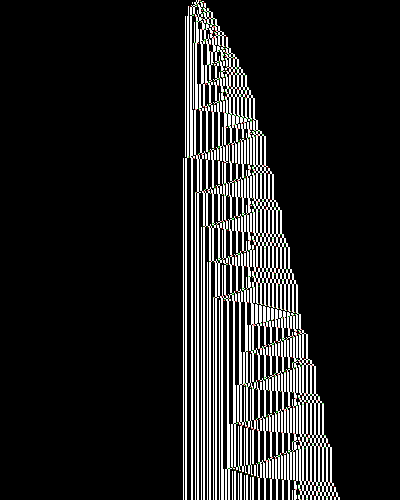
About this picture
The standard picture (bbchallenge.org's Default view): each row is the whole tape at one step, time runs downward, and the head's path draws the pattern.
Overview
In one sentence
Phases convert one budget block per 4-trip cycle; each new layer is ~4/3 the last and n mod 3 picks the next phase.
- Upstream
- The blank-start machine halts: PR_ChaoticBell4.v.TM2 ↗.
- Status
- Externally Solvedobserving · updated 2026-10-14Parked · Observe done (about 2 h). The 3 open questions are optional.idle since Oct 14 16:43 (44 h ago) · status.json 2026-10-14
- Class
- Chaotic Bell Class 4ours: sheet Chaotic Bell Class 4 ≠ ours Layered Bell counter: budget phases with a x4/3, mod-3-branching layer law (cryptid-like) · med confidence
- On the list
- not on
BB6_holdouts_663.txt(line 333 of the previous list) · historical 740 line 333 · observe.json rank #333
Your calls on file 3
- priority call (answered)
- Cryptid-like (pre-registered stop): the layer law is x4/3 and n mod 3 picks the next phase; no halting branch is known. Park it, or fund one 2 h stage for an exact phase-level accelerator (R1-R3 plus measured phase-end maps) and a census of the residue branches?
- parked
- Dennis 2026-10-14: park
- 2026-10-14 · park
- W6-5's layer law is x4/3 with n mod 3 picking the next phase (the pre-registered stop): park it, or fund one 2 h stage?
Mechanism
How it works: 3 notes
- Trip and phase level: three short trips cross the unary counter 1001^c, the fourth converts one budget block; the budget sum is conserved and c grows by 2 per cycle (R1-R3 validated 60/60, 40/40, 40/40).
- Epoch level: at a phase end the counter (about 8n cells) becomes a layer of (4n+r)/3 blocks, and n mod 3 picks the next phase (0: H6 shift phase, 1: R1 phase at once, 2: re-eat an older layer).
- To 1e11: layers 5803, 9996, 13333, 17774; the old 9996 layer is re-eaten at 4.8e10..8e10 and rebuilt; no halt (halting needs B> 111, never written).
Figures for Checkpoint A
Count the trips from the right edge: three turn near the counter, the fourth crawls left through 100001 blocks.

Each slanted boundary is a budget being eaten; each new band is a layer left by a phase end.

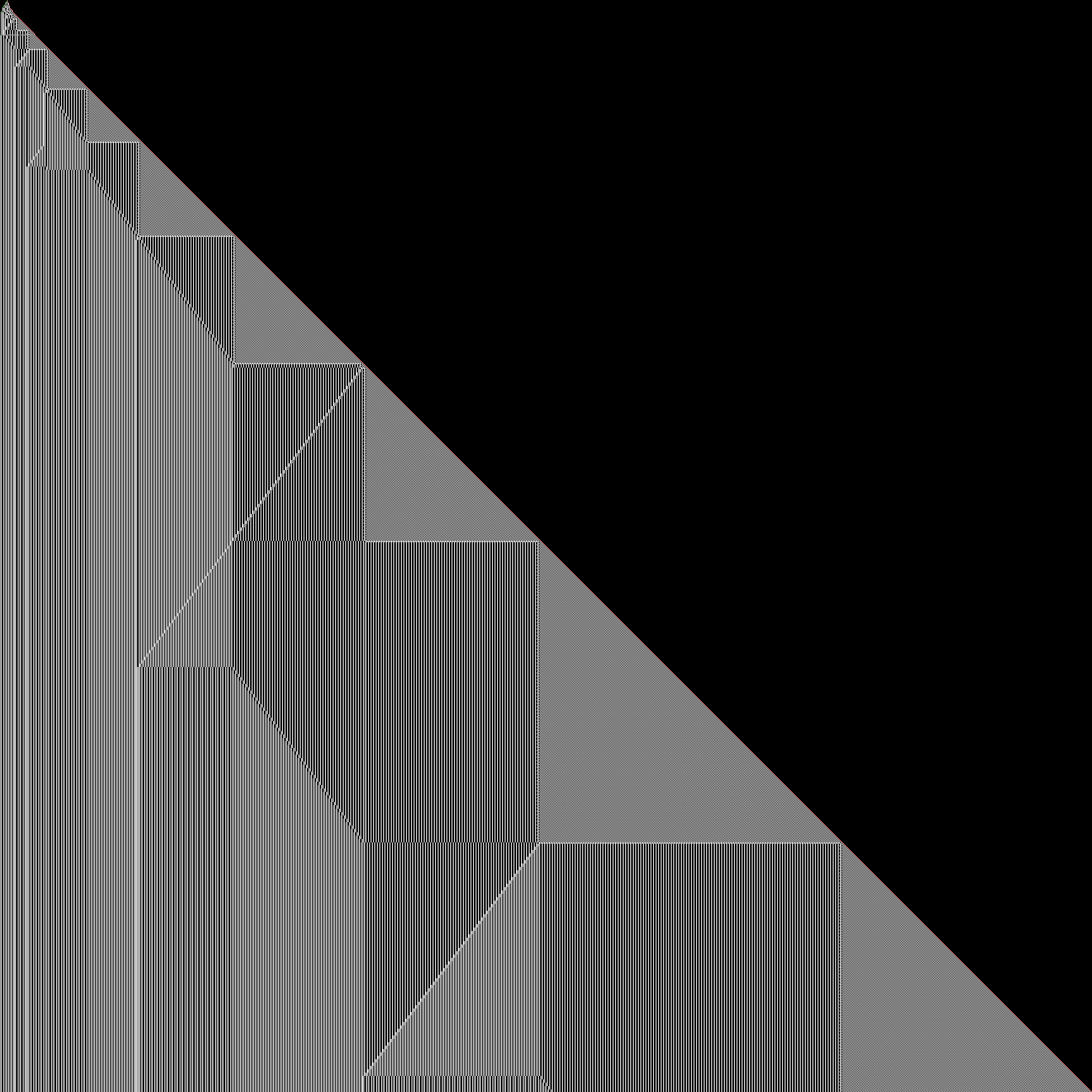
More figures (2)Fig 3–4: Default view, first 10,000 steps · Records to 2 million steps
The site's own picture: a growing triangle of striped regions, head sweeping to the right end.
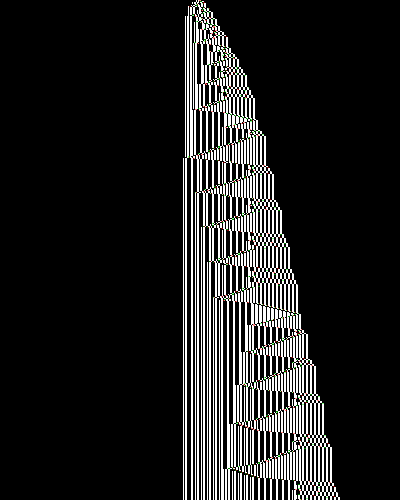
One row per new record; the grey right band is the counter, diagonals are budget boundaries.
Rules (4/4 validated)exact tape rewrites the proof will formalize, each re-checked by simulation
| rule | from ⟶ to | cases | steps | checked |
|---|---|---|---|---|
| R1 (K6 eats H6) | 0∞ 1011 (110010)a 12 04 1101 (100001)b+2 (1001)c A> 0∞ ⟶ 0∞ 1011 (110010)a+1 12 04 1101 (100001)b+1 (1001)c+2 A> 0∞ | b+2 >= 2 (the last block, b+1 = 1, is the phase end) | — | ✓60/60 |
| R2 (1e8 hub) | 0∞ (1011)3 (001011)a 04 (110)2 (000110)b+2 (01)2 1 04 (110010)p+1 (110000)q+3 13 01 (1001)c A> 0∞ ⟶ 0∞ (1011)3 (001011)a+1 04 (110)2 (000110)b+1 (01)2 1 04 (110010)p+1 (110000)q+3 13 01 (1001)c+2 A> 0∞ | b+2 >= 2 | — | ✓40/40 |
| R3 (5e8 hub, Y^2 -> X) | 0∞ (110)3 X^a (010110)2 (000110)3 110 Y^(b+3) (000110)p+1 (01)2 (100001)q+1 (1001)c A> 0∞ ⟶ 0∞ (110)3 X^(a+1) (010110)2 (000110)3 110 Y^(b+1) (000110)p+1 (01)2 (100001)q+1 (1001)c+2 A> 0∞ | X = 010110010110000110000110, Y = 010110000110; b+3 >= 3 | — | ✓40/40 |
| E (phase end, budget n) | phase 6 with budget n = g+h (real 1.29e10 configuration, h varied) ⟶ new layer of (4n+r)/3 blocks; n = 0 mod 3: H6->H6 shift phase; 1 mod 3: R1 phase at once; 2 mod 3: re-eats the older 5803 layer | n mod 3 (r = 7 for residue 2, 5 for residue 1 at the measured snapshot) | — | ✓6/6 |
Compressed historythe tape as phase 6 at the A record: 0∞ L (110)2 03 (110010)g 12 04 1101 (100001)h (1001)c A> 0∞ at 3 moments: where the rules are read off
| step | g | h | c |
|---|---|---|---|
| 12,500,084,130 | 9,144 | 853 | 18,290 |
| 12,700,067,096 | 9,459 | 537 | 18,921 |
| 12,900,059,348 | 9,773 | 223 | 19,549 |
glast 9,773hlast 223clast 19,549Template comparisonW5-3: partly applies · the nearest solved proof, what carries over, and the transitions that differ
| 0 | 1 | |
|---|---|---|
| A | 1RB | 0LB |
| B | 0LC | 0RE |
| C | 1LA | 1LD |
| D | 0LB | 1LD |
| E | 1RA | 0RF |
| F | 1RA | --- |
- file
- —
- module
W5-3 (our kill)- machine
1RB1RA_1LC1LE_1RF1LD_1RE0LD_0LB0RA_---0RC(10 transitions apart)- diff
no table within 5 transitions; architecture comparison only- note
- Our W5-3 kill (machines/<W5-3>/ .v, read). R1-R3 are linear walk lemmas like W5-3's Wk/W2Q. W5-3 closes its eats with a binary counter and one size bound; here the phase ends feed a x4/3 layer law with a mod-3 branch, which no template covers.
Proof strategy & riskshow the formal proof will go · 3 risks to watch
Parked under the cryptid protocol. If funded: build an exact phase-level accelerator from R1-R3 plus measured phase-end maps, run it far past 1e11, and census the residue branches for a closed set of phase shapes.
- ▲The layer law n -> (4n+r)/3 with a mod-3 choice of successor phase is Collatz-like (Hydra-style x3/2 relatives); a closed invariant may not exist.
- ▲Phase ends were measured on 6 instances from one real configuration only; other phase types may have other offsets.
- ▲Phases reach back into older layers (9996 re-eaten at 4.8e10), so the state is a stack of layers, not one counter.
Stats & provenance1011 steps simulated · 601,752 cells · the status in full · files
- simulated
- 1011 steps
- tape
- 601,752 cells
- growth
- span about 1.9-2.0 x sqrt(steps): 19k at 1e8, 58k at 1e9, 204k at 1e10, 602k at 1e11
- status now
- Observe done (about 2 h). The tape is a stack of layers of periodic words (110000, 110010, 1100, 110 rotations). The head runs 4-trip cycles: three short trips over a unary counter 1001^c, one long trip that converts one block of the current budget region; per cycle the budget sum is conserved and c grows by 2 (rules R1-R3 validated 60/60, 40/40, 40/40 from random instances). When a budget n runs out, the counter (about 8n cells) becomes a new layer of (4n+r)/3 six-cell blocks, and n mod 3 selects one of three successor phases (measured on n = 9996..10001 from the real 1.29e10 configuration: residue 0 -> H6 shift phase, 1 -> R1 phase at once, 2 -> re-eat the older 5803 layer). That is the pre-registered W6-5 stop rule (x m/k law with a residue split), so the cryptid protocol applies: rules formalized in observe.json, flagged, stopped. Direct run to 1e11: no halt, span 601,752; layers 5803, 9996, 13333, 17774; the old 9996 layer was re-eaten at 4.8e10..8e10 and rebuilt. Halting needs B> 111, never seen. (status.json, 2026-10-14)
- observer's note
- Pre-registered W6-5 stop rule met: the epoch law is x4/3 with a mod-3 residue split (three successor phases, one re-eats older layers). R1-R3 validated; phase ends measured on 6 instances. No halt to 1e11.
- files
- observe.json · notes.md · status.json
Proof & checks
No proof work yet.
Files
machines/<tm>/: 7 entries · raw notes, status, scripts, images
| name | size | changed |
|---|---|---|
| notes.md ↓ | 6.7 KB | 2026-10-14 14:25 |
| status.json ↓ | 2.1 KB | 2026-10-14 16:43 |
| observe.json ↓ | 7.7 KB | 2026-10-14 14:26 |
| decisions/ | 1 item | 2026-10-14 16:43 |
| img/ | 4 items | 2026-10-14 14:24 |
| scripts/ | 6 items | 2026-10-14 14:24 |
| work/ | 7 items | 2026-10-14 14:24 |
status.json in full
{
 "tm": "1RB0LB_0LC0RE_1LA1LD_0LB1LD_1RA0RF_1RA---",
 "label": "W6-5",
 "status": "CRYPTID_CANDIDATE",
 "stage": "observe",
 "updated": "2026-10-14",
 "confidence": "med",
 "holdout_line_740": 333,
 "reason": "Observe done (about 2 h). The tape is a stack of layers of periodic words (110000, 110010, 1100, 110 rotations). The head runs 4-trip cycles: three short trips over a unary counter 1001^c, one long trip that converts one block of the current budget region; per cycle the budget sum is conserved and c grows by 2 (rules R1-R3 validated 60/60, 40/40, 40/40 from random instances). When a budget n runs out, the counter (about 8n cells) becomes a new layer of (4n+r)/3 six-cell blocks, and n mod 3 selects one of three successor phases (measured on n = 9996..10001 from the real 1.29e10 configuration: residue 0 -> H6 shift phase, 1 -> R1 phase at once, 2 -> re-eat the older 5803 layer). That is the pre-registered W6-5 stop rule (x m/k law with a residue split), so the cryptid protocol applies: rules formalized in observe.json, flagged, stopped. Direct run to 1e11: no halt, span 601,752; layers 5803, 9996, 13333, 17774; the old 9996 layer was re-eaten at 4.8e10..8e10 and rebuilt. Halting needs B> 111, never seen.",
 "siblings": [],
 "sibling_note": "No other start or mirror of this table is on the 740/778 lists (canon from all 6 starts). Starts C, E, F are eqv_1590 lines 122, 128, 132 (276's equivalence group). In the critic's family only 479 and 145 share a table (145 = 479 from B); 333, 683 and 276 each have their own table. The time-shifted record-twin claim for 479/683 was not re-checked.",
 "upstream": "No upstream proof; sheet Results row: class only, note 'Possible bouncer'; discarded-machines tab: 'unanalysed'. No Discord hit.",
 "priority_call_answered": "Cryptid-like (pre-registered stop): the layer law is x4/3 and n mod 3 picks the next phase; no halting branch is known. Park it, or fund one 2 h stage for an exact phase-level accelerator (R1-R3 plus measured phase-end maps) and a census of the residue branches?",
 "parked": "Dennis 2026-10-14: park"
}