Find the decision before it happens
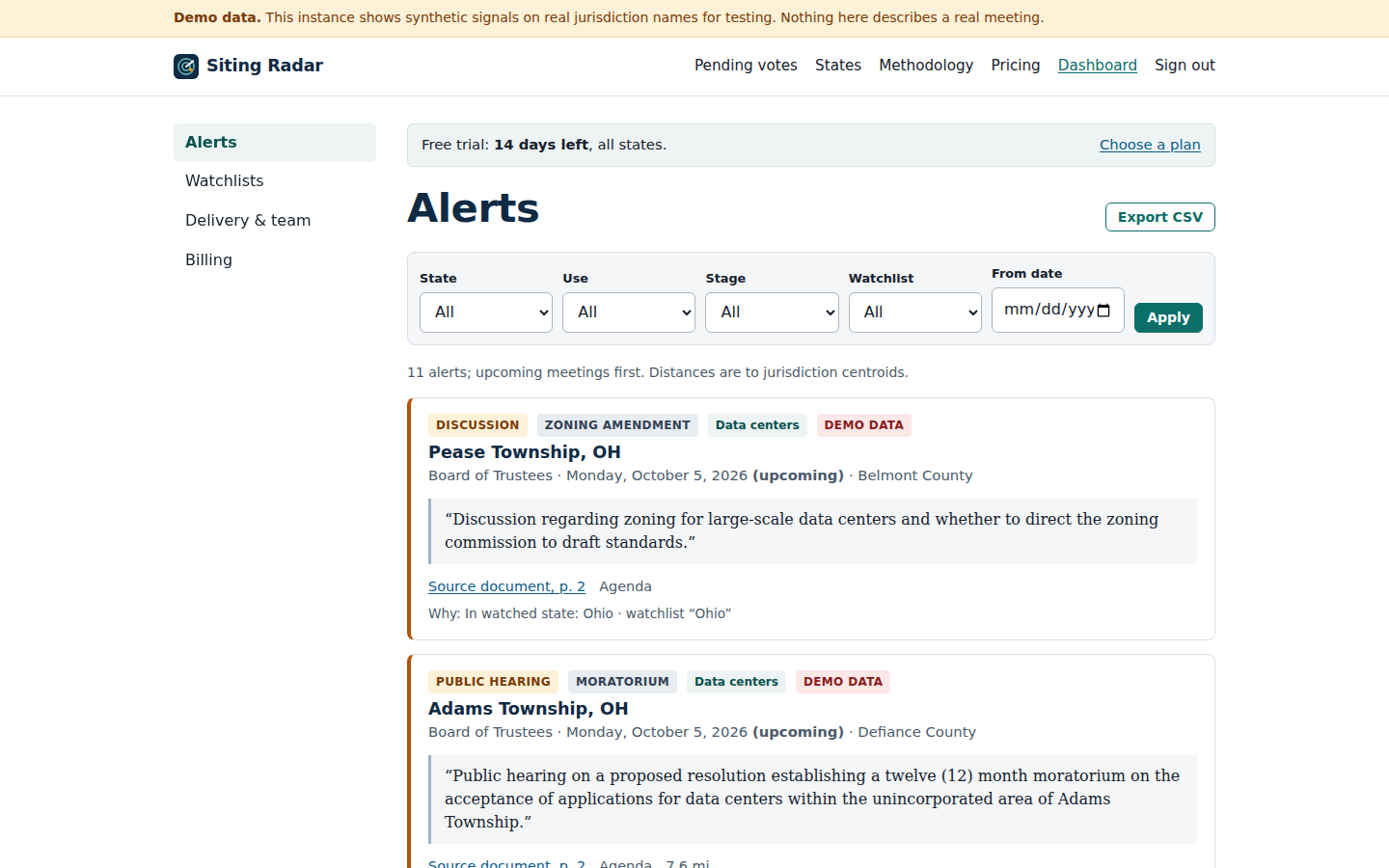
Local energy siting rules are scattered across municipal agendas, packets, minutes, and hearing notices. Siting Radar collects these public sources and extracts candidate events with a jurisdiction, sector, stage, date, verbatim quotation, and page citation.
The pipeline separates finding a source, obtaining a document, extracting text, detecting a relevant event, and verifying it for display. That separation makes coverage failures visible: a missed event can originate in an absent source or unreadable scan before the detector ever runs.
A quotation is necessary, but not sufficient
Mechanical grounding checks require a quoted span to occur in the stored text. Early review nevertheless found many false positives: old minutes inside newer packets, model ordinances, and general guidance could all contain genuine quotations without establishing an upcoming local decision.
The response was a verification gate and explicit feedback on stage, jurisdiction, and relevance. The historical backtest also retains stricter variants instead of relying on one headline: the recorded snapshot found signals at least five days before enactment for 176 of 420 reference moratoria; requiring a posting date for minutes reduced that count to 143.
Measure the pipeline honestly
The product includes a public methodology and coverage view. Historical document dates support a retrospective detection study, not proof that a customer received an alert before the event. The reference dataset is Moratorium Nation, used with attribution under CC BY 4.0. Geographic coverage, extraction quality, and live precision remain separate measurements.
Limitations
- Historical backtest results are not prospective alert recall.
- Quotes occurring in source text do not establish correct interpretation.
- Coverage varies by state and source platform; blocked or inaccessible sources remain gaps.
- No customer or revenue claim is made.
Source code & evidence
Results reflect the linked evidence snapshots. Source artifacts retain their dates and experimental conditions.