The idea
Build a complete computer whose layers remain small enough to follow. The LF-16 starts with an original instruction set and memory-mapped devices, then adds an assembler, the C-like Glint language, a monitor ROM and a browser IDE. Its games and music tools run on the machine it defines.
From source to behavior
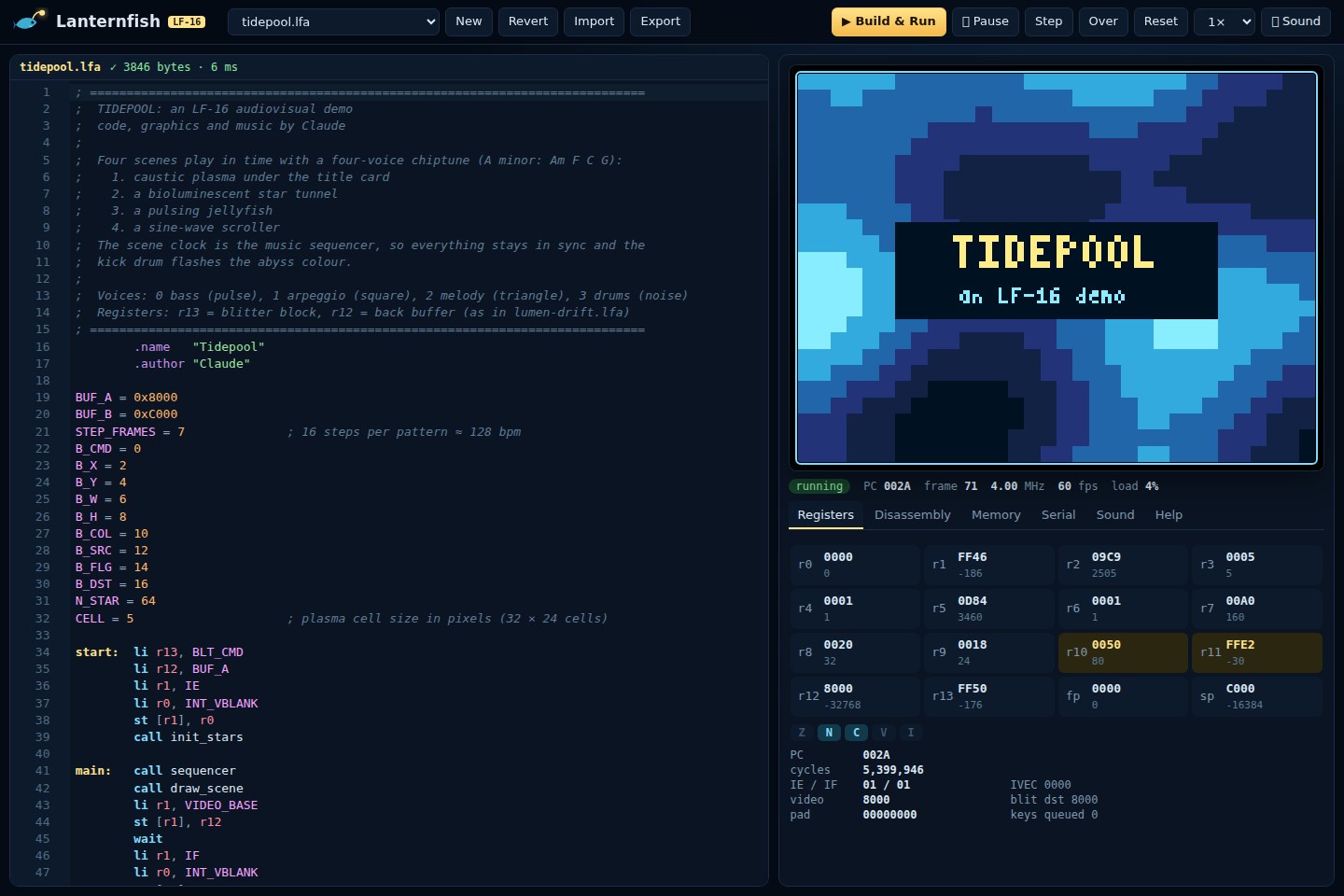
The IDE connects source code to live machine state. Breakpoints, stepping, disassembly, registers, memory and serial output provide different views of the same execution. Glint source maps make the compiler output inspectable; assembly cartridges expose individual instructions.
The deliberately bounded machine has 64 KiB of memory, a 160 × 120 display, a 16-color palette and four audio voices. Original cartridges include Lumen Drift, Tidepool, Prism Courier and Abyss Tracker. Source and cartridge import/export let the environment serve as a workshop as well as a demo.
The collaboration
Claude Code led the ISA, emulator, assembler, IDE and assembly programs. Codex built the Glint compiler, monitor ROM, puzzle game and tracker. Each reviewed the other’s components. The integration question was concrete: could independently built toolchain layers agree well enough to execute and debug real programs?
Limitations
- Glint intentionally omits features such as floating point and structs; there is no separate linker.
- Audio is a software approximation, and the editing experience is best on desktop.
Source code & evidence
Results reflect the linked evidence snapshots. Source artifacts retain their dates and experimental conditions.