The idea
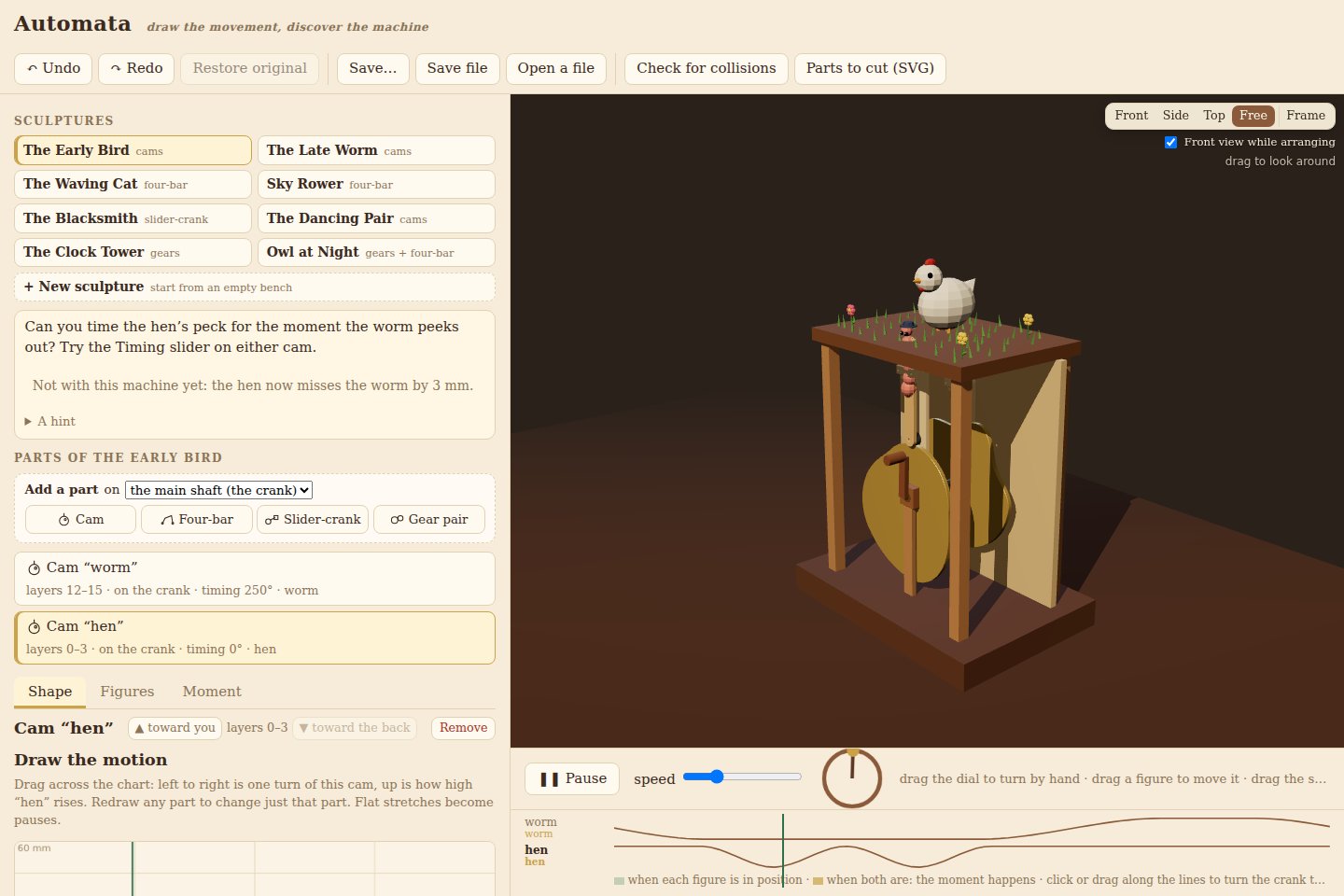
Sketch a rise, a pause and a return, then watch a mechanism perform that motion. Automata connects a motion editor to a bench of kinetic sculptures: a pecking bird, a waving cat, a blacksmith, a clock tower and other small mechanical scenes. Relative timing makes their parts interact.
Mechanisms with inspectable limits
The core models four-bars, slider-cranks, gear pairs and cams. It separates prepared part geometry from per-frame rigid poses, and moves expensive scans into a worker. Unreachable poses, excessive cam pressure angles and interference become identifiable diagnostics.
Editable dimensions and phase link the sculpture to its mechanism. Dimensioned SVG exports retain one global scale and a calibration mark. A sampled collision check states what was checked; it does not turn a set of clear frames into a proof of continuous clearance.
The collaboration
Codex developed kinematics, inverse cam geometry, interference checks and exports. Claude Code built the editor, guidance and eight-sculpture collection. The published browser exposes these tools, while earlier source documentation still records an in-progress product gate; this case study treats the application as a working workshop with explicit physical limits.
Limitations
- Ideal rigid bodies omit friction, strength, fit and hardware volumes; physical fabrication has not been validated.
- Collision clearance is sampled, and the recorded experience-acceptance status is incomplete.
Source code & evidence
Results reflect the linked evidence snapshots. Source artifacts retain their dates and experimental conditions.